


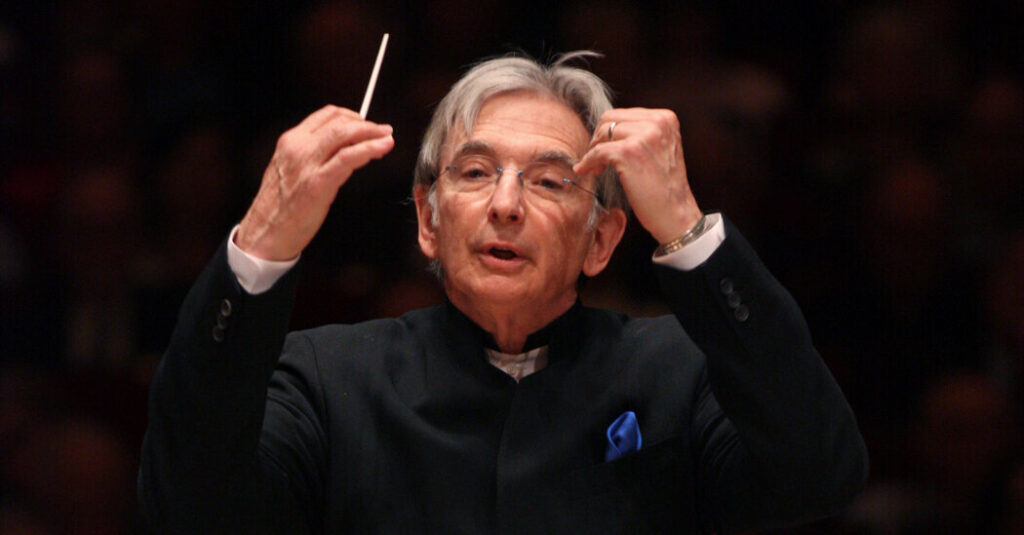
His official debut with the orchestra, in the fall of 1969, leading a challenging program of works by Haydn, Ives, Stravinsky and Debussy, proved auspicious. “Resisting the temptation to prophesy,” Michael Steinberg of The Boston Globe wrote in his review, “let me say simply that right now he is one of the ablest and most interesting conductors in the profession.”
Later that year, when William Steinberg, the Boston Symphony’s music director, became ill during a program at Philharmonic Hall at Lincoln Center (now David Geffen Hall), Mr. Thomas, then 24, had to take over for the second half, conducting works by Robert Starer and Richard Strauss.
The event was a triumph. “A tall, thin young man, he came onstage with an air of immense confidence and authority and showed that his confidence was not misplaced,” Harold C. Schonberg of The Times wrote in his review.
As Steinberg recuperated, from what was later determined to be a heart ailment, Mr. Thomas wound up leading the orchestra in 37 more concerts, many including works he had not previously conducted. In 1970, he was appointed associate conductor of the Boston Symphony, an upgrade, and made his London debut with the London Symphony Orchestra that same year.
Steinberg was slated to step aside in 1972, the year after Mr. Thomas became music director of the Buffalo Philharmonic. But there was talk in Boston musical circles of whether Mr. Thomas might have a future in Boston as well. Michael Steinberg explored the question in a January 1972 article for The Boston Globe Magazine. Mr. Thomas was already engaged in adventurous projects with players in Buffalo who seemed open to anything.
“I don’t know, I wonder,” Mr. Thomas remarked to Mr. Steinberg. “Perhaps some of the smaller orchestras, the less prestigious ones — St. Louis, Atlanta, Buffalo, which are not so committed to a received idea of a particular sort of greatness — are by their nature more flexible.”