


Peanut butter is typically more of a pantry staple than an art supply.
But 800 pounds of the creamy spread are the centerpiece of a museum installation that opened on Thursday in the Netherlands in honor of the artist Wim T. Schippers, who died last month at 83.
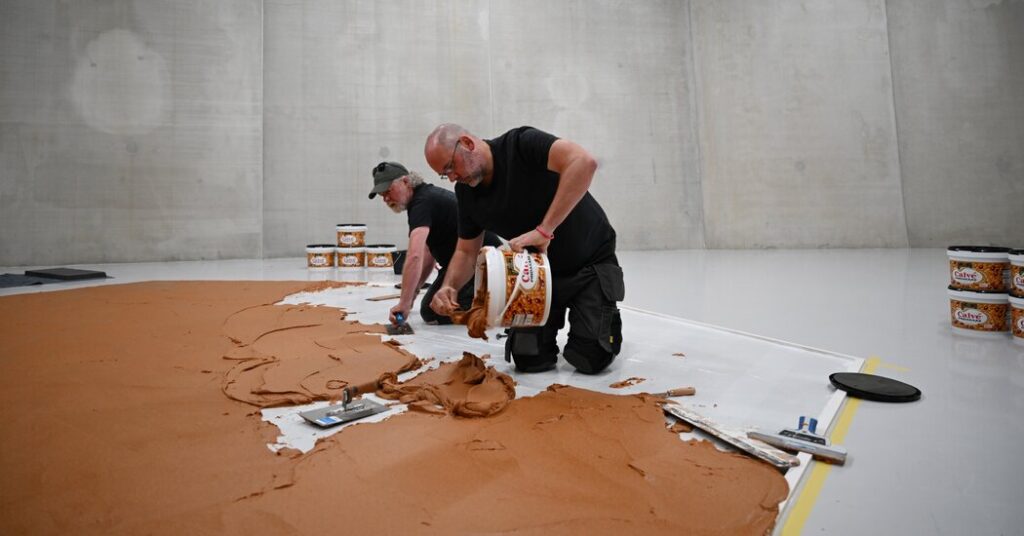
The installation features a 270-square-foot hexagon spread on the floor of the Depot of Museum Boijmans Van Beuningen in Rotterdam. The museum’s acting director, Sandra Kisters, said visitors can “follow the smell” from the atrium at the entrance up to the exhibition in the third floor gallery.
Schippers was a beloved and eccentric cultural figure in the Netherlands, where he produced provocative television shows, wrote poetry, composed music and once directed a play performed entirely by German shepherds.
Before he died, he left strict instructions for the application of the nutty paste for “Pindakaasvloer,” or “Peanut Butter Floor”: The installation must use 3.2 pounds of smooth peanut butter — never the chunky kind — for every square foot and it must be spread as evenly as possible, according to a statement from the museum.
Two Museum workers used taping knives to spread buckets of peanut butter donated by the Dutch manufacturer Calvé, the brand Schippers endorsed for its spreadability. The total volume used in the installation is equivalent to roughly 860 standard 16-ounce jars of peanut butter.
The Museum Boijmans Van Beuningen advises visitors with allergies to avoid entering the exhibit area as a precaution, though it noted that there was only a small risk of serious symptoms.
Schippers first envisioned covering a large museum hall floor with peanut butter in the 1960s, but the plan didn’t materialize until a 1989 exhibition. The concept was later purchased by the Museum Boijmans Van Beuningen for 50,001 euros and exhibited in 2011, said Sjarel Ex, a former director of the museum and a friend of the artist’s.
Ex said the installation always attracted significant attention, particularly from children fascinated by the vast quantities of peanut butter on the floor.
“It’s both a parody of art and an invitation to think about art differently,” he said. “Wim liked scandals and provoking his audience.”
Like his work, the Dutch artist’s final resting place is also unconventional. A few close friends buried him last month in a remote, wooded area east of Amsterdam, leaving no gravestone or lasting marker.
Schippers’s body was lowered into the grave to a live saxophone performance of a melody by Thelonious Monk, one of his favorite musicians, according to Titus Muizelaar, his friend of 40 years and the chairman of the Wim T. Schippers Foundation, which was established in 2024 to preserve the artist’s legacy.
Muizelaar, who was among the few who attended the funeral, said that even though “Peanut Butter Floor” was Schippers’ most famous work of visual art, he did not have any appetite for the paste.
For nut lovers, however, the museum’s cafeteria has added a peanut butter sandwich to its menu for visitors to enjoy this summer.