


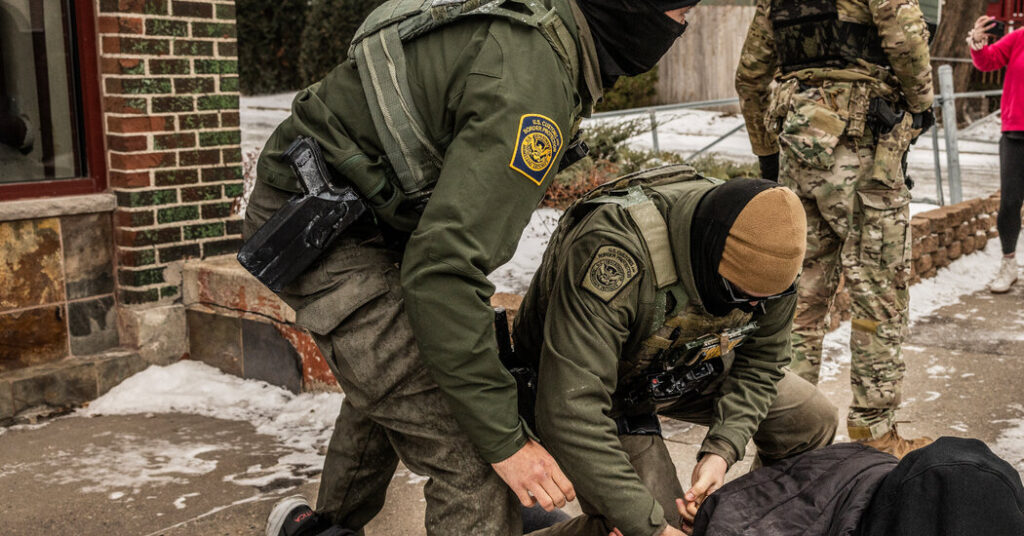
Since immigration agents began carrying out a string of big, aggressive sweeps last year, civil rights groups have argued that the Trump administration’s mass deportation campaign has been defined by brazen racial profiling.
Now, body-camera footage, text messages and other documents emerging from lawsuits around the country reveal how race and ethnicity have figured in the dragnets that unfolded in Los Angeles, Chicago, Minneapolis and other U.S. cities.
In several instances documented in court filings, federal agents referred to targets as “tonks” — a derogatory term typically used to refer to Mexican immigrants and intended to echo the sound of agents’ flashlights striking their heads. Migrants suspected of being undocumented were described as “wet,” shorthand for the slur wetback. And an agent who led an operation in Southern California later described the appearance of individuals he considered suspicious: “older Hispanic males.”
Yet even as evidence of racial profiling has come to light, what seemed like settled law — that law enforcement officers could not question or detain someone solely based on their race or ethnicity — has turned out to be far more of an open question when it comes to immigration enforcement.
Last year, the Supreme Court took a step toward upending a half-century of jurisprudence when Justice Brett Kavanaugh gave a provisional blessing to such racial profiling by agents seeking out undocumented immigrants. The government has maintained that their operations are constitutional.
The lawsuit that led to the court’s temporary decision and other similar suits are still working their way through lower courts, and it could be months before they are resolved and years before the Supreme Court has a chance to say more.
In the meantime, civil rights lawyers are continuing to amass what they hope will be a valuable trove of evidence that racial profiling by immigration agents is prevalent — and that it is unconstitutional in the manner that it is being carried out today.
In 1975, the Supreme Court cleared the way for some degree of racial profiling in immigration enforcement when the justices allowed race and ethnicity to be one of the factors — but not the only one — used by agents deciding when to stop a car on suspicion that the occupants include undocumented immigrants.
Jennifer M. Chacón, a Stanford law professor who studies immigration law, said the current wave of cases — and the Supreme Court’s recent order — engages with the question of whether the 1975 decision, in U.S. v. Brignoni-Ponce, still holds.
“Is this still good law, and even if it is, when does agency behavior cross the line of what is permitted?” Professor Chacón said.
The latest batch of depositions, videos and surveillance records in Los Angeles, first reported by CalMatters and The Los Angeles Times, show that immigration agents and officers were focused on finding “day laborers.” But civil rights groups argue that their vague and varying explanations for whom they were looking for often defaulted to anyone who looked Latino, had darker skin or spoke English with an accent. That reliance on perceived race and ethnicity, they argued, also ended up unlawfully sweeping up U.S. citizens.
In one sworn declaration, a driver in a traffic stop in San Bernardino, Calif., said an officer told him he had been pulled over “because he looked like a ‘paisa,’” a slang term for a Mexican compatriot or newly arrived immigrant.
In another declaration, Angel Santiago Tafolla, a U.S. citizen in Anaheim, Calif., said that agents chased him — a dark-skinned Latino man — while ignoring his light-skinned co-workers at the Orange County carwash. One agent discharged a Taser, arcing electricity in front of Mr. Tafolla, whose clothes were wet from his work. He was handcuffed and loaded into a van, according to the document.
“I kept saying ‘I’m American,’ but they just kept telling me I was Latino and my documents were false and to stop talking,” he said.
Such encounters were not limited to California. In more than a dozen lawsuits filed in courts across the country — including in Alabama, Illinois, Oregon and Minnesota — civil rights lawyers argue that residents, predominantly Black and Latino, were wrongly targeted based on their appearance, specifically their skin color, perceived ethnicity, accents and work attire.
At least 65 U.S. citizens were described as having been stopped, questioned or detained, and because all of them were eventually released, they were able to provide lawyers with detailed accounts of their encounters with immigration agents. Some said officers refused to accept their passports or valid drivers’ licenses as proof of citizenship. Several were threatened with Tasers, tackled and handcuffed. A few were held for hours before being released, according to court filings.
Many of the filings depict federal agents as working under crushing pressure to meet a new national quota, which for a time was as high as 3,000 immigration arrests daily. The increase — a near threefold increase in May 2025 from the prior base line — forced officers to shift from individualized investigations to street sweeps intended to round up as many people as possible. Roving teams of officers in unmarked S.U.V.s repeatedly converged on Latino neighborhoods and businesses, including carwashes, Home Depot parking lots, construction sites and shopping corridors, the court records state.
“For the individuals that they’re stopping, they don’t have any information about them other than the demographic profile that they appear Latino and working class,” said Mayra Joachín, a lawyer with the American Civil Liberties Union working on the Los Angeles case.
Government lawyers maintain in court filings that immigration operations have been highly targeted, and that isolated examples of derogatory or inflammatory language are not evidence of an agencywide policy or intent. They also argue that agents have broad powers to question people they believe are not citizens of the United States, particularly when they are only briefly stopping someone to investigate their legal status and not necessarily to conduct an arrest.
In an emailed statement, Katherine Currie, a homeland security spokeswoman, did not respond to questions about agents using slurs. She called allegations that federal officers were engaged in racial profiling “disgusting, reckless, and categorically false.”
“What makes someone a target for immigration enforcement is if they are illegally in the U.S. — not their skin color, race or ethnicity,’” Ms. Currie said.
For more than 50 years, courts have taken the Fourth and Fifth Amendments, along with the 1975 Supreme Court ruling to mean that immigration agents cannot stop or detain people without a specific, factual basis for believing they are in the country illegally and that race or ethnicity cannot be the sole factor in targeting someone.
Federal law has granted immigration officers far more latitude at immigration checkpoints and within a 100-mile radius of any of the nation’s borders. But civil rights groups argue Border Patrol agents have been exercising those powers deep in the interior of the country.
Now, as the cases move through the courts, the rulings will determine whether federal agents are exclusively relying on race and ethnicity to stop, question and detain people for immigration violations — and whether the limits banning such tactics will remain in place.
Kevin R. Johnson, an expert in immigration law and a professor at University of California, Davis, said that most recent Supreme Court order and accompanying opinion from Justice Kavanaugh had emboldened federal officers to rely on racial profiling nationwide.
But he cautioned that the emergency order was not the last word. The newest footage — taken from inside patrol vehicles in Chicago and Los Angeles — could raise fresh concerns for the justices when the underlying lawsuit almost certainly returns to the Supreme Court for full consideration, he said.
“The racial slurs are troubling and coupled with the recent string of Latinos killed in car stops and detention centers, they are likely to get the justices thinking about what is going on here in ways that they haven’t,” said Mr. Johnson, a former dean of the law school at U.C. Davis.
In videos from Chicago, agents point out people on the street as “tonks.” The slur has been used since at least the 1990s by immigration officers along the nation’s Southern border.
The epithet is echoed in the latest batch of video evidence filed in the Los Angeles case. More than a dozen body-camera and bystander videos capture agents bypassing people who appeared white, moving instead to question and detain men who appeared Latino nearby.
In one video, taken Aug. 6, 2025, a group of heavily armed, masked agents in camouflage cluster in the back of a moving truck, peering out. A backpack is visible on the floor.
“Whose backpack is that? Tonk?” one agent asks. “Tonk backpack?”
In most of the other footage, agents appear to be casual as they drive, joking and speculating about how successful raids had been.
“They filled three vans,” one agent says to another as they drive through a Los Angeles neighborhood on June 19, 2025. Later, one of those agents recounts seeing a man sitting in a minivan whom he did not end up approaching. “I’m pretty sure he was wet,” he says.