


Nova Scotia has become the latest province to start charging an extra fee for battery-powered cars and trucks.


As of Thursday, electric vehicle (EV) owners will pay $500 every two years in addition to their vehicle registration fee. Plug-in hybrid vehicles will have an additional $250 fee.
Some drivers call it an unfair cash grab, but the provincial government argues it’s a way to pay for road repairs since EV drivers don’t pay the provincial gas tax.
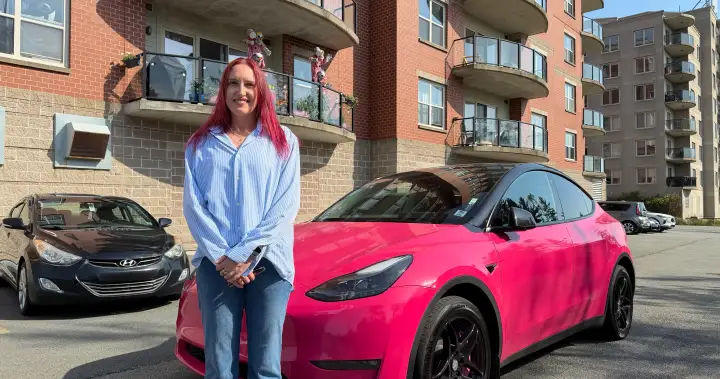
Halifax resident and Tesla owner, Karina Baxter, says it doesn’t add up.
“I do save a significant amount of money on this EV: no gas, no oil changes and things like that. But I still don’t think the math is mathing,” she said.
In February, when the changes were tabled as part of the budget, Premier Tim Houston told reporters the levy was necessary.
“EVs have a wear and tear element on our roads and highways … they’re generally a lot heavier, so they sometimes have quite a bit more wear and tear, and the owners of those vehicles should pay something towards that,” he said.
Baxter says she agrees to a certain extent.
“Yes, we do affect the roads maybe a little more because a lot of people will bring up the weight of these EVs. So I’m happy to pay for these taxes and these fees, I just think there’s a better way to do it.”
She points out drivers who pay for gas are essentially fueling up what they need and therefore paying for how much they drive.


Get daily National news
Get daily Canada news delivered to your inbox so you’ll never miss the day’s top stories.
“With this, it’s a flat rate, which I don’t think is fair. They should track our kilometres or something like that, which makes it a little more fair, especially for those who don’t drive as much,” she said.
Local EV advocate, Kurt Sampson, says the number of EVs on the road is only increasing, so a solution needs further discussion.
“It would be nice to see a system that is standard and fair, equitable across all of Canada, really,” said Sampson, who is the EV expert with CAA Atlantic.
Other provinces have similar fees
Saskatchewan was the first province to make the move, and doubled its fee last year to $300 annually. Alberta charges $200 a year, and the Quebec government has said it will start charging $125 as of next year.
At the same time, the federal government has been incentivizing electric vehicle purchases by launching consumer rebates.
“This year showed about 34 per cent of Canadians said that they would consider an EV for their next purchase, and that’s up from about 28 per cent in 2025,” said J.D. Ney, the director and automotive practice lead for J.D. Power Canada, a data analytics company.
Down the road, more EVs will mean less gas in tanks and less money in government coffers.
“I think there’s a wide acknowledgement in the auto industry and beyond that … almost everyone eventually will be driving an electric vehicle of some type and gas tax is going to dry up,” said David Kennedy, Toronto bureau chief with Automotive News Canada.
“If you don’t have a gas tax that keeps your roads from completely deteriorating, you need some sort of alternative in the long term. And you know I think, at least as a short term stopgap solution, maybe (EV levies) is where we’ll go.”
But Baxter worries these types of levies and fees might discourage people from making the switch to an EV, which would knock the government off its zero-emission vehicle targets.
“There’s already some people that are apprehensive about EVs because they don’t really know that much about them, so this on top of that I think is just going to have a negative impact,” she said.
— with files from David Murdock and Heidi Petracek
© 2026 Global News, a division of Corus Entertainment Inc.