


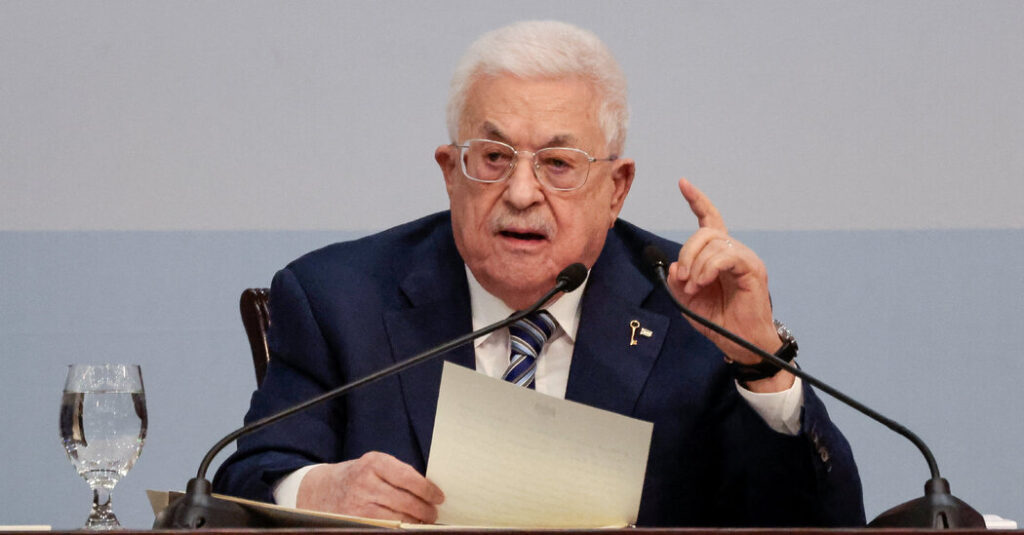
Mahmoud Abbas, the longtime president of the Palestinian Authority, on Thursday set Palestinian parliamentary elections for this November in what would be the first such vote in more than two decades.
The announcement appeared to be part of an effort by the Palestinian Authority, which exercises limited self-rule over parts of the Israeli-occupied West Bank, to convince the United States and European and Arab nations that it was willing to make changes to its system. The authority has been dogged for years by accusations of corruption, and U.S. officials have said that it can play a meaningful role in postwar Gaza only if it can carry out a significant overhaul.
But some Palestinians and analysts questioned whether the elections would happen at all. Mr. Abbas called a similar election in 2021 only to abruptly cancel the vote after it became clear his hold on power was under threat. Mr. Abbas’s elections decree does not mention a presidential vote, which could threaten his position at the top.
“We need elections, and we would love for the opportunity to vote,” said Mahzouz Shalaldeh, 41, a resident of a village in the Hebron area in the southern West Bank. “But I just can’t see them actually taking place.”
Mr. Abbas, 90, was elected to office in early 2005 after the death of his predecessor, Yasir Arafat. As the leader of Fatah, the ruling party in the West Bank, Mr. Abbas has consolidated his authority by ousting rivals, sidelining the judiciary and cooperating with Israel on security.
His announcement comes at a volatile moment for the West Bank, where violence has sharply risen since the war in Gaza began and numbers of settler outposts have surged. Extremist Israeli settlers frequently attack Palestinians and are rarely held accountable.
The decree issued Thursday calls on Palestinians in the West Bank, Gaza and East Jerusalem to participate in parliamentary elections on Nov. 28.
By calling for new elections, Mr. Abbas was likely hoping to answer international demands to overhaul the Palestinian Authority, according to analysts of Palestinian politics.
“Abbas feels that by running these elections, there will be an image of reform,” said Ghaith al-Omari, a former adviser to Mr. Abbas. “But there’s a lot of skepticism, because we’ve seen this movie before.”
Mr. al-Omari said Mr. Abbas might feel more comfortable holding the vote because he last month had issued a new elections law aimed at excluding Hamas and Palestinian Islamic Jihad, his rivals, from running. But he could still face pressure from rivals within his own party, he added.
Under the new law, candidates must abide by the political program of the Palestine Liberation Organization, the body that negotiated a series of deals in the 1990s leading to the creation of the Palestinian Authority. In 1993, the P.L.O. recognized Israel’s right to exist, a position that Hamas and Islamic Jihad adamantly oppose.
Mr. Abbas’s critics have warned that, despite his gestures toward change, he helped elevate a member of his family to a major leadership role in the party in May, prompting accusations of nepotism and backroom dealing.
Hamas did not immediately issue an official statement on Mr. Abbas’s decree.
The last time the Palestinians went to the polls, in 2006, it led to a brittle governing body, international isolation and, eventually, violence.
In the elections that year, a rival party representing Hamas trounced Fatah in legislative elections, leading to a year and a half of uneasy power sharing.
The United States and much of the West refused to work with the unity government because Hamas, which they designated a terrorist organization, would not accept demands such as renouncing violence.
Then Fatah and Hamas fought a brief civil war in the coastal territory of the Gaza Strip. It ended in June 2007, with Hamas seizing control there after routing forces loyal to Mr. Abbas and confining his authority to parts of the West Bank.
Holding legislative elections in Gaza is likely to be challenging, given the enormous devastation in the territory from years of war. But the Central Elections Commission of the Palestinian Authority has already studied ways to organize the vote amid the conditions there, according to an internal document produced by the commission.
Israel could also try to obstruct the elections from taking place by restricting movement of voters in the West Bank, arresting candidates and refusing to coordinate the delivery of supplies from the West Bank to Gaza. The Israeli prime minister’s office did not respond to a request for comment.