


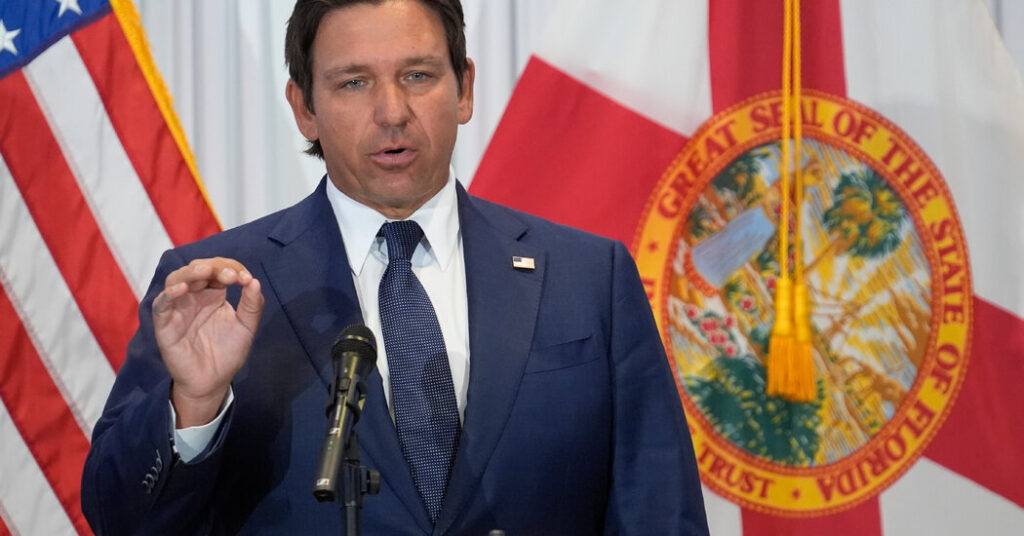
An appellate court on Tuesday struck down parts of a Florida law that restrict the teaching of ideas related to race, sexism and unconscious bias in college classrooms.
The higher education provisions of the law, the “Stop WOKE Act,” which Gov. Ron DeSantis, a Republican, signed into law in 2022, had already been blocked that same year by a lower court judge. That judge had said the law amounted to viewpoint discrimination and violated the First Amendment.
On Tuesday, a U.S. appellate court agreed in 2-to-1 decision, criticizing the state’s assertion that it can control the speech of a professor whose salary it pays.
The law “runs headlong” into the Supreme Court’s endorsements of academic freedom, wrote the two judges, from the U.S. Court of Appeals for the 11th Circuit.
“Florida’s salary-for-speech rule is a breathtaking assertion of power to ban unpopular ideas from public discourse in the very places the State’s own statutes recognize as centers of inquiry — classrooms where students are trusted to puzzle through ideas that are good and bad, easy and hard, ideally getting ever closer to the truth,” the decision said.
The act includes a similar provision for K-12 education that restricts how concepts related to sexism and racism can be taught. That remains in place.
The DeSantis administration did not immediately respond to a message seeking comment.
Several states, including Oklahoma, have also passed laws aimed at curbing the teaching of “divisive concepts.” The American Civil Liberties Union, which filed the court case in Florida, is also challenging the Oklahoma law, among others.
“This ruling sets a strong precedent that higher education cannot be limited to the whims of politicians,” Leah Watson, a senior staff attorney with the A.C.L.U., said in a statement.
The Florida ruling does not directly affect legal challenges in other states with similar laws, but it signals that the First Amendment “still protects against blatant ideological censorship of teaching at public universities,” said Jonathan Friedman, with PEN America, a free-expression group.
Recognizing that laws like Stop WOKE were on shaky constitutional ground, some conservatives in recent years have advocated different approaches to asserting control over curriculum they don’t favor. Those methods include restricting general education courses at universities so they are less accessible and eliminating classes altogether.
Mr. Friedman said those who want to censor speech in college classrooms have moved away from explicit prohibitions in favor of “dismantling tenure, shared governance, accreditation and institutional autonomy.”
The Stop WOKE Act prohibits instructors from promoting, among other things, the idea that a person’s skin color determines whether they are an oppressor or oppressed, or that virtues such as merit, hard work and colorblindness are racist or sexist.
The court on Tuesday said that Florida was seeking to strip professors and students of the ability to “fully engage with ideas that are, for better or worse, very popular in some academic circles.”
“Hearing an idea you disagree with is not discrimination,” the ruling stated. “It is an opportunity to come up with a better idea, or maybe even change your mind.”