


Repairing that break, Glimcher has curated the beautifully installed current exhibition with Noah Khoshbin, director of the Paul Thek Foundation at the Watermill Center in Water Mill, N.Y., and Oliver Shultz, chief curator at Pace. It charts the arc of Thek’s career. Raised in a Roman Catholic family in Brooklyn, he graduated from Cooper Union in 1954 and bounced between Miami and the Northeast, doing set design and odd jobs before settling in New York in 1959.
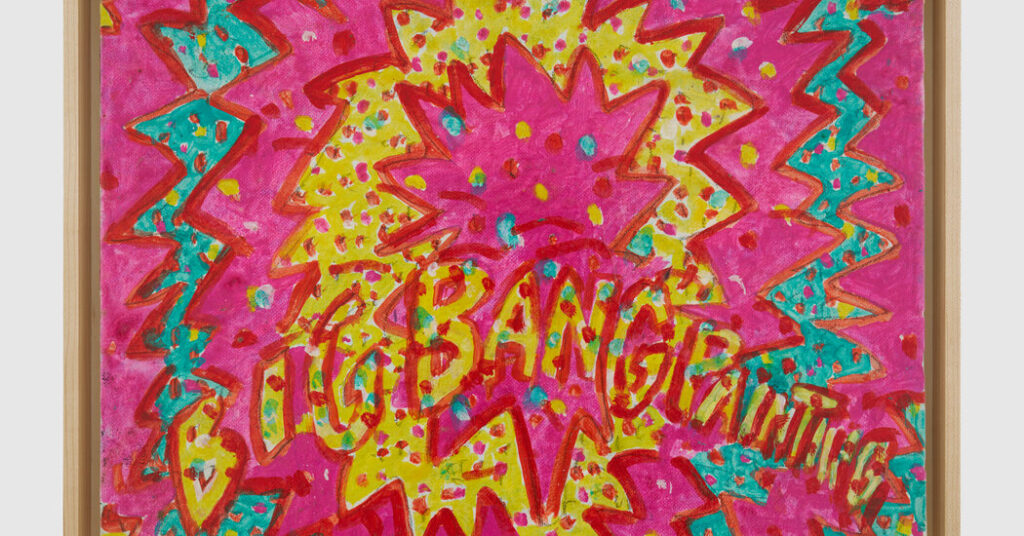
In the early 1960s, he was painting gorgeous abstract oils on canvas, like “Untitled (the Rhinemaidens/Wagner),” circa 1962, which show an affinity with the second-generation Abstract Expressionists. By 1969, he was using newspapers as his ground. (The International Herald Tribune was a favorite). Unlike Robert Rauschenberg and Jasper Johns, who collaged scraps of newspaper in the 1950s before covering them with paint or wax, Thek composed his pictures in gouache or oil directly on a page, leaving part of the paper exposed so that it would yellow as it aged.
At Pace, some of Thek’s earliest body casts made with molding materials are on view, including a plaster one he made between 1959 and 1962 of the finger of the photorealist painter Audrey Flack, who was working alongside him then in a textile design studio. (“He was so beautiful,” she told me. “He had this sun-washed blond hair. I couldn’t stop looking at him.”) Encased in a glass butter dish on a Plexiglas plinth at the gallery, the facsimile of her finger is a precursor of such “Technological Reliquaries” as “Untitled (Hand With Ring),” 1967, in which Thek cast his own hand and painted it with a colorful pattern as groovy as any by Peter Max.
Although the show includes a couple of wall-mounted meat pieces, there are none of the bravura ones like “Hippopotamus Poison,” 1965, made to look like a slab of rotting flesh, which is in the permanent collection of MoMA (and on view there). Unavoidably absent, too, is his masterpiece, “The Tomb,” a 1967 installation of a pink ziggurat that contained a life-size wax effigy of himself, painted pink, a blackened tongue protruding and the fingers of the right hand cut off. “The Tomb” was lost after Thek failed to claim the sculpture on its return from a show in Rotterdam in 1982. At Pace, a photograph Hujar made in Thek’s studio of a waxen hand that was part of the installation hints at its creepy power.