


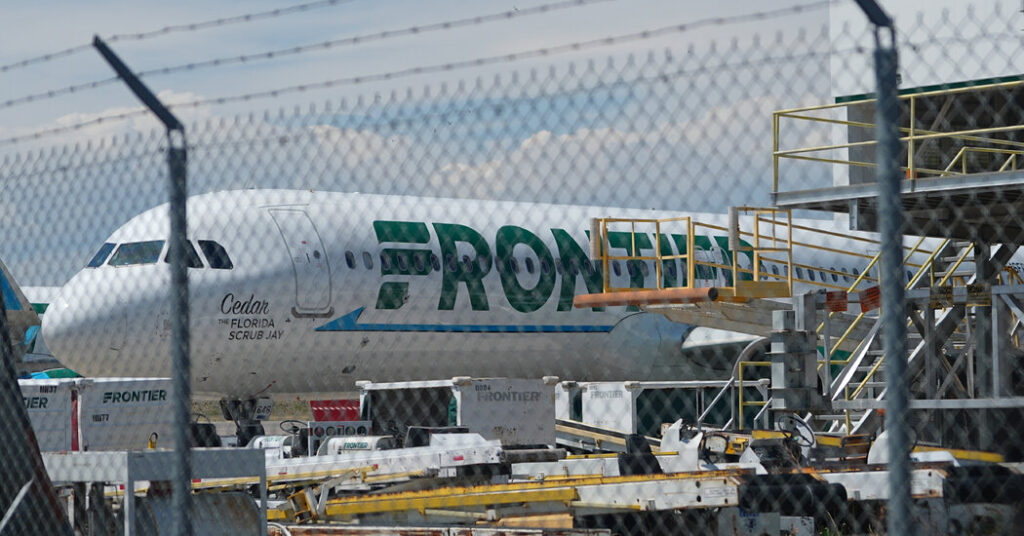
The person who was struck and killed by an airplane on a runway at Denver International Airport on Friday has been identified by the authorities.
The person, Michael Mott, 41, jumped over the airport’s perimeter fence Friday night minutes before he was hit while crossing a runway as a Frontier Airlines jet was taking off, airport officials said Tuesday at a news conference. He was not an airport employee, they said.
Sterling McLaren, the chief medical examiner of Denver, said that Mr. Mott’s death was ruled a suicide and that he died after being drawn into the airplane’s engine, which started a fire.
The pilots immediately aborted the takeoff after reporting the engine fire and telling air traffic controllers that there was smoke inside. The plane was evacuated, and passengers exited the jet on the runway using emergency slides.
Phillip Washington, the chief executive of Denver International Airport, praised the actions of the pilots and crew members. “This could have been far worse,” he said.
The Frontier Airbus A321 jet, with 224 passengers and seven crew members, was leaving on Flight 4345 to Los Angeles International Airport when the accident took place, according to Frontier and the Federal Aviation Administration. Frontier is based in Denver.
The plane stopped on the runway soon after it started accelerating for takeoff, according to the aviation tracking website Flightradar24.
Denver Airport said in a statement that the episode happened at about 11:15 p.m. and that firefighters put out an engine fire on the plane. The airport said that 12 people sustained minor injuries, with five taken to nearby hospitals. The injuries were sustained during the evacuation.
The National Transportation Safety Board, the Transportation Security Administration, the F.A.A., airport officials and local law enforcement were all investigating the accident.
Investigators sifted through about 4,000 feet of debris caused by the incident.
The authorities were still contacting Mr. Mott’s family members to learn more about him and why he did it. Investigators said they had not found any note from him outlining his rationale.
One person listed as a relative of Mr. Mott declined on Tuesday to comment about his death, and several others could not be reached for comment.
According to investigators, the airport has 36 miles of fence line, closed-circuit television monitoring, security patrols and a ground-based radar system to detect intruders, among other safety measures. Still, they said, Mr. Mott was able to jump over an eight-foot fence topped with barbed wire before he was struck by the airplane two minutes later.
The airport’s ground-detection system set off an alarm near where Mr. Mott breached the fence, Mr. Washington said. An operator reviewed the alarm and identified a herd of deer outside the airport’s perimeter fence and did not see Mr. Mott, he added. There were also ditches in the area, where Mr. Mott could have hidden from view, he said. It took Mr. Mott about 15 seconds to jump over the fence, he said.
“Given the short time period, we were not able to intervene and prevent this person from reaching the runway,” Mr. Washington said.
Officials said they were reviewing their security of the perimeter after the incident.
Sonia A. Rao and Billy Witz contributed reporting. Kitty Bennett contributed research.