


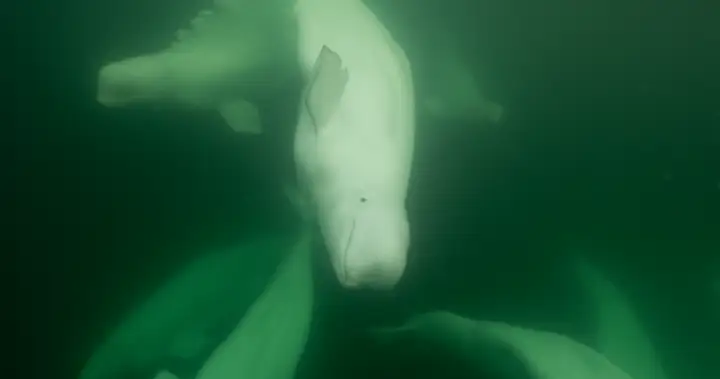
The pristine, subarctic wilderness of Churchill, Man. is home to thousands of beluga whales this time of year, and soon hundreds of polar bears will also gather around the community, waiting for the sea ice to form.


“It’s really incredible, we get this big migration, thousands of beluga whales migrate here and they spend the summer in the estuary,” said Kieran McIver, the manager of Churchill field operations for Polar Bears International.
A beluga whale approaches the underwater camera on Polar Bear International’s ‘beluga boat’.
Kieran McIver / Polar Bears International
The non-profit organization just wrapped up its ‘beluga boat’ season, which launched on July 15 to coincide with Arctic Sea Ice Day. Throughout the summer and until the end of August, the beluga boat heads out on the water daily, capturing and livestreaming underwater images of the beluga whales in the Churchill River estuary and along the shores of the Hudson Bay.
Kieran McIver with the beluga boat on dry land after another season of capturing images of Churchill’s beluga migration.
Marney Blunt / Global News
McIver says the beluga whales are curious of the boat and cameras and often follow them, something that is relatively unique to the belugas in the Churchill-area, he says.


Get breaking National news
Get breaking Canada news delivered to your inbox as it happens so you won’t miss a trending story.
“They seem to just be really curious,” he said.
“Something that kind of makes them unique as well is their cervical spine is not fused vertebrae, so that gives them the ability to move their heads and necks around. So when they are coming and approaching the paddle boarders or kayakers or us on the beluga boat, you can see them physically looking up at you – so it’s a pretty neat experience.”
Polar Bears International is the only non-profit organization in the world dedicated solely to polar bear conservation through research and education.
Kieran McIver holds a life-sized replica of a male polar bear skull at Polar Bears International in Churchill, Man.
Marney Blunt / Global News
“Our goal is to keep polar bears in the Arctic for a long time and to do that we need to understand the species,” Polar Bears International director of science Alysa McCall told Global News.
The organization does a variety of research on the bears, aiming to better understand their physiology, genetics, behaviour, and the coexistence between humans and bears.
“We want to keep polar bears around for a long time, and we also know more polar bears are spending a longer time on-land, especially in Canada, so we have this obligation to support the people that now have to increasingly live with this very large predator,” McCall said.
Alysa McCall is the director of science with Polar Bears International.
Source / Zoom
Polar Bears International also supports tracking research in conjunction with Environment & Climate Change Canada and the University of Alberta. Each year, tracking collars are put on about ten female bears in the Churchill area.
Polar Bears International says the biggest threat to polar bears is the loss of sea ice due to climate change.
BJ Kirschhoffer / Polar Bears International
McCall said that research is useful in understanding the bear’s patterns as they deal with their biggest threat; sea ice loss caused by climate change.
“I like to call them blubber-hunting ice bears,” McCall said. “They’re really out there to hunt seals, eat blubber, they’re mainly focused on fat, they’re on the ice – but within that, there is so much individual variation of where the females move – It might depend on their age, what their mom taught them, but the patterns we see our really cool.”
© 2026 Global News, a division of Corus Entertainment Inc.