


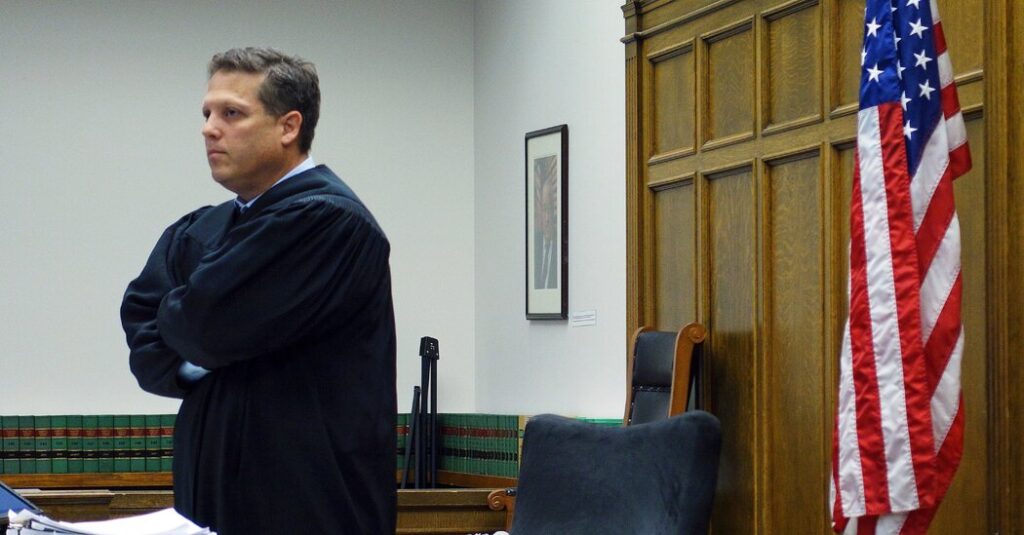
A U.S. attorney in Washington State who was abruptly fired by the Trump administration filed a lawsuit on Tuesday contesting his termination, the first legal challenge of its kind to a Justice Department that has exerted fierce control over top prosecutors.
Roger Rogoff, who was fired last week less than an hour after a panel of district court judges unanimously appointed him, argues in his lawsuit that the president does not have the power to terminate judicially appointed U.S. attorneys, despite having done so several times in his second term.
The law allows judges to nominate their own U.S. attorneys, and the district court in Washington selected Mr. Rogoff last week after the position sat vacant for months. But he became the latest U.S. attorney to be swiftly dismissed by the Trump administration, whose officials have said they will not tolerate judicial appointments in the absence of close consultation with the Justice Department.
The lawsuit marks the first salvo in what is likely to be a hotly contested and closely watched legal battle. It represents the first time that a U.S. attorney appointed by judges — and subsequently fired by the Justice Department — has moved against the federal government.
U.S. attorneys, who lead federal prosecutors’ offices, can be selected one of two ways: They can be nominated by the president and confirmed by the Senate or — absent a Senate-confirmed U.S. attorney — they can be appointed by judges.
Mr. Trump has refused to make many permanent appointments as he has tried to take closer control of the Justice Department than any president in more than a half-century.
Mr. Rogoff’s lawsuit uses the legal logic that sets the terms for U.S. attorneys’ appointments as an obstacle to termination.
Mr. Rogoff argues that by firing him, President Trump trod on a power explicitly granted to Congress, which plays a fundamental role regarding executive branch appointees. His lawyers interpret the law as saying that a judicially appointed U.S. attorney should serve until his or her position is filled by a Senate-confirmed nominee — placing a check on the president’s ability to circumvent the confirmation process.
Mr. Rogoff is facing an uphill battle. Presidents have broad power to terminate their subordinates in the executive branch. This power was expanded last month when the Supreme Court ruled that Mr. Trump could fire regulators even if they led agencies traditionally considered independent from the White House.
“The outcome of any lawsuit is far from certain, even though the administration is thumbing its nose at the Constitution and the rule of law by firing Rogoff and trying to install their preferred candidates without bothering to follow the Appointments Clause,” said Elizabeth G. Porter, a law professor at the University of Washington, in an email prior to Mr. Rogoff’s filing.
She added that while “there are strong arguments” in support of Mr. Rogoff, “they are challenging given the current Supreme Court’s support of broad executive power.”
The Justice Department and the White House did not immediately respond to a request for comment on the suit.
After Mr. Rogoff was fired last week, a department spokeswoman said that his firing had been “wholly within the President’s authority,” as was the case in other, similar firings.
In July 2025, the Justice Department immediately fired U.S. Attorney Desiree Leigh Grace after a panel of New Jersey judges appointed her. The attorney general at that time, Pam Bondi, said that her department would “not tolerate rogue judges.”
Since then, Ms. Bondi’s successor, the acting attorney general, Todd Blanche, has pledged that no judicially appointed U.S. attorney would stay in the job unless judges received sign-off from the department. Along with New Jersey, the White House has fired judicially appointed prosecutors in the Northern District of New York and the Eastern District of Virginia.
The administration is entitled to appoint interim U.S. attorneys for 120-day tenures. In a number of instances, after the tenures of its interim choices have expired, the administration has left those officials leading their respective offices with the title of first assistant — which is often the title of a U.S. attorney’s top deputy.
In one instance, in New Jersey, the Justice Department went along with a judicially appointed U.S. attorney. In that case, Robert Frazer took office after judges in the district negotiated directly with Mr. Blanche.
After announcing Mr. Rogoff’s firing last week in Washington, Mr. Blanche — who is in the midst of his own Senate confirmation process as Mr. Trump’s nominee for attorney general — referred to that type of negotiation as a “time-honored process.”
Mr. Rogoff, 57, has had a long legal career. He received his degree from the University of Washington School of Law in 1993. He has served as a prosecutor in the Washington office he was chosen to lead and as a judge in King County Superior Court in Seattle, among other positions.