


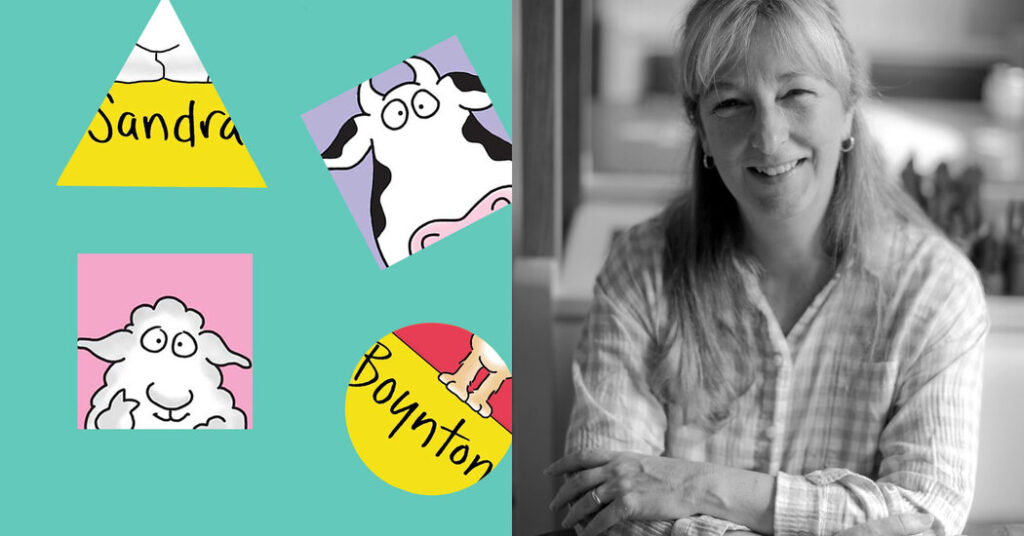
You won’t choose your first favorite Sandra Boynton book. It will choose you. The baby shower gift with a cute cow on the cover that you’ll ignore amid a sea of froofy onesies but later unearth at 3 a.m. and be flattened by. The board book with teeth marks from the library that you’ll realize is both an exemplar of horror storytelling and appropriate for a 1-year-old. The book you don’t even like that much at first, but your kid does; 100 readings later you’ll decide it ranks among the greatest works of children’s literature, and 1,000 readings later among the greatest works of literature, period.
Boynton is a children’s book author and illustrator (and songwriter and greeting card artist and coffee vendor) who concisely alchemizes a world of literary and artistic influences into the best first books for fresh humans, and the most enjoyable ones for the older souls who are enlisted to read to them. Her friendly, brightly colored cows, hippos, chickens and penguins will ensnare you with their googly-eyed gazes. Then their accompanying perfect rhymes will take up permanent residence in your mind. You’ll be able to close your eyes and recite her works by heart. (This will come in handy when you’re forced to read them on repeat in the back of a car while prone to carsickness.)
Boynton’s children’s books will find you when you need them: when you’re at a lifetime maximum of sleep deprivation and need reassurance that losing your mind doesn’t necessarily mean giving up a life of the mind. There are more than 85 and you’ll contort your bookshelf to accommodate them. You’ll wonder why more people don’t say Sandra Boynton’s name in a series with Sendak and Seuss. You’ll become an evangelist for inept turkeys and indefatigable penguins. You’ll rediscover the joy of reading, just in time to spread that joy to a child.
Maybe you’re one of the millions of readers who know all of this already. But in case Boynton’s books haven’t found you yet, choose one of these to start.
I want to start right at No. 1 (and then count to 9 and back again)
Boynton’s first children’s book, “Hippos Go Berserk!” welcomed us into her world, stamping her name (and hippos) on cultural and literary tropes, mathematical laws and biblical truisms, and recasting them all through the story of one wild (hippo) party. See the Boyntonian update to the requisite party climax of many a high school movie: A hippo in possession of an empty house who invites a few friends over for a small, seriously low-key gathering will soon lose control to a swinging party (comprising 45 hippos and an ambiguous monster).
The Boyntonian update to Chekhov’s Gun principle: If there is a painting of Whistler’s Mother (in which Whistler was likely a hippo, since his mother certainly was one) on the wall in the first act of a hippo party, it will be dislodged from said wall by raucous partygoers in the final act. The Boyntonian update to Newtonian physics: What goes up (the number of hippos in your house at a party) must come down. The Boyntonian update to Genesis: From one hippo we come and to one hippo we do return.
You’ll never count to nine — or rate the depth of children’s literature — the same way again.
If “Hippos Go Berserk!” leaves you wondering what happens after you count to nine, you’ll be glad to know that the subgenre of Boynton counting books is strong. Pick the scenario that is most intriguing and count away: Have you ever imagined what you might do if all but one of your 15 pets were named Bob and you had to count them? Consider “15 Animals!” (my favorite of this bunch). What if all the dogs in your neighborhood were vocally expressing themselves at the same time in different dialects? (“Woof!,” “Yap!,” “Rrowff!”) That’s “Doggies: A Counting and Barking Book.” What’s the right number of animals for taking a car ride? Spelunking? A ballet class? Find out in “One, Two, Three!”
How about an alphabet book that doesn’t phone it in when it gets to the tricky final letters?
In the middle of a sleepless night, it dawns on you. “I know how I’ll make my quick fortune: a children’s alphabet book!” You start with ease, already mentally accounting for each dollar of your advance. The words are right there to pluck off the apple, banana and cherry trees of plenty. But then, as you face down Q … V … X … you toss and turn, and the hubris hits hard. You concede that you should leave alphabeteering to the pro who inspired this fever dream, with “A to Z.”
Here, 26 animals are busy: gophers grinning, iguanas itching, quail quacking. And then the moment of brilliance: If you accept that a quail can quack, why not accept made-up animals, like uglybirds (being ugly) and a xylo (xylophoning). It’s Boynton’s world to make and break the rules, even in the cutthroat realm of alphabet books.
I want genius comedic timing stripped to the bone
To call “Blue Hat, Green Hat (the OOPS book)” a story of a sorry turkey who can’t put his clothing on correctly — the everyfowl who can’t catch a sartorial break, the Job of just getting dressed — would be technically accurate, and yet would miss that this book is a child’s first lesson in proper joke pacing, punchline delivery and situational irony (as well as in colors and the names of some common garments).
A hat on his feet? Oops. A coat on his beak? Oops. This master class in minimalism starts with a staccato leitmotif (“Blue hat, green hat, red hat, oops”) that only becomes more allegro (“Blue coat, oops. Red socks, oops”) as it builds toward its finale. I’d tell you what happens when the turkey finally manages to put his hat on his head and his shoes on his feet, but it’d be cruel to ruin the punchline.
I want the comforting voice of Davy Jones stuck in my head for the better part of a year
Love has layers, and each reading of “Your Personal Penguin” exposes new ones. On first read, the book feels like something to crib for a marriage proposal, or vows even: “I want to be Your Personal Penguin. I want to travel with you far and wide. Wherever you go, I’ll go there, too. Here and there and everywhere and always with you.”
Then you look closer. The hippo seems a little skeptical. Is this penguin affection requited? The statement “I want to talk with you night and day” sounds romantic until you see that the penguin is waking the hippo up with a blinding flashlight. Is this a creepy story? On the contrary, that is the page where the book reveals what it’s really about: the dawning magnitude, complexity and beauty of the commitment of parental love. You, the adult reader, are that big hippo, and you’re learning in real time what it looks like, for better and for exhaustion, to have a tiny penguin who loves you at every moment of every day “from now on.”
The song version of this book, performed by Davy Jones of Monkees fame, is a gleeful earworm, a dead ringer for a 1950s doo-wop classic and an excellent introduction to Boynton’s star-studded music catalog. (“Snuggle Puppy!” is also a banger.)
I want one of the greatest rhymes in children’s literature, and/or another great book about hippos
I like to imagine that “But Not the Hippopotamus” exists solely because Boynton stumbled upon the gold-medal-worthy rhyme of “Come join the lot of us” with “hippopotamus,” and built a story around it. This is a straight-talking micro-novella about who gets excluded (the hippo) and included (the hog and the frog and everyone else) in society, and how hard it can be to figure out how to join in the fun. Boynton spins the tale in the most alluring poetic meter, which builds and builds to the splash of that holy-grail rhyme.
I want to be reminded of how singing cartoon animals are actually sort of strange
In the universe of children’s literature and media, animals talk and sing. We’re so inured to this surreal concept that it takes Boynton’s “Moo, Baa, La La La!” to remind us how startling it is that pigs are singing rather than oinking. After you finish this gem, set aside your metatextual reflections and return to blindly accepting animals’ musical talents: Go whole hog into the rollicking “Barnyard Dance!,” where it makes total sense that the animals “promenade, two by two.” If they didn’t, that would be weird.
Give me the weirdest Boynton hippo book
Boynton has already established that hippos are like us: Sometimes their parties get out of hand, they’re shy about joining a crowd, they’re not sure what to make of intense love from another. As we learn in her “Belly Button Book!,” they also all have belly buttons (or “bee bos,” as the tiny hippo calls them). Of the many works in Boynton’s cosmos of the strange, this ode to the umbilicus strikes me as the weirdest — in the best way: a hippo in a “Navel Academy” crop top; the existence of Belly Button Beach; the belly button song sung by the hippos after dark at said beach; and the oddest of notes at the end, accompanying the story’s dramatic and unforeseen turn toward wintertime, “when belly buttons hide.”
There are no hidden lessons about colors, numbers, letters, feelings, opposites or daily routines to be found here. These are just some hippos who love belly buttons. Maybe an irrational obsession with something small and arbitrary is their most human trait of all.
I want to first grapple with my identity as a new mother and then support my budding contrarian-in-residence
Someone gave you this cute animal book at your baby shower and now, a few weeks into new parenthood, you pluck it off the shelf, since you’ve heard you should start reading to your baby immediately. The soulful, inquiring, slightly anxious-looking bovine on the cover is staring at you, asking the very same question that you, knocked out by the all-consuming commitment of early breastfeeding, have recently been asking yourself far too often: “Are You a Cow?”
The book mercifully supplies the answer, since you are too frazzled, too seen, too startled to think: No, you are not. (Nor are you a duck, a frog or a pig.) Its final words, “You must be YOU! Now isn’t that great!” — meant to bolster a very young reader’s self-esteem — supply the rallying cry you yourself need. You are still you, whatever “you” means these days. Fast forward a few years and you’ll wonder why the book appears bizarrely tear stained. (It’s now the most fun, sanctioned way for your toddler to yell “No!,” over and over again.)
I don’t want to get tired of getting tired
“The Going to Bed Book” is Boynton’s more celebrated bedtime book, but I much prefer “Dinosnores,” which outlines the pre-slumber routines of dinosaurs. For this page alone, “Then they YAWN and they YAWN and they YAWN and they YAWN,” which magically (and scientifically) confers sleepiness on the reader, it’s the winner. But then you get to make weird snoring sounds: “Honk SHOOOOO!” And on the last two pages, a previously unseen rabbit makes a surprise appearance, adding a complex framing narrative to the book I found myself reading every night for a year.
Give me the best original holiday book
Kids like what they know, so I blame no children’s authors for adapting their greatest hits for holiday specials (see “Moo, Baa, Fa La La La La!” and “Boo! Baa, La La La!”). But with “Eek! Halloween!” Boynton doesn’t just mine her own I.P. She delivers an original spooky tale that moves little folks through the key paces of classic horror movies. The chickens on the farm are nervous because “STRANGE THINGS ARE HAPPENING.” Kids, on the other hand, will savor their first dose of dramatic irony. Unlike those silly chickens, they know it’s Halloween. You read the title to them after all!