


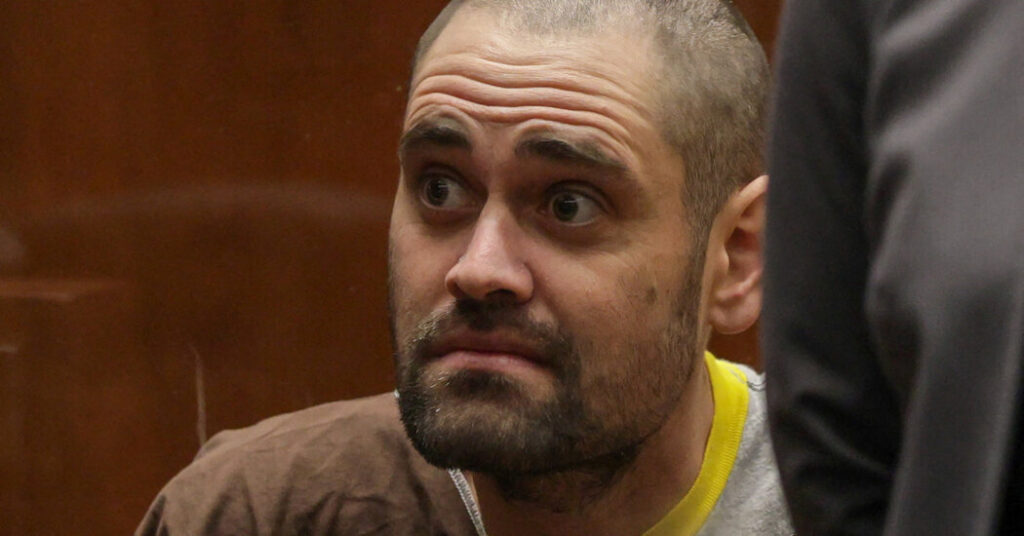
A financial steward of Nick Reiner’s $1.6 million trust fund argued in court papers that California’s “slayer statute” prevents Mr. Reiner from receiving that money to defend himself against charges that he murdered his parents.
Mr. Reiner, the younger son of the Hollywood director Rob Reiner and Michele Singer Reiner, has pleaded not guilty and has taken legal action to gain access to the money so he can hire a private lawyer. He is currently represented by a public defender.
In court papers filed this week, a professional fiduciary with oversight of the fund Mr. Reiner’s parents established when he was a baby opposed the request. The papers cite a California law known as the slayer statute, which prevents people from inheriting money from someone they “feloniously and intentionally” kill.
“California has enacted no exception permitting a killer’s inheritance to be used for criminal defense costs,” wrote Lauriann Wright, a lawyer for the professional fiduciary, Jodi Pais Montgomery.
In the filing, Ms. Wright wrote that under the slayer statute, the trust funds in this case would be passed to Nick’s siblings, Romy and Jake, and that Ms. Pais Montgomery has a fiduciary responsibility to them as well. She noted that although Mr. Reiner is presumed innocent, releasing the funds now would be “irreversible.”
In a statement, a lawyer for Mr. Reiner, Anita P. Wu, rejected the assertion that the California law applies.
“The slayer statute requires a determination, not a mere accusation,” she said. “Nick is presumed innocent and has been convicted of nothing.”
A spokesman for the family did not immediately respond to a request for comment.
A hearing in the case is scheduled for Monday.
Ms. Wright argued that the question would ultimately be determined by the criminal proceedings. Mr. Reiner was indicted by a grand jury on murder charges in July; he is scheduled to return to court for a pretrial hearing on Sept. 15.
Hanging in the balance of the financial dispute is whether Mr. Reiner, 32, will ultimately be able to rehire Alan Jackson, a high-profile criminal defense lawyer. Mr. Jackson, whose past clients have included Karen Read and Kevin Spacey, briefly represented Mr. Reiner but said in court papers that he was forced to withdraw after Mr. Reiner’s family decided not to fund his services.
The legal fight over the money in Mr. Reiner’s trust began in earnest in June, when Ms. Wu petitioned a probate court in Los Angeles to force a trustee to release the portion of funds that Mr. Reiner believes should have been paid to him when he turned 30. In court documents, the trustee estimated that amount to be roughly $558,000. Ms. Wu said the trustee could not “retroactively erase” a payment that should have been made more than two years ago.
The remaining balance is supposed to be paid out when he turns 35, but his lawyer has argued that the manager of the trust can disburse money sooner for his “support, maintenance, health and education.”
Ms. Wright wrote that Mr. Reiner had been made aware that he could have taken a payment at age 30, but that he did not, thereby consenting to keep the funds in the trust.
Lawyers for Mr. Reiner responded on Friday by filing a two-page declaration with his signature. “I did not give my consent to any trustee of my trust to withhold, defer or retain my age-30 distribution indefinitely as ‘property of the trust,’” he wrote.
He added later, “As I have stated in my petition and other documents, I would like for my money to be released.”
Held without bail in the Twin Towers Correctional Facility in Los Angeles, Mr. Reiner has argued that he also needs access to the trust fund to buy basic items such as socks and soap in the commissary.