


In January 1945, the artist Lyonel Feininger wrote to Galka Scheyer, his friend and representative in the United States, to tell her that donating her large collection of Modernist artworks to a California museum was a good idea.
The reason, he wrote, was simple: “because this is where you enabled us, gave us our first foothold in the United States.” The letter arrived just months before Scheyer died in Los Angeles, at 56.
The letter is part of “Dear Little Friend: Impressions of Galka Scheyer,” an exhibition at the Norton Simon Museum in Pasadena, Calif., running through July 20.
Instead of focusing on her famous artists, the show focuses on Scheyer herself. In showcasing personal correspondence and Modernist artworks — including eight rare portraits of Scheyer — the exhibition casts a light on the friendships she built with her artists, the circle she gathered around her and the work and willpower it took to bring radical European Modernism to the United States.
Galka Scheyer was born Emilie Esther Scheyer in 1889 in Germany. She began as a painter, but it was meeting the Russian artist Alexei Jawlensky in 1916 that truly set her course in the art world.
Jawlensky gave her the nickname that would define her — Galka — from the Russian word for jackdaw, a clever, gregarious bird. He also introduced her to three other Bauhaus masters, Wassily Kandinsky, Lyonel Feininger and Paul Klee, the Modernists Scheyer united, along with Jawlensky himself, under the name “the Blue Four.”
Scheyer arrived in the United States in 1924, first in New York City and soon after in the San Francisco Bay Area and Los Angeles, where she held lectures and salons promoting “the Blue Four.”
“She was instrumental in establishing California as a center for modern art,” Gloria Williams Sander, a curator at the Norton Simon, who organized this exhibition, said on a recent Monday morning in the intimate gallery space surrounded by 12 artworks and a handful of letters and documents under glass.
The Norton Simon holds Scheyer’s Blue Four Collection, which includes some 500 paintings, drawings, prints, photographs and sculptures from both the Blue Four and other artists, assembled over two decades, along with an archive of Scheyer’s correspondence with her artists.
Reading through those letters, especially those from Feininger, gave Williams the idea for the show. For decades, he would start his letters to Scheyer with the salutation, ‘Dear Little Friend.’
“That’s what captivated me to think about how to frame this show,” Williams Sander said. Of the 12 artworks in the show, eight are portraits of Scheyer, which Williams Sander explained were “gifts, tokens of friendship,” adding, “it’s how the artists saw her.”
Williams Sander answered some questions on how we, too, should see Galka Scheyer. This conversation has been edited and condensed.
Who was Scheyer?
She was one of the most adventurous female art impresarios of the early 20th century. She was a champion of modern art trends and a gifted communicator.
Scheyer represented four of Europe’s most radical painters under the banner of “the Blue Four.” What was her goal as a dealer and collector?
Her goal was to share the passion she had for art as a vehicle for spiritual and emotional ideas, for uplifting the soul, so to speak. There is a little bit of tension there, because she came to the United States to promote their work and sell their work and cultivate collectors in order to send money back to them in very difficult times in Europe, and specifically in Germany.
On the other hand, she wrote to the Blue Four in a letter after she arrived in California: “My work here has nothing whatsoever to do with the selling of art, but with the awakening and development of an understanding of art.”
How did she end up in California?
When she realized New York was going to be closed to her — she landed there in 1924 and simply could not get a foothold — she went to the New York Public Library and wrote hundreds of letters to every museum director and university art gallery director across the country, explaining her project to show this radical art from the “Blue Four” artists. Only California responded. The director of the Oakland Art Gallery [the predecessor of today’s Oakland Museum of California], William Clapp, wrote back and said he’d love to have a show.
The open-minded West Coast, freer of tradition and convention.
Exactly.
The show is called “Dear Little Friend.” What does that phrase tell us about how these artists saw her?
“Dear Little Friend“ is the phrase that comes up frequently in Lyonel Feininger’s letters to Galka, and it’s a term of affection, a term of intimacy. That’s what sort of captivated me to think about how to frame this show, as I was looking through the letters, I realized we have these gifts to her, and we have these images of her in portrait form.
I know some people have asked me, isn’t that patronizing to say “dear little friend?” But I think that’s looking at that salutation from the point of view of the 21st century. It’s endearing and because it happens so frequently, even in some of the artworks or inscriptions, it’s just an affection and homage between them.
Is there a work you gravitate toward?
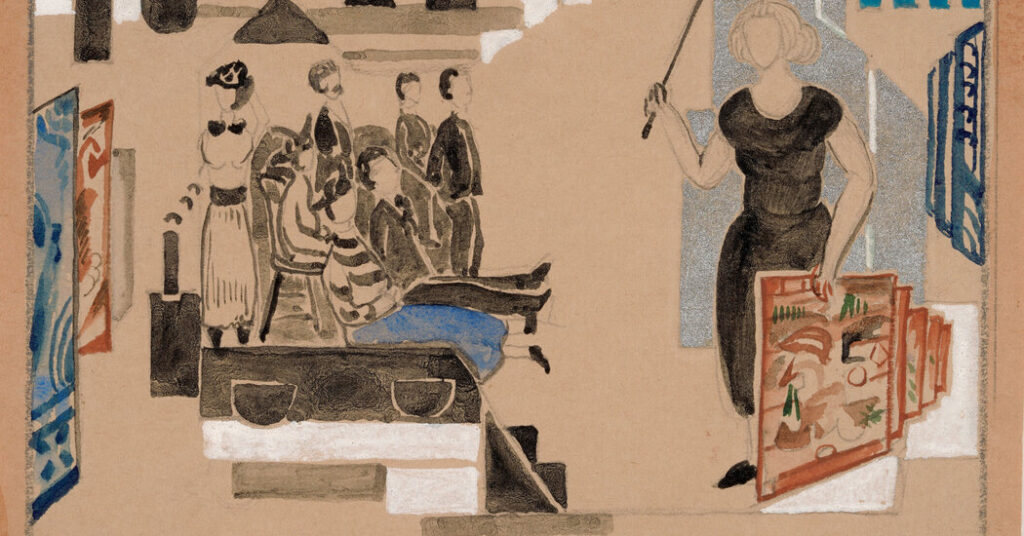
The Peter Krasnow, because it is emblematic of how she operated. Peter no doubt attended many of these salons where she appeared. It is a snapshot of these gatherings at people’s homes that she held, Hollywood stars’ homes, her own home in the [Hollywood] Hills. And then it has the four blue lines at the top, an emblem that represented “the Blue Four.” If you had to say, what’s an emblem of Galka Scheyer and her work here, I would have to choose that.
Why should we be interested in Scheyer?
She really believed in her mission on behalf of these artists and modern art beyond just the commercial value of it. It was for its aesthetic and spiritual impact.
And there’s something worth reflecting on in the context of her life: She was doing all of this in the 1920s, ’30s, and ’40s as a single Jewish woman with a German accent, against the backdrop of the Depression and World War II.