


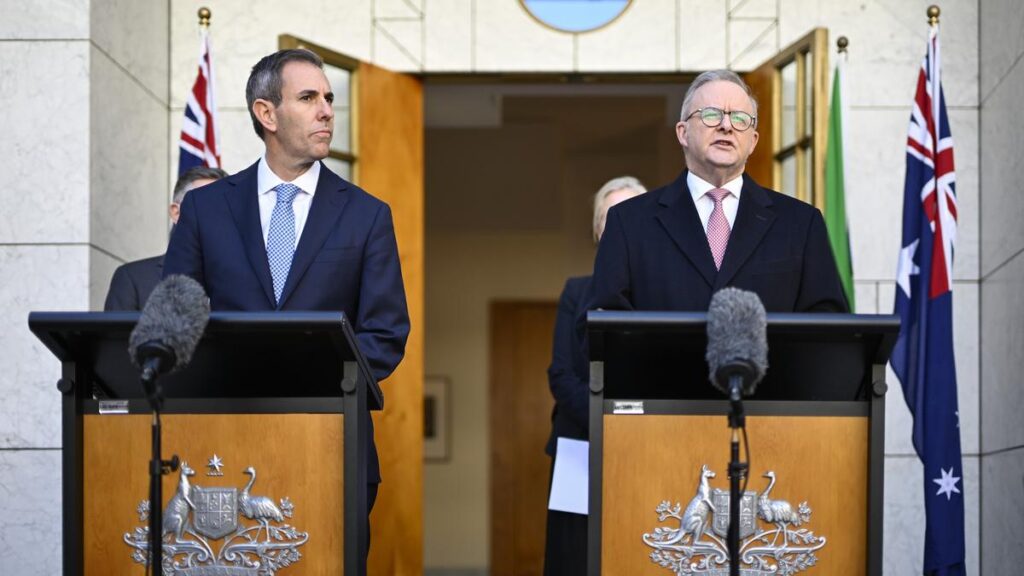
Despite trying to stay out of politics, the Reserve Bank has blamed Labor’s Budget taxes on investors for the housing market slump.
The observation was made hours after ANZ predicted the worst housing market plunge in more than four decades.
This year’s three rate hikes and Labor’s contentious Budget taxes on property investors are already denting property values in Sydney, Melbourne, Brisbane, Perth and Adelaide.
The already unpopular central bank says Treasurer Jim Chalmers must share the blame, with Labor maintaining its policies are designed to slow home price growth rather than spark a downturn.
“This follows a long period of very strong growth in housing prices and reflects the combined effect of cash rate increases, tax changes announced in the Federal Budget, and weaker sentiment,” the RBA’s latest statement on monetary policy released on Tuesday said.
Reserve Bank governor Michele Bullock noted elevated construction costs could diminish demand for both established and brand new homes, with Labor scrapping negative gearing from July next year for those who bought an existing property after the May 12 Budget.
“Basically, construction costs are rising and if established housing prices are falling, then what you can sell new construction for obviously is going to come down as well and at the same time, you’ve got construction costs rising,” Ms Bullock said.
“We’re already hearing, particularly in the high-density market, that it wasn’t worth building because the costs it took you to build, you couldn’t sell for it.
“That’s the way in which it might constrict housing construction.”
So much for Labor trying to boost the supply of housing.
Hours before the RBA decision, ANZ updated its forecasts to have a peak-to-trough fall of 14.5 per cent in Sydney.
This would be more severe than the 13 per cent plunge from 2017 to 2019 following a banking regulator crackdown on interest-only loans, meaning it would be the most dramatic downturn since 1983 during a year-long recession, historic Cotality data showed.
“We are forecasting the worst downturn in Sydney housing prices since 1983 and I think it’s really a combination of factors: affordability, something that’s been weighing on the Sydney market for a while,” ANZ economist Madeline Dunk told The Nightly.
“You couple that with restrictive interest rates – our view is that the RBA is done but nonetheless, we do think the cash rate is slowing down the economy and clearly slowing down the housing market.”
Melbourne, another market where prices have been going backwards since February, was forecast to see a peak-to-trough decline of 12.8 per cent, which would also mark the steep decline since 1983.
Brisbane values were tipped to plunge by 7.9 per cent, which would be the worst since the aftermath of COVID.
Adelaide prices were forecast to fall by a record 9.8 per cent as Perth prices slid by 5.2 per cent, which would be the worst decline since the post-mining boom slump of 2014 to 2019.
Capital city prices were forecast to fall by 4.3 per cent this year alone, following by 3.4 per cent drop next year when the Reserve Bank is expected to cut rates.
That 10.6 per cent decline from this year’s peak would be worse than the 8.2 per cent plunge from 2017 to 2019, meaning the worst downturn since the early 1980s.
ANZ is expecting home prices to bottom out in mid-2027 before the Reserve Bank cut interest rates again in August and November.
While more expensive suburbs of Sydney have traditionally suffered the biggest drop in house prices earlier in the downturn cycle, Ms Dunk is expecting house and unit prices in outer suburbs to suffer the biggest drops.
“Areas where investors are more dominant in the western suburbs, for houses for example, are likely to be more affected,” she said.
Ms Bullock, however, is expecting home prices to rise again, given Australia has a housing shortage.
“It will correct — it mightn’t necessarily correct in a hurry, but that’s the mechanism in which it might flow through in the short run but ultimately over a longer period, you will see that the forces of supply and demand deliver price incentives, if you like, to construct more dwellings or for people to reduce their demand for dwellings,” she said.
“It might come through higher prices that people are willing to pay more and people are willing to build them.”
If fewer first-homebuyers enter the market, the pain of falling prices in 2026 and 2027 before a recovery would have been in vain.