


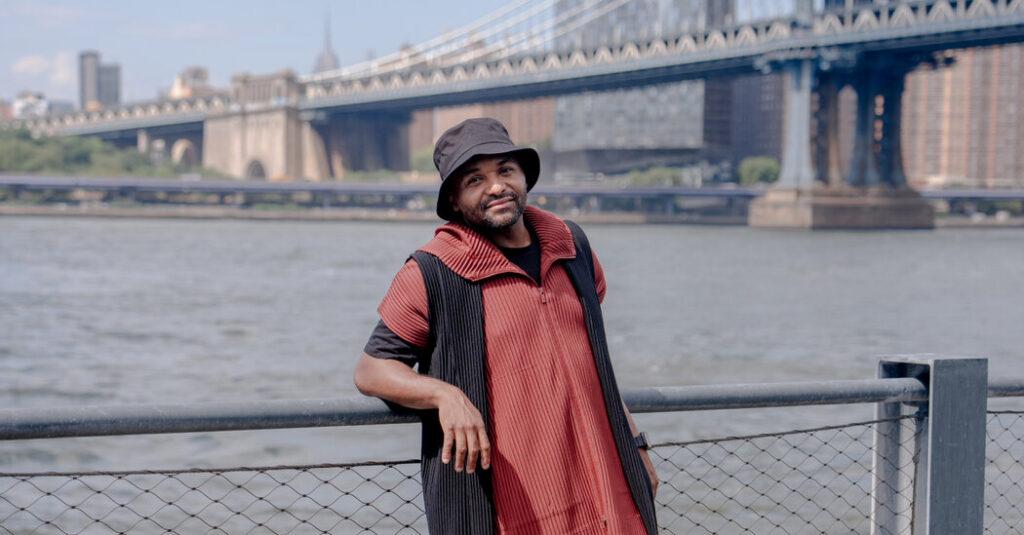
Whenever he’s at home in New York, where he has lived since 2008, Sullivan Fortner makes a habit of playing at the Concord Baptist Church of Christ in Bedford-Stuyvesant, Brooklyn. There, the pianist, one of the most esteemed and decorated jazz musicians of his generation, gets a welcome dose of humility.
“There’s no celebrity there,” he said during a recent interview in the backyard of a bakery in Brooklyn’s Boerum Hill neighborhood. “They recognize you and they appreciate you and all that stuff, but the star is Jesus.”
When he visits his hometown, New Orleans, and plays at his parents’ church, his ego takes an even bigger hit.
“These people here look at me like, ‘Yeah, I changed your diapers. You ain’t nothing to me,’” Fortner, who will turn 40 in December, explained in his animated Southern drawl, before bursting into laughter. “‘If you playing it wrong, you playing it wrong. If I don’t like it, I don’t like it. I’m going to tell you I don’t like it.’ That’s what I grew up in.”
Outside the congregation, Fortner has encountered significantly more fanfare. Earlier this year, he won his first Grammy in the prestigious category of best jazz instrumental album (and third, overall) for “Southern Nights,” his intimate and approachable 2025 trio effort. He beat out a field that included a posthumous release of a live recording by Chick Corea, a perennial Grammy favorite. Months earlier, Fortner had received the Larry J. Bell Jazz Artist Award, a lucrative prize given by the Gilmore, an international piano festival based in Kalamazoo, Mich., which, for more than 30 years, had exclusively honored classical pianists. (In 2015 he won the Cole Porter Fellowship in Jazz.)
Fellow musicians speak of him with reverence that borders on awe. In an interview, Jason Moran, a former teacher of Fortner’s and one of the standout pianists of the generation before, marveled at how “his technique matches his brainpower,” to the extent that he can “definitely get four to five different ideas into his hand at once.” (To sample a typical bit of Fortner dazzlement, play his unaccompanied version of the 1960s show tune “I’m All Smiles,” from his 2023 “Solo Game” album, where his lines tumble and interlock like a troupe of acrobats.)
“You may want to do it with your eye, your brain, but your hands may say otherwise,” Moran said. “But his actually meet the computation that his brain imagines.”
The eminent trumpeter Ambrose Akinmusire, who has performed with Fortner in various contexts including duos inspired by the iconic trumpet-piano partnership of Louis Armstrong and Earl Hines, praised the way that Fortner’s facility never outshines his musicality.
“The thing I love most about Sullivan is his commitment to playing exactly what needs to be played in a moment,” Akinmusire said. “He could just rip up and down the piano and he would sound equally as amazing, but he’s really committed to being a conduit for the music.”
That commitment extends to Fortner’s zigzagging aesthetic. Some of his recordings, such as “Southern Nights” and the standards-heavy first half of “Solo Game,” give the impression of an unabashed traditionalist. Others are considerably weirder, like the new “Leave That in There,” out Aug. 28. Encompassing flamboyant excursions on organ and keys, futuristic art funk and even a choir made up of Fortner’s own overdubbed voice, it feels like an unfiltered transmission direct from his imagination.
Layered on a bedrock of tracks featuring his regular road band, with the bassist Tyrone Allen II and the drummer Kayvon Gordon, the album is as dense as “Southern Nights” was unadorned. The opener, “Sugarcane”— the title of which alludes to an 1811 rebellion by enslaved people working on plantations near LaPlace, La., where Fortner lived as a child — finds Fortner adding marimba and Moog to Gordon’s Afro-Cuban batá rhythm, before the full piano trio fades in. (The album features various other references to the area; some, including the title, are drawn from lines in “When the Levees Broke,” Spike Lee’s 2006 documentary on Hurricane Katrina and its aftermath.)
In conversation, Fortner — sporting a close-cropped beard and wearing a customary ball cap, this one with text that read “To Be Young, Gifted and Black” — cited a broad range of influences, including Thelonious Monk, Bach and Stevie Wonder. But in perhaps his most telling name-drop, he described himself as a “huge ‘I Love Lucy’ fan,” with encyclopedic recall of the show.
“She always manages to get into trouble, no matter how simple the solution, how much she could have avoided it,” Fortner said of the protagonist. “But for some reason, it always ends out OK.”
“It’s my whole idea of playing music,” he continued. “It’s always been that. How far can I take it? Even though they tell me not to, how much can I play before it really falls apart?”
Accordingly, for “Leave That in There,” the mission was one of playful exploration: “Let’s just all come together with all these tools and see what happens.”
Fortner’s early training came from his mother, who played organ at the Missionary Baptist church, and taught him and his sisters music theory through the lens of gospel. Another church organist exposed him to jazz and classical music, and he enrolled in the New Orleans Center for Creative Arts, where he learned from veteran local trumpeter and mentor Clyde Kerr Jr. alongside peers who included Troy Andrews, known as Trombone Shorty, and Jon Batiste.
Fortner credits Kerr both with igniting his passion for jazz, by passing him a copy of Erroll Garner’s “Concert by the Sea,” and instilling a certain open-mindedness. Once Kerr sat with a teenage Fortner as he attempted to play through the sheet music for Charlie Parker’s bebop standard “Confirmation.”
“He knew I couldn’t read, but he sat there and he watched me. Said, ‘Take it real slow,’” Fortner recalled. “And then if I made a mistake, he was like, ‘Yeah, that’s hip!’” Remembering Kerr’s unusual patience, he exploded into laughter. “‘Dead wrong, but that’s hip.’”
Even as his skills improved, Fortner envisioned himself as a supporting player. “My dream was to play with Whitney Houston and Chaka Khan and Stevie,” he said.
His first major sideman gigs came after college, once he arrived in New York to pursue his master’s degree at Manhattan School of Music, where he studied with Moran. After a stint with the vibraphonist Stefon Harris, he joined up with the trumpeter Roy Hargrove, replacing his hometown friend Batiste on keys, a job that would last throughout much of the 2010s.
Unlike Moran or other 21st-century piano pacesetters such as Vijay Iyer and Robert Glasper, Fortner is an ambivalent composer. “I don’t really enjoy writing,” he said. (In contrast to prior Fortner releases, “Leave That in There” consists mostly of originals, which, he said, “is kind of a miracle unto itself.”)
His devotion to the core jazz repertoire is intense and can make his live sets feel like he’s shuffling a massive internal playlist full of standards.
“The songs themselves are perfect,” he said. “There’s a story in the melodies. There are lyrics that are attached to it, and the lyrics go hand in hand with the melodies. The chord progressions that are used are great; they’re perfect. They make sense harmonically.”
In an email, the brilliant singer Cécile McLorin Salvant, Fortner’s close collaborator for a decade, including on the Grammy-winning 2018 duo album “The Window,” called him a “reservoir of song.”
“I don’t think he approaches covers differently than he does playing his own original compositions,” she wrote. “He is conducting a choir when he plays, no matter what he’s playing. In that sense, the notes are anthropomorphized; they are voices and the voices are alive, so anything he plays is imbued with a dynamism that I suspect surprises even him at times.”
The veteran pianist Fred Hersch, a friend and former teacher who also has a strong allegiance to standard tunes, said in an interview that this quality is less common in Fortner’s generation.
“Now young musicians are expected to be composers: ‘I want to do my own music with my own band,’” he said. “And I think Sullivan has the attitude, like, ‘I want to play what’s fun and interesting, period.’”
By following that straightforward principle, Fortner has become more of a leader, and a luminary, than he ever imagined.
“I just play because I love to play,” he said. “It’s nice to be recognized, but I don’t need it.”
But as Moran noted, Fortner’s talent is too extraordinary for such humility to impede his rise.
“Because he doesn’t do all that rah-rah around himself,” he said, “he’s been able to elude that trap of becoming the star. But he’s the star for us.”