


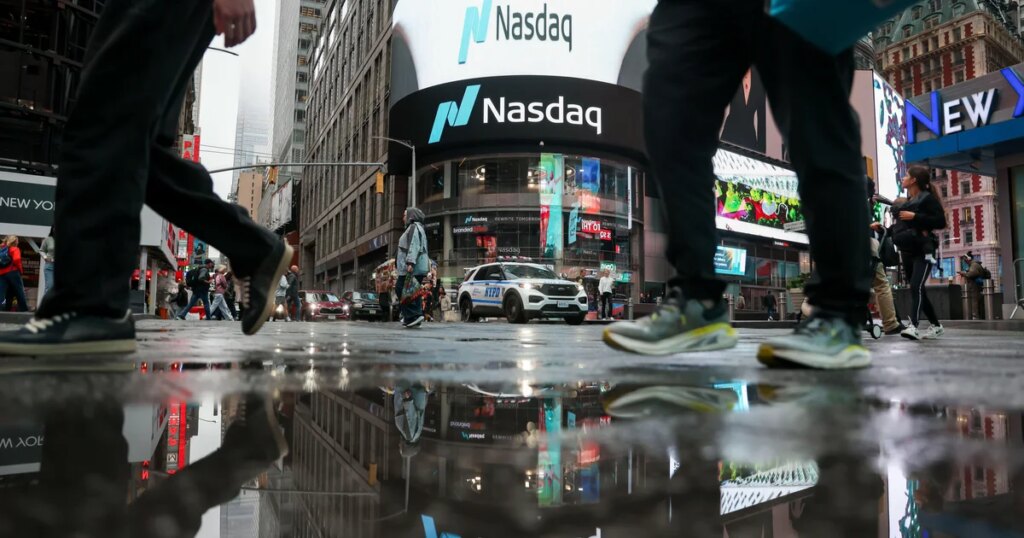
Financial markets slumped on Friday as investors bailed on technology stocks amid concerns that companies exposed to artificial intelligence are starting to wobble.
The tech-heavy Nasdaq Composite tumbled more than 650 points, or 2.4%, in afternoon trading, to 26,116 and was headed for its first weekly loss in five weeks. The broader S&P 500 and blue-chip Dow Industrial Average sank 1.2% and 0.6%, respectively.
Chipmakers and other tech companies have been under pressure this week as investors worry about the heavy borrowing associated with the emergence of AI and the rapid buildout of thousands of data centers required to provide computing power for AI models.
So-called neocloud companies like CoreWeave, which provide the brute computing power AI models need to function, were particularly hard hit. That’s because they are financing much of their capital expenditures through debt and equity issuance rather than cash flow, raising investor concerns about mounting debt, market analyst Adam Crisafulli, head of Vital Knowledge, told CBS News.
Shares of CoreWeave slid 12% on Friday and were down nearly 26% this week as investors nervously eye its mounting debt. Micron Technology fell 4.1%, Advanced Micro Devices dropped 5.1%, Broadcom was down 3.6% and Intel lost 4.7%.
Elsewhere on Wall Street, Tesla shares fell 2.8% after the electric vehicle company unveiled a new Roadster sports car that appears capable of thrusting itself into the air.
Inflation moving in wrong direction
Also rattling investors this week were fresh signs that U.S. inflation is increasing and moving further away from the Federal Reserve’s 2% annual target.


Yields on the 10-year U.S. Treasury bonds — a key benchmark for mortgages, credit cards and other loans — held steady at 5.1% on Friday. Earlier this month, bond yields surged to their highest level in more than two decades amid concerns over inflation and rising U.S. government debt.
The hot inflation readings this week could spur the Federal Reserve to raise interest rates at its next meeting on Oct. 28-29, according to some economists. For now, most Wall Street traders expect the central bank to keep its short-term rate unchanged, but the odds of a rate hike at the Fed’s December meeting have jumped to 74.3% from 50.2% a month ago, according to CME FedWatch, which tracks Fed funds futures prices.
On Friday, Fed Chairman Kevin Warsh offered no hints about potential interest rate policy moves while attending a meeting of financial leaders in Bangkok. The Fed hiked rates at its last meeting in September, bringing the federal funds rate to between 3.75% and 4% — its highest level since December 2025.