


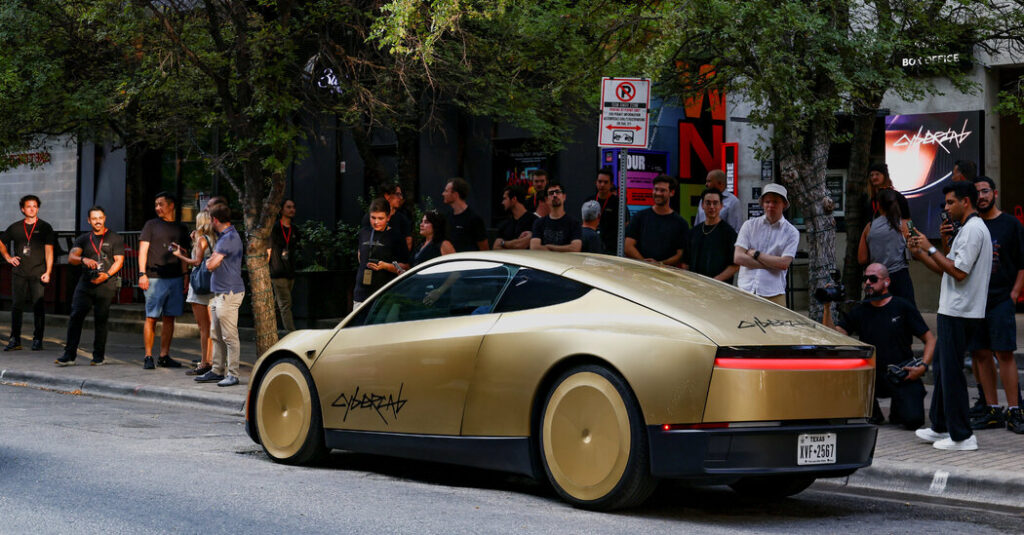
Federal regulators have opened an investigation into whether Tesla’s new Cybercab model is compliant with safety regulations, a potentially big obstacle to the company’s plans to offer paid rides in the driverless vehicles.
The investigation by the National Highway Traffic Safety Administration began Thursday, according to a document posted on the agency’s website, the same day that Tesla displayed dozens of Cybercabs in Austin, Texas, near the factory where they are produced.
Tesla has indicated that it plans to offer paid rides in the Cybercabs, which do not have steering wheels, brake pedals or side and rearview mirrors. The company has also invited inquiries from people interested in buying fleets of Cybercabs. The car is not yet available to be purchased by individuals.
The Cybercab is central to plans by Elon Musk, Tesla’s chief executive, to revolutionize transportation and dominate the growing market for vehicles capable of acting as robot chauffeurs. Tesla’s $1.4 trillion stock market valuation depends in large part on the success of its taxi service.
“The future of transport is safer, more enjoyable & gives you more time back,” Tesla said on the company’s X account Thursday, one of a series of posts about the Cybercab.
“The streets won’t be the same anymore,” Ashok Elluswamy, head of artificial intelligence at Tesla, said on X.
But some investors appeared to have doubts. Tesla shares were down 6 percent Friday morning.
Federal regulators allow carmakers to certify on their own that vehicles comply with auto safety standards, subject to review by regulators. Among other things, the regulations require cars to have brakes and steering wheels. Tesla may have decided that some regulations do not apply to Cybercabs, the agency said.
The agency “will consider the extent to which Tesla’s certification depended on determinations that certain F.M.V.S.S. are inapplicable to the Cybercab,” it said, referring to federal motor vehicle safety standards.
Tesla did not immediately respond to a request for comment.
Zoox, a division of Amazon, operates small self-driving vans in Las Vegas and San Francisco that do not have standard driver controls. But Zoox in July obtained an exemption from federal regulators to put up to 2,500 of its vehicles on U.S. roads for two years. Tesla has not yet obtained a similar waiver.
A “compliance and safety” document on Tesla’s website indicates that some Cybercabs may have brake pedals and be capable of manual operation. The document makes no mention of a steering wheel.
Officials at the auto safety agency have said they are considering new rules to accommodate self-driving vehicles. But they have asked automakers to get permission before widely introducing new technologies that do not comply with federal regulations. The agency’s rules allow automakers to put small numbers of noncompliant vehicles on public roads for research and testing.
“N.H.T.S.A. fully supports the safe development and deployment of automated vehicles,” Jonathan Morrison, the agency’s administrator, said in a statement Friday. “But as the federal regulator, we need to ensure that all of our laws are followed.”
Tesla has permission from the Texas Department of Motor Vehicles to offer paid rides in 45 Cybercabs. The company paraded out some of the vehicles, painted a shiny gold, in Austin on Thursday as part of what the company called a launch event.
The company did not broadcast the event online, to the disappointment of many fans.
Cybercabs were also spotted in other cities like Miami and Washington, although it was not clear if those vehicles have manual controls.
“To me the Cybercab is a distraction,” said Matthew Wansley, a professor at Cardozo School of Law in New York. “If Tesla wants to build a lot of vehicles they can build a lot of vehicles. The question is can they build an automated driving system that works.”