


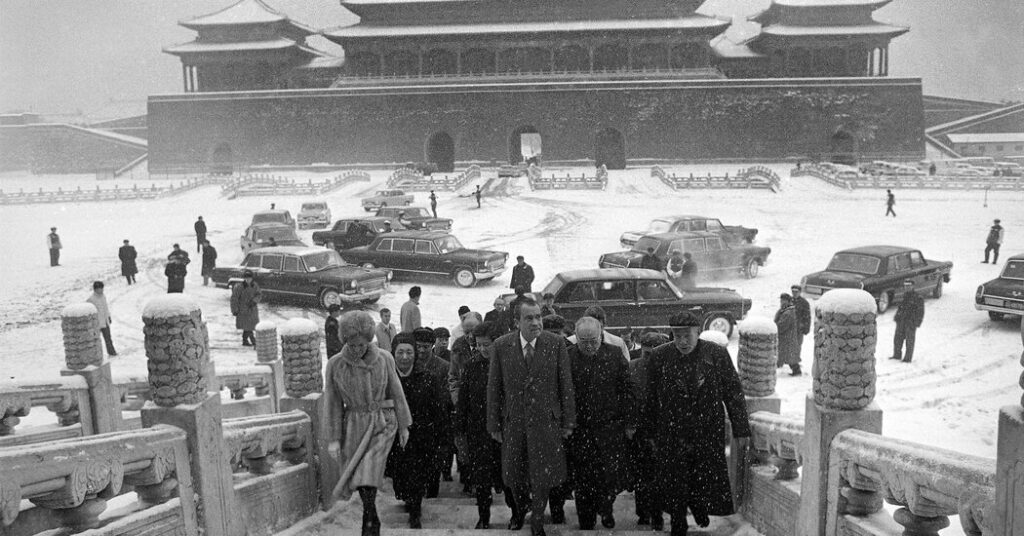
When Richard M. Nixon went to Beijing in 1972, it was a gamble. He was betting that a diplomatic opening with the Communist government, and downgrading relations with Taiwan, which claimed to be the rightful ruler of China, would serve American interests.
Successive visits to China by American presidents built on that idea.
The visits are in a continuum of alternating dark and bright periods in relations, from the gloom after the massacre around Tiananmen Square to the electricity as China entered the World Trade Organization and became an engine in the global economy.
All the while, American presidents hoped that integration through trade would lead to political change in Beijing one day.
As China’s power grew, and the nation became more confident — some argue arrogant — in its dealings with the United States, the dynamics of the summits changed. Many Chinese officials and analysts now regard the United States as a nation in terminal decline.
Before his arrival in Beijing on Wednesday, President Trump posted online that he planned to ask Xi Jinping, “a Leader of extraordinary distinction,” to “open up” China — language that echoes the way American presidents have framed relations with China for half a century.
1972
Richard M. Nixon
Nixon to China is one of the seminal overseas trips by a U.S. president in the post-World War II era.
It came in 1972 after Henry Kissinger, the president’s national security adviser, made a secret trip to Beijing the previous year to feel out the possibilities for a diplomatic opening with Mao Zedong and Zhou Enlai, the premier. The United States had not had formal relations with the People’s Republic since Mao established it in 1949, and instead had embraced the anti-Communist Kuomintang government on the island of Taiwan as the legitimate ruling power of China.
But an important shift had occurred in geopolitics to spur Mr. Nixon and Mr. Kissinger’s efforts. The Soviet Union and China had grown apart, and it was this split that prompted the Nixon administration to reach out.
Nixon’s visit produced memorable moments, including his walk on the Great Wall (“You would have to conclude that this is a great wall and that it had to be built by a great people,” he said) and the arrival later of a pair of pandas at the National Zoo in Washington was an enduring symbol of the international bond.
President Gerald Ford made a five-day visit to China in December 1975, 10 months before the death of Mao Zedong. China was in the final stage of the Cultural Revolution, the decade-long period resulting from a campaign by Mao to hold onto power that devastated the country’s social, economic and political foundations.
The Communist Party was still committed to the path of diplomatic rapprochement with the United States when Mr. Ford visited, and the talks paved the way for normal relations that President Jimmy Carter would establish in 1979. (Mr. Carter did not visit China during his presidency, nor did President Joseph R. Biden Jr.)
1984
Ronald Reagan
When the ardent Cold Warrior Ronald Reagan set foot in China in 1984, he did not talk of a need to overthrow the Chinese Communist Party or to undermine its policies, language that embodied his policy toward the Soviet Union.
Mr. Reagan visited Beijing as a practical statesman, nudging forward discussions about trade, which would later become the centerpiece of U.S.-China relations.
Mr. Reagan told reporters after his visit that he had been heartened by “the injection of a free market spirit” into the Chinese economy, The New York Times reported.
1989
George H.W. Bush
When President George H.W. Bush touched down in Beijing in February 1989, he was returning to a country he had become fond of. His familiarity with China was rooted in his post from 1974 to 1975 as the chief of the U.S. Liaison Office in Beijing, meaning he was the de facto ambassador in a period before formal diplomatic relations were established.
U.S.-China ties had growing momentum in the months leading up to that visit, but the Tiananmen Square protests and massacre would complicate relations later in 1989.
An episode during Mr. Bush’s visit foretold the quake to come. Ambassador Winston Lord and the U.S. Embassy gave Chinese officials a list of people the U.S. government wanted invited to the state dinner. They included Fang Lizhi, a well-known astrophysicist and political dissenter.
Shortly before the banquet, the Chinese government crossed Mr. Fang off the list. American officials objected.
Later that year, when the Chinese military killed hundreds or thousands of protesters around Tiananmen Square on June 3 and June 4, Mr. Fang fled to the U.S. Embassy with his wife, Li Shuxian, and hid there for 13 months.
“This turned out to be a dinner party that turned out to be a revolution,” Mr. Lord said.
1998
Bill Clinton
President Bill Clinton’s visit to China occurred in a heady decade for the United States following the fall of the Soviet Union, when America — and its system of politics and economics — appeared to be unchallenged in the world.
This was the “end of history,” as Francis Fukuyama, the political scientist, wrote. To U.S. officials, China appeared to be embracing the inevitable direction of the world order.
If engagement was the goal, China’s leader Jiang Zemin projected the right energy for it. He tried to speak English in a few public settings, and even recited lines from the Gettysburg Address.
During Mr. Clinton’s visit, Mr. Jiang made a surprise announcement — that their news conference would be televised live.
“That was the most extraordinary interaction I’ve witnessed between Chinese and American leaders,” said Orville Schell, a China analyst who has written about leadership summits for decades. “There’s Clinton bantering with Jiang, and they were clearly enjoying each other’s company.”
Mr. Schell recalled the moment in an interview as he was flying to Beijing on Tuesday to report on Mr. Trump’s visit. “You could see these people were open for business,” he added.
George W. Bush was in the stands in Beijing for the opening ceremony of the 2008 Summer Olympics, a highly symbolic moment interpreted by many as a “coming out” party for China on the world stage.
It was his fourth visit in the era of high globalization, when China’s economy was surging after its entry into the World Trade Organization.
But that visit came on the eve of the global financial crisis. That, combined with the Iraq war, resulted in a growing belief on the part of Chinese officials, including Hu Jintao, the party secretary and president, that the United States and its allies had lost their way. In their eyes, China’s ascent seemed unstoppable, and by contrast the systems of the Western nations appeared decadent and hollowed out.
“Now it’s common for people to focus on 2008 as the turning point,” said John Delury, a historian of East Asia. “The Chinese had a sense of confidence then that was seen by the Americans as hubris.”
Mr. Obama’s first visit, in 2009, came in the shadow of the global financial crisis that rippled out from the failures of U.S. financial institutions. While Mr. Obama was trying to dig his country out of its plight, China’s economy basically continued surging.
In talks in Beijing, Mr. Obama raised the planned Copenhagen climate summit and his plans to avert Iran’s nuclear ambitions through trying to forge a diplomatic agreement.
Mr. Obama visited Beijing again in 2014 for an economic summit of Asian nations but met Xi Jinping for bilateral talks and a state dinner. By then, relations had evolved for the worse. China had become much more aggressive in its military activities in the surrounding seas, angering other Asian nations, and was engaging in cyberespionage regularly against the United States and other powers.
On his final visit, in 2016, Mr. Obama’s jet landed in Hangzhou, but he had to exit from the rear of the aircraft after Chinese workers failed to wheel a staircase to the front of the plane. Though the cause could have been a technical malfunction, many observers interpreted this a snub by China and an emblem of the country’s growing assertiveness.
Mr. Trump criticized China, and particularly its trade practices, on the campaign trail in 2016. At the same time, progressive politicians were also talking more forcefully about the ills of globalization. Mr. Trump’s trip took place against that backdrop: a desire to place limits on globalization and to reorient certain U.S. industries away from China.
Mr. Trump was effusive in his praise of Mr. Xi, telling the Chinese leader “you’re a very special man.” The two first couples walked together through an empty Forbidden City, and the leaders announced a handful of trade and investment deals.
But Mr. Trump harbored other designs. Soon after the trip, in January 2018, he started a trade war with China. That consumed most of his presidency, along with the pandemic, which many experts say originated in China.
Relations with China became more combative, though Mr. Trump eschewed talk of democracy and human rights, which pleased Chinese leaders.