


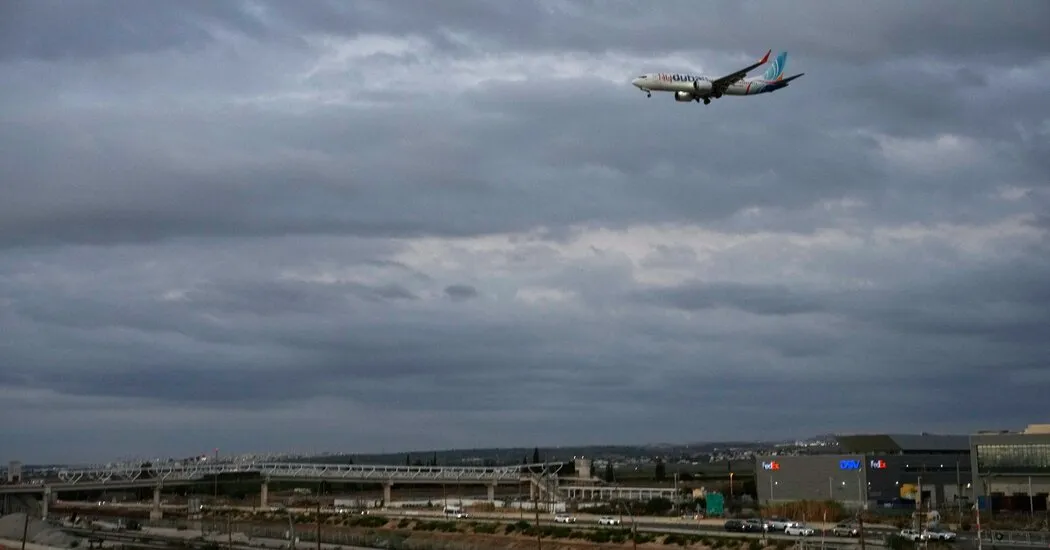
Five-year-old Nina Manes, flying home to Tel Aviv with her family in business class, needed to use the bathroom.
Her mother, Tali, stood waiting for her outside the plane’s lavatory, when she suddenly heard frightening shouts and loud bangs coming from behind the closed door to the flight deck.
What unfolded next was a harrowing chain of events that led the passengers aboard FlyDubai Flight 1073 to think that they were all about to die in a terrorist attack — but instead turned into a tale of heroism on the part of an Indian pilot and a handful of Israelis.
Hearing what sounded worrisomely like a melee, Ms. Manes, 46, said she pulled a backup pilot, seated in his uniform nearby, by the hand and prodded him to investigate.
He pulled open the cockpit door — which had been unlocked from the inside — onto a horrific scene.
There was blood all over the flight deck.
And the first officer was stabbing the captain, again and again and again.
Four Israeli passengers aboard Wednesday morning’s flight from Dubai are being hailed for racing unarmed into harm’s way, overpowering the first officer, giving the captain first aid, and making it possible for a second backup pilot to take over and land the plane safely in Saudi Arabia.
Yaniv Hayoun, in Row 11, a plumber who liked to watch a television show about air-crash investigations.
Asaf Rajuan, in Row 7, a financial planner who had narrowly escaped death last year, when an Iranian missile slammed into the apartment building next door to his own.
Tzvika Manes, in Row 1, a banking executive returning from an exhilarating two-week family vacation in Japan, the early fulfillment of his 11-year-old daughter’s wish for her bat mitzvah.
And Shota Musaev, a dentist in Row 13 who was returning from China with his wife after a weeklong trip.
But it was Mr. Manes’s wife, Tali, whose horrified screams upon witnessing the carnage in the flight deck had served as the alarm that propelled ordinary passengers into action.
And it was the plane’s pilot, Capt. Smit Machchhar, who, pushing himself to unlock the cockpit door even as he was on the floor fighting for his life, had made it possible for those passengers to save all 182 souls on board.
This article is based on interviews with more than a dozen passengers on Flight 1073 and the accounts that other passengers gave to Israeli television stations, as well as an account that Captain Machchhar gave to his country’s prime minister, Narendra Modi on Friday.
Some of the Israelis said they remembered feeling the kind of beleaguered helplessness that they felt on Oct. 7, 2023, during the Hamas-led attack on Israel, and how ordinary Israelis had rushed to defend themselves and each other when the government failed to protect them.
Some also said the situation called to mind the 9/11 attacks, and propelled them to act without hesitation, much like those on United Flight 93 who had raced forward to confront that doomed plane’s four hijackers.
Nearly all the passengers were Israelis making their way home from far-flung trips across Asia or Africa to a nation at war. Some said they had occasionally felt the sting of anti-Israel sentiment or antisemitism abroad, felt the need to hide Star of David necklaces, or told people they were from another country. Waiting to board her flight in a Dubai airport lounge, Ms. Manes said her eldest daughter, Daniella, heard a television report about Israeli settler violence, got upset and took a seat in a far corner of the room.
But the connecting flight to Ben-Gurion Airport in Tel Aviv — on an airline that had continued flying to Israel when many others hadn’t — meant being surrounded by fellow Israelis, fellow Jews, fellow Hebrew speakers.
It should have been possible, at last, to let one’s guard down.
‘Absolute Horror’
The three-hour flight began uneventfully. Almog Itali, 52, returning from Japan with his wife and two teenage children, chose a film from the seat-back video system: “Send Help,” a horror film about the aftermath of a plane crash on a remote island.
Miryam Ochayon, 24, in a middle seat in Row 6, was on her way home after 10½ months of solo traveling around Asia, from Mongolia to the Philippines, on the sort of post-military odyssey that is an Israeli rite of passage.
She was returning home in part because she had been scheduled for reserve duty in the coming weeks, and also to attend her family’s memorial service on Sunday for her brother, Evyatar Ochayon Abukasis, a sergeant who was killed at Kissufim on the Gaza border on Oct. 7, 2023, just before his scheduled discharge.
Raised in an ultra-Orthodox family in Jerusalem, Ms. Ochayon had left that lifestyle behind as a teenager. She still made a habit of saying the Jewish traveler’s prayer before takeoff but for some reason, she didn’t think to recite it when lifting off from Dubai, just after 7 a.m., she recalled.
Ms. Ochayon said she quickly fell asleep, her head on her seat’s tray table.
The Manes family, sitting in the first two rows, were exhausted from their all-night journey back from Tokyo, but still savoring what had been a particularly sweet trip.
Daniella, who had developed an obsession with Japan at age 6, had made a visual presentation with the Canva app to persuade her parents to make the trip and specifying everywhere the family should go: “culinary experiences” like sushi, cotton candy and matcha, “fashion highlights” like Brandy Melville and other stores in the Shibuya district of Tokyo. (The 7-Eleven was overhyped, but everything else was a hit, her mother said.)
A French toast breakfast was served around an hour into the flight, but Tali Manes slept through it. About an hour later, a little after 9 a.m. Dubai time, Tali Manes was on her feet, waiting for her Nina, a few days shy of 6, outside the bathroom just behind the flight deck and galley.
Suddenly, Ms. Manes said she heard “a noise you don’t usually hear” coming from inside the flight deck — “something knocking on the door.”
She turned to a backup pilot sitting a few feet away and told him something was wrong. “He was on his iPad and didn’t understand what I wanted,” she said. “I said to him, ‘Go check.’ I pulled him by the hand. I’m not an impolite person, I mean I would never do something like that. But there was this apathy.”
The man reached for the flight deck’s door. “It wasn’t locked,” Ms. Manes said. “That was our great luck.”
“What we saw there,” she said, “was absolute horror.”
Ms. Manes said she saw one of the pilots stabbing the other, with a knife of some kind, though she could not describe it in any detail.
The victim collapsed, and the attacker “kept stabbing him and stabbing him,” she said.
She said she started screaming: “He’s stabbing the pilot!”
‘I Couldn’t Let All of Them Die’
Inside the flight deck, Captain Machchhar, a 17-year flight veteran — on the floor, badly wounded and still being attacked — could feel the plane plunging to earth.
“I was so badly hurt that I had fallen to the ground,” he told Mr. Modi in the video released by the prime minister’s office. “But I knew I had to act,” he added. “I could feel the aircraft was going down.”
He reached for the door, which can only be opened from inside. “I was doing it to save myself, but I also knew I couldn’t let all of them die,” he said.
“I told myself, ‘this is the last push, Smit, do it. The door is right there.’ And then I somehow opened it.”
‘We Acted on Pure Instinct’
Mr. Hayoun, the plumber, 50, heard Ms. Manes scream “He’s stabbing him!”
His first thought, he said, was that one passenger was attacking another.
“And at the very moment I stand up and step out of my seat, the plane banks — banks very sharply to the left — and then levels out again,” he told Kan 11, Israel’s public broadcaster. “That shook me.”
The lurch of the plane made him connect the plane’s behavior to Ms. Manes’s screams, he said. He told his wife and daughters to buckle up tightly. And he ran forward to the flight deck.
Before he reached there, he said, the plane went into a steep dive that threw him sideways, onto the seats and against a cabin wall. “There was an insane G-force,” he said. “I couldn’t lift myself up.”
Ms. Ochayon said that when the plane started to dive, it wasn’t so much the angle of descent as the plane’s acceleration that was unbearable. “It felt like 10 times a roller-coaster,” she said. “Our faces — melted.”
At one point, she heard a loud cracking sound coming from the rear of the plane.
Hila Evron-Cohen, 48, was sound asleep in Seat 26C, across the aisle from her husband, when the jolt of the plane woke her. She was returning with her husband and two teenage boys from Zanzibar and Tanzania, on the last leg of a five-flight trip home that had begun Tuesday morning in the Serengeti.
As the plane nose-dived, she said, she felt her mind and body separating — and felt a fear she hadn’t experienced since Oct. 7. “It floods you,” she said. “It paralyzes you.”
At the front of the cabin, Mr. Hayoun felt the plane level off slightly. Regaining his balance, he made his way to the flight deck door.
The backup pilot was standing there, holding the door handle but doing nothing, he said. Other passengers corroborated this, saying it appeared that the backup pilot was too stunned to act.
Mr. Hayoun said he pushed past him and saw the captain on the floor just inside the door, and the first officer leaning with his knees on the instrument panel.
He said he grabbed the first officer by the throat, put him in a chokehold and pulled him backward — all while shouting for help.
Ms. Manes said her husband, Tzvika, 48, had fallen to the floor next to her from the force of the plane’s motion. “We looked into each other’s eyes, and I will never forget that look,” she said. “And he stood up to help.”
He grabbed their daughter from the bathroom, returned her to his wife, and joined the fray.
Mr. Rajuan, 44, ran forward, too. “We acted on pure instinct,” he said. “You don’t think.”
Mr. Musaev, 47, said he had started to shoot video with his phone, thinking the plane was experiencing extreme turbulence, but quickly realized it was some kind of attack and ran to the front of the plane.
In her seat, Ms. Ochayon took out her phone and started recording videos. The first was time-stamped 9:23 a.m. Dubai time — 52 minutes before the plane was scheduled to land in Tel Aviv.
‘Everyone Did What Was Necessary’
Terror had taken hold throughout the cabin.
Ms. Ochayon turned to the woman next to her and said, “I can’t die, I can’t die — I can’t do this to my mother, who already lost my brother.”
Ms. Evron-Cohen said that her 13-year-old son, Hillel, began shouting to her: “Mom, I love you! Mom, I love you!”
She understood then that she and her children were going to die.
“You spend your whole life trying to protect your children,” she said. “That they don’t get hurt, that they aren’t cold, that they aren’t hot, that they’re always comfortable, that they have food and clean things.”
Now she had no way to protect them. “That helplessness is something you cannot explain in words,” she said.
If the moment seemed to drag on forever for the passengers, in the flight deck, the struggle was quick.
Mr. Manes said that someone brought wired headsets to tie up the attacker’s wrists and ankles, and a crew member brought heavy-duty zip ties.
Mr. Musaev, the dentist, said he attached an oxygen mask to Captain Machchhar’s face and tried to stanch his bleeding, pressing on his wounds with a shirt. “He had a deep head wound, his hands were all cut up and he had minor injuries on his body,” he said. “He lost a lot of blood.”
The pilot was conscious but his pulse was weakening. Mr. Musaev said he told a crew member, “We have to land as quickly as possible, because he won’t survive.”
Mr. Hayoun remained inside the flight deck along with the backup pilot. Mr. Hayoun told Israeli interviewers that he pulled back on the controls of the plane for a few seconds, before the backup pilot, by now roused from his seeming paralysis and also bleeding from a hand wound sustained during the struggle in the cramped flight deck, took control.
Outside the flight deck, the other Israeli men guarded the cockpit door, refusing to let anyone pass, until a second backup pilot persuaded them to let him in.
In a matter of a minute or two, several realizations had swept over the Israelis on board that were nearly as jarring to their states of mind as the plane’s horrifying dive, twists and recovery had been to their bodies.
The initial threat, and the terror it had caused, were over. But they also could not be sure that they were in the clear. Israelis accustomed to being ever vigilant in unfamiliar settings now became hypervigilant. They said they trusted no one.
“There was a great deal of fear that he might have accomplices,” Mr. Musaev said of the flight officer. “That’s what we were afraid of. We started telling people to spread out around the plane, so that nobody could pull out a knife and stab us, the women or the children.”
With a new pilot flying the plane, Mr. Rajuan said that those fears did not dissipate.
“We didn’t know if the pilot was with us or not, we didn’t know who was against whom. We even started suspecting the flight attendants,” he said.
“Underneath us was only desert,” he added. “We were afraid we were being taken to a hostile country.”
Eventually, the passengers quieted down. “There were no screams, no panic, no shrieking,” Mr. Rajuan said. “Everyone understood the situation we were in and what needed to be done, and everyone did what was necessary.”
The new pilot steered the plane to a safe landing in Tabuk, Saudi Arabia, at around 9:45 a.m., despite the fact that much of the plane’s rudder had apparently broken off in midflight.
Videos showed the passengers bursting out in songs of gratitude and pride: “Hashem Yitbarach,” or “May God be praised,” and “Am Yisrael Chai,” or “The people of Israel live.”
Pragati K.B. and Pranav Baskar contributed reporting.