


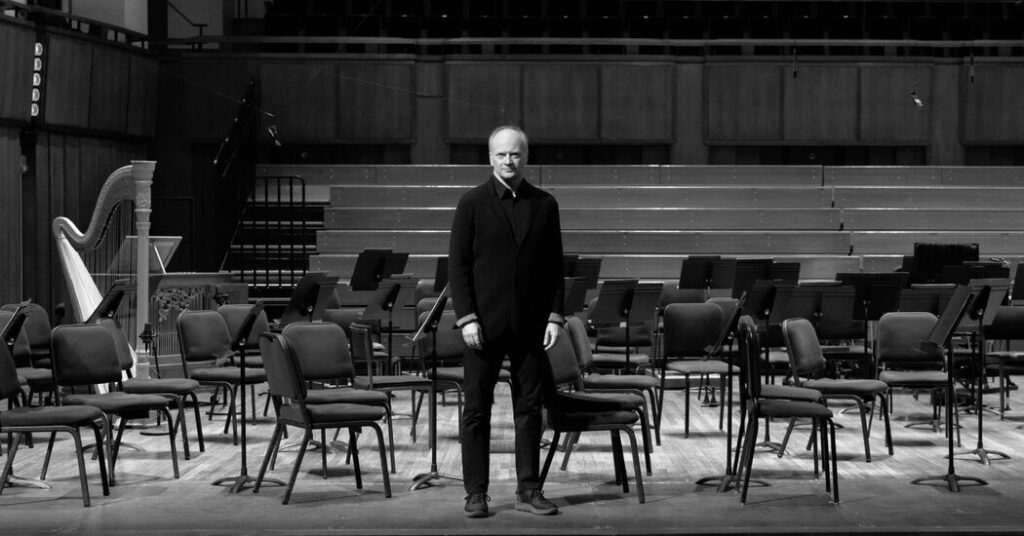
The National Symphony Orchestra on Tuesday provided the answer to the question that had clouded its future for months: where it would perform as its home, the John F. Kennedy Center for the Performing Arts, moved to shut down for a two-year renovation.
The orchestra will perform 60 concerts in six halls scattered across the Washington area. And it will embark on its first national tour in years, taking in seven cities in five states.
“It’s not been an easy time,” said Gianandrea Noseda, the orchestra’s music director. He said he was hopeful this would work for the two years the Kennedy Center board said it would need to complete the $250 million renovation demanded by President Trump.
“We will be a touring orchestra in the area,” he said. “Being at home, sleeping on our own beds. But a touring orchestra.”
The announcement comes after the center’s board, dominated by Trump appointees, voted last week to proceed with a shutdown that had been temporarily blocked by Judge Christopher R. Cooper of the Federal District Court in Washington. Judge Cooper ruled in May that the board was “derelict” in its deliberations before it originally voted to shut down the hall.
That judge also barred the board from renaming the center — built as a memorial to John F. Kennedy — to include Mr. Trump’s name. As part of last week’s vote, the board approved a workaround plan that would add, under the center’s official name, “Restored and Renovated by President Donald J. Trump.”
The board’s actions will almost certainly need to be approved by Judge Cooper. But the orchestra could not wait. Its first performance — the season-opening gala, to be held at the Music Center at Strathmore in Bethesda — is Sept. 26, less than two months away. As it is, the orchestra is extraordinarily late in announcing its season, a delay that has frozen ticket sales and marketing while leaving artists and guest conductors in limbo. The season’s programming would typically have been announced in February.
“We are starting super late,” said Mr. Noseda, who will conduct the opening concert, which includes works by Tchaikovsky, Carlos Simon and Respighi.
Leonard Slatkin, a former music director of the National Symphony who is scheduled to appear during the season as a guest conductor, said it had been “unclear whether there would be performances.”
“Most of us have been holding dates for at least a year,” he said. “I never intended to withdraw as I am devoted to my former orchestra.”
Mr. Trump’s efforts to remake the center, including by naming himself chair, have drawn a fierce backlash.
Many artists said they would boycott the center because of Mr. Trump’s actions, including the composer Philip Glass, who withdrew a symphony about Abraham Lincoln that the orchestra was to have debuted. The Washington National Opera announced it was cutting its ties with the center completely.
The orchestra decided to stay at the center, but faced a sharp decline in attendance and revenues. Mr. Noseda said he was hopeful that patrons who were avoiding the Kennedy Center would be willing to hear the orchestra at other halls.
“We can really bring out a new audience and bring the music where people are,” he said. “I hope to reach new people and get back some of the audience that had stopped coming.”
The orchestra’s announcement gave credit to Mr. Trump for this new chapter. “Both N.S.O. and Kennedy Center leadership are thrilled to expand the orchestra’s reach under the strategic direction of Chairman of the Center, President Donald J. Trump,” the announcement said. Asked if Mr. Trump was a fan of classical music, Mr. Noseda responded: “I don’t know. I don’t have any evidence of that. I don’t think so.”
The orchestra’s concerts in the Washington region next season will be at Strathmore; the Center for the Arts at George Mason University in Fairfax, Va.; Lisner Auditorium at George Washington University; Rachel M. Schlesinger Concert Hall and Arts Center at Northern Virginia Community College; the Clarice Smith Performing Arts Center at the University of Maryland; and the Lincoln Theater in Washington.
And it will embark on a national tour, with performances in Indiana, Missouri, Oklahoma, California and Nevada. In a sign that the orchestra is setting its sights beyond the Potomac River, Mr. Noseda will lead it tonight in its Hollywood Bowl debut.
Next year’s 60 concerts in the Washington region are about as many as the orchestra played at the Kennedy Center in a typical year. But it will be reaching fewer people: The center’s Concert Hall has 2,465 seats, significantly more than the halls where it will perform.
Mr. Slatkin said he was glad there was at least a resolution about the orchestra’s immediate future. Still, he said there were longer term risks in bringing the orchestra to the suburbs. “If suburban patrons get used to the orchestra in their neighborhoods,” he said, “they may be less inclined to travel downtown.”