


Progressive Democrats have romped through primaries this summer, dispatching incumbents and minting new stars of the left in deep-blue territory in New York and Colorado.
In the coming weeks, they’ll take their fight to tougher turf.
Primary elections in Michigan, Wisconsin and Minnesota will test whether Democratic voters in swingier territory have the appetite to send liberal candidates into statewide general elections where the outcome is not assured.
The view from the left: Progressives believe that, in a moment of deep frustration with inequality and the cost of living, insurgent candidates can both win primaries and turn out voters in the fall — and send their party a sign that it should return to its populist roots.
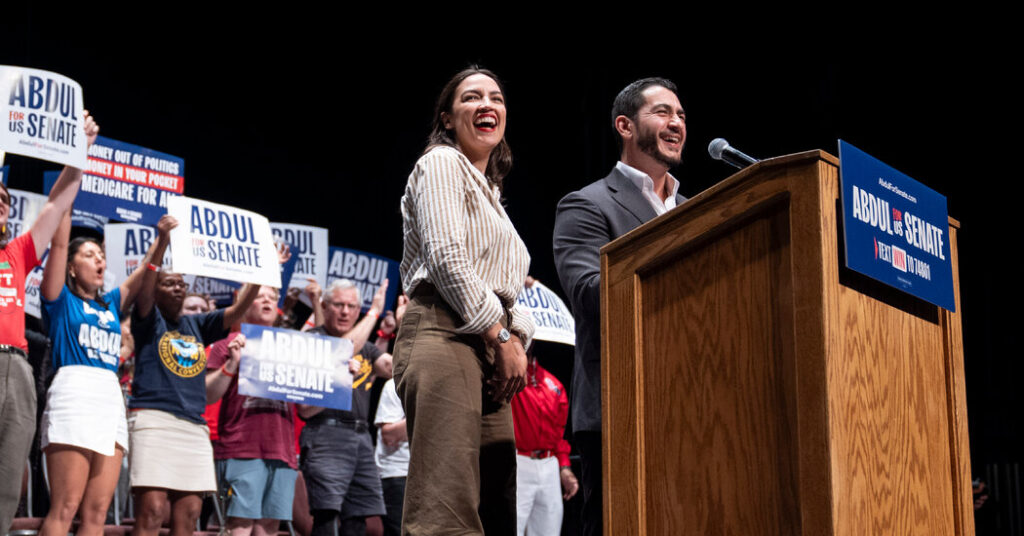
“We have to be willing to name the mistakes that got us in this mess in the first place, because it wasn’t just that Donald Trump won, it’s that Democrats lost,” Representative Alexandria Ocasio-Cortez of New York said at a rally on Sunday for Abdul El-Sayed, the progressive former public health official she has endorsed in Michigan’s Senate primary.
The pushback: The rise of these candidates has spooked moderate Democrats who argue that their party’s activist base is on the verge of nominating figures who could fumble away winnable general elections.
“We are in danger of losing some races we could otherwise win if we go too far left in states like Michigan that voted for Donald Trump a year and a half ago,” Matt Bennett, a co-founder of Third Way, a centrist Democratic think tank, told me.
Here are the races we’re watching.
Michigan
The Senate primary here pits El-Sayed, who also has the support of Senator Bernie Sanders of Vermont, against Representative Haley Stevens of Detroit’s northern suburbs. The contest has become a summertime battle royale, with tens of millions of dollars washing through the race.
El-Sayed, a former Wayne County health director who fiercely criticizes Israel’s government, backs “Medicare for all” and has a wry social media presence, seems to have a slight lead in the polls.
But Stevens, a moderate supporter of Israel who has the backing of Senator Chuck Schumer, the minority leader, has an enormous advertising advantage. She has been buoyed by nearly $30 million in spending tied to the American Israel Public Affairs Committee, plus an additional $20 million from super PACs with undisclosed donors.
There are several big questions left to answer. Is all that money making a difference? How enthusiastic are Black voters, who, polls suggest, are more supportive of Stevens? Does Michigan have enough young and progressive voters to put El-Sayed on top?
And, as my colleague Reid Epstein asked in a deep look at Stevens’s campaign, can a pro-Israel Democrat still win a big, competitive primary?
The primary is Aug. 4.
Wisconsin
The state’s Democratic primary for governor has gotten messy, to put it mildly.
State Representative Francesca Hong, 37, a democratic socialist, has been steadily rising in a crowded field, making the case that her politics will appeal to factory workers and farmers in one of the nation’s swingiest states. My colleague Kellen Browning explored her candidacy this month.
This has worried Democrats who believe that anyone associated with socialism can’t win a heartland governorship that the party sees as a bulwark for its national ambitions.
Lt. Gov. Sara Rodriguez was seen by some in the party as a viable moderate alternative — until she dropped out after revelations about mismanaged campaign funds. It led another Democrat who had previously dropped out, David Crowley, the Milwaukee County executive, to re-enter the race and immediately win the endorsement of Gov. Tony Evers, the Democratic incumbent.
All of that chaos just might help Hong. The primary is Aug. 11.
Minnesota
I know. Minnesota is not a swing state. It has two Democratic senators and a Democratic governor, and it hasn’t backed a Republican for president since Nixon. But this one is still interesting.
To replace Senator Tina Smith, Democratic voters will choose between Representative Angie Craig, who has successfully defended the southern Minnesota congressional district she flipped from red to blue in 2018, against Lt. Gov. Peggy Flanagan, who has drawn support from the likes of Sanders and Senator Elizabeth Warren of Massachusetts.
Craig has described herself as a pragmatic choice who will challenge members of her own party; Flanagan has called Craig a “corporate Democrat” and says she’s the one willing to take on bigger fights.
Gov. Tim Walz of Minnesota is staying out of it. The primary is Aug. 11.
And beyond
It’s not just statewide races. In St. Louis, former Representative Cori Bush, a member of the so-called Squad, is making another run at Representative Wesley Bell, who beat her in 2024 with the help of heavy spending from pro-Israel groups. Back in Michigan, Representative Shri Thanedar faces a challenge from State Representative Donavan McKinney, 34, who has the support of Sanders and Representative Rashida Tlaib.
We’ve rounded up more House races where incumbents face progressive challenges here.