


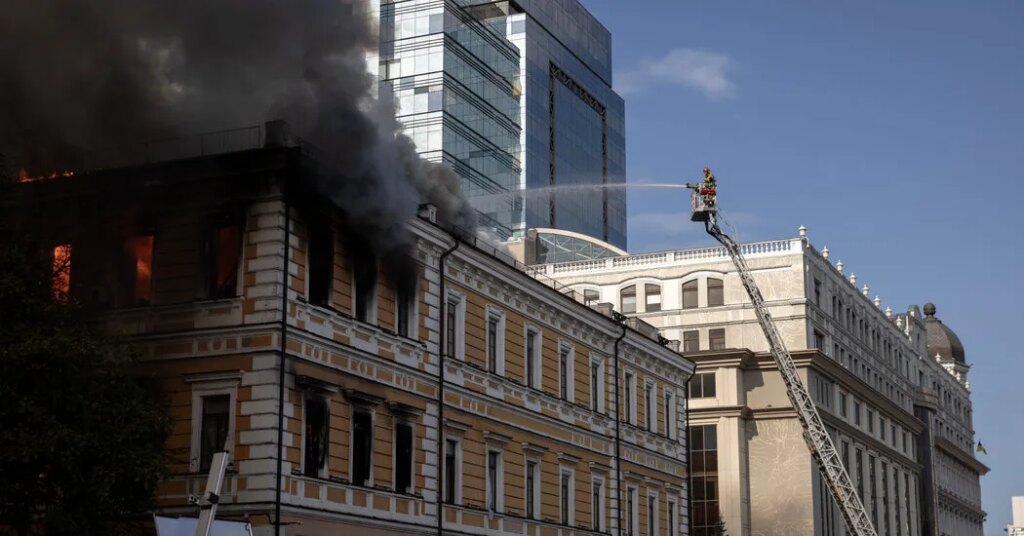
The jet-powered attack drones scream through Kyiv’s skies at hundreds of miles per hour, outracing air defenses as they slam into gas stations, bridges, power plants or civilian buildings. They arrive so quickly that those nearby barely have a chance to run.
Russia began firing these drones, which travel much faster than older propeller-driven models, at Ukraine’s capital in large numbers this summer, aiming to snuff out the city’s ability to support ordinary life. Since then, Ukrainian companies have been under intense pressure to develop an effective defense.
They are all pursuing the same goal: an interceptor fast enough to counter the threat.
The quest has taken them to farm fields across Ukraine. On one recent day, in a freshly harvested expanse of corn, operators placed a tiny jet-powered interceptor, shaped like a miniature stealth bomber, on a catapult. It launched skyward, then plunged into the soil a few yards away, throwing up dust.
Ukrainian Air Force officers who had come to watch the test groaned. They gathered with the engineers to discuss what needed fixing.
For Kyiv’s three million residents, solutions cannot come soon enough. The Russian drones are inflicting more damage and inducing more fear than the capital has experienced since the war’s earliest weeks.
The interceptor race is the latest in a series of technological duels that have pitted Ukrainian engineering against Russia’s military-industrial complex.
Engineers and military officials say Ukraine’s best hope lies in building a new class of jet-powered drones and outfitting them with artificial intelligence that can steer them into a target moving at 350 miles an hour or faster.
A year ago, Ukraine had largely solved the problem of the fixed-wing Russian drones known as Shaheds. These drones, designed in Iran, were propeller-driven and slow enough for fleets of interceptors to hunt.
Russia has since transformed the Shahed by developing jet-powered versions, making them too fast for most interceptors to catch.
The newer Shaheds also have a better connection to operators and automated guidance. Ukrainian military researchers even found a propeller-driven Shahed outfitted with a Chinese A.I. surveillance camera that they say could help identify interceptors.
In September alone, Russia launched more than 3,000 jet-powered Shaheds at Ukraine, according to the country’s air force, up from 350 in June.
The emergence of jet-powered drones has implications beyond Ukraine. The propeller-driven Shahed and its jet-powered relative have wreaked havoc in the Persian Gulf during the U.S.-Israeli war against Iran, with Shaheds even striking U.S. bases. (Ukrainian interceptors have also been used there.)
Ukraine can shoot down jet-powered Shaheds, but at a price. President Volodymyr Zelensky has said Ukraine downs about 60 percent of them, relying heavily on air-to-air missiles fired from F-16s. Each missile can cost nearly $1 million. A jet Shahed costs tens of thousands of dollars.
In a war approaching its sixth year, which is ever more a contest of economic endurance, the math does not work for Ukraine.
Nearly two dozen Ukrainian drone makers are racing to develop low-cost interceptors. Ukraine hopes to have these in wide use by November or December.
“The faster I make it work, the more peacefully I will sleep in Kyiv,” said Ihor, a designer at F-Drones, the company behind the test model that crashed in the cornfield. He, like others interviewed, asked that his last name be withheld for security reasons.
Failure is part of development, he said. On its second try, the company’s drone whizzed above the fields with a loud whine.
“I’m just a field mouse now,” Ihor said, referring to all the time he spends outdoors working on the drone with his team.
Ihor’s team plans to equip the F-Jet 80 interceptor with A.I. to find and hunt Shaheds. The team has already taken it into combat, chasing Russian drones as they cross the border in northern Ukraine. It has intercepted several, he said.
Two other Ukrainian companies also make interceptors that can catch jet-powered Shaheds, according to F-Drones. But those cost $20,000 to $70,000 each. The F-Jet 80 runs about $7,000.
Ukraine has improvised drone interceptions since the early days of the war. Helicopter crews would fly near Shaheds and shoot them down with machine guns. That was cheap and effective, but dangerous.
Oleh, a 45-year-old pilot with Ukraine’s Land Forces, flew dozens of those missions. Now, instead of guns or rockets, his helicopter carries A.I.-guided, propeller-driven interceptor drones.
Russia still mixes propeller-driven Shaheds with jet-powered versions in large attacks, so Oleh keeps flying. On one recent flight, his crew downed eight. F-Drones is studying whether helicopters could carry faster interceptors.
However they are launched, many of the cheap interceptors depend on A.I. guidance. F-Drones says its interceptors combine A.I. that recognizes and tracks targets with software to calculate how to intercept them. Like a quarterback leading a receiver, the software picks a point well ahead of the Russian drone where the two will meet.
The jet-powered Shaheds pose an additional challenge. They relay signals back to Russia through a mesh network, so operators can fly them remotely. When a Russian pilot spots an interceptor, he can try to dodge. The interceptor’s software has to maneuver in response.
There is no time to waste in developing these systems. When a jet drone struck the National Academy of Sciences building in Kyiv on Sept. 28, Anna Voitenko, 58, a professor, was inside attending a dissertation defense. She ran from the building and watched as the place where she had worked for years burned.
“A.I. is a question of saving our lives now,” she said. “Without A.I., we will not be able to compete in this arms race.”
Ukraine’s arms makers agree. “Any development now includes A.I. at some stage, at some level and in different ways,” said Mykola, the chief executive of Firebolt Engineering, a British-Ukrainian defense company.
Firebolt produces the Griffen, a jet-powered fixed-wing interceptor. The company’s engineers use A.I. to analyze flight data from combat missions for patterns that can suggest improvements to its guidance system and even to the drone’s mechanical design.
But A.I. is only half the challenge. The harder part is jet design, said Andrii Hrytseniuk, the chief executive of Brave1, a government platform that funds defense start-ups.
As it has done against problems it has faced throughout the war, Ukraine is unleashing its start-up culture. Eight of the 22 companies working on high-speed drone interceptors have already put designs through combat tests, Mr. Hrytseniuk said.
Back in the cornfields, an air force lieutenant named Andriy was pushing the developers to add another rudder to improve maneuverability. He visits the test sites daily while his soldiers put the drones through combat trials.
“It is so irritating when they fly over our heads and we have nothing to bring them down with,” he said.
He pulled up a video of one of his team’s interceptors chasing a jet-powered Shahed. As the Russian drone slowed before its final approach, the interceptor closed in. Then the gap widened, and the Shahed pulled away.
While the effort to bring down jet-powered drones is just in its infancy, the interceptors, once they go into mass production, may offer only six months’ reprieve before a new Russian innovation renders them obsolete, said Serhiy Sternenko, the founder of a charitable organization that supports the military.
Russia, he said, is likely to keep increasing the speed and sophistication of its weapons, moving from drones to missiles or hybrid systems. The next answer, he said, is probably an inexpensive surface-to-air missile.
“We always have to catch up,” he said. “Literally and figuratively speaking.”
For many in Kyiv, the drone bombardment has become too much. On the day Russia struck the National Academy of Sciences, there were several other attacks in Kyiv. Lera Burlakova, a Ukrainian military veteran, said one drone exploded near her son’s school.
The attacks continued over the following days.
“We went to sleep in the corridor, and my child told me that he hoped that if we died, we would die together,” Ms. Burlakova said.
Two days later, they left Kyiv.