


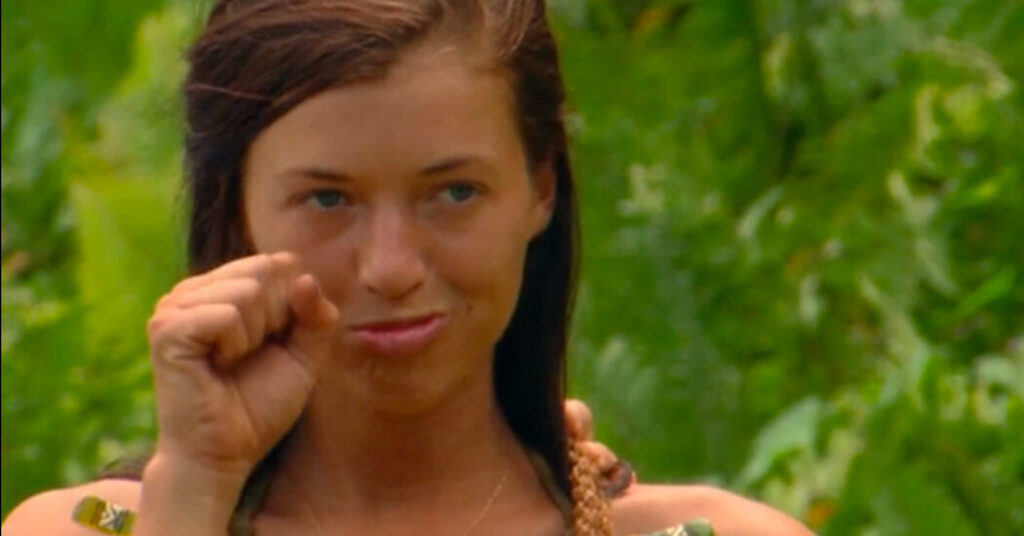
Quintavius Burdette does not consider himself a villain. Few “Survivor” villains do.
Burdette, who goes by Q, was a Season 46 contestant who returned for the reality show’s landmark 50th season, which is drawing closer to its May 20 finale. He took issue with a ranking that listed him 18th among the show’s long list of antagonists.
While it described him as “charismatic and lovable,” it also noted his tendency to switch alliances and create chaos. Most notably, Burdette used colorful confessional catchphrases — like saying he was going to “cancel Christmas” for his rivals — and refused to give in to a contestant, Liz Wilcox, who desperately wanted to accompany him for an Applebee’s reward feast.
“The villains in today’s game are more chaos creators who are just going to stand out and do their own thing, be their own selves, and not be influenced by a group,” Burdette said. “Whereas back in the day, the villain was a very, very cruel person that would just say whatever and do whatever.”
Reality television is the origin of many a villain, those strong-willed personalities viewers tune in to loathe, like Omarosa Manigault Newman of “The Apprentice” or Spencer Pratt of “The Hills.”
It was “Survivor” that helped give birth to the trope when Richard Hatch landed on a Malaysian island back in 2000.
Traditionally, villains are the ones who will do anything to win a game’s lucrative prize. On “Survivor” that has included behavior like lying about a dead grandmother, burning a contestant’s clothes or throwing out a competitor’s food.
“A celebrated villain is fantastic, and they are almost always the most popular players of a season,” Jeff Probst, the show’s host and producer, wrote in an email.
But as the show has evolved over a generation-plus, so have the definition and characteristics of the villain. Most contestants now grew up as fans of the show, and expect to be blindsided and voted out at some point by former alliance members. Today’s “Survivor” seasons are shot in fewer days (26 versus 39), so emotions do not have as long to build up.
“The betrayals don’t cut as deep because the game is shorter, the game is faster,” said Rob Cesternino, who debuted in the show’s sixth season and pioneered switching alliances.
The notion of villains and heroes in reality television seemed quaint when Hatch debuted on “Survivor.”
Hatch formed the show’s first alliance at a time when many curious viewers just wanted to see how the stranded contestants cohabitated and survived. He was widely viewed as calculating and arrogant, and his penchant for being nude raised eyebrows across prime-time television.
“Everyone hated Richard’s guts, but he played maybe the cleanest game of anyone who’s ever played on ‘Survivor,’” said Mario Lanza, a writer and historian of the show. “He never really betrayed anyone.”
Steve Granelli, a pop culture expert and a teaching professor of communication studies at Northeastern, noted that the show’s early antagonists, like Hatch and Jerri Manthey, who sometimes bickered with tribemates, were essentially deemed villains because they were seen as unlikable by many viewers.
In Season 7, known as “Survivor: Pearl Islands,” Jon Dalton, who goes by Jonny Fairplay, raised the villainous stakes.
Fairplay had never watched “Survivor” before being cast, and he binged previous seasons after ordering them on eBay. While watching the reruns, Fairplay, who has a pro-wrestling background, recalls thinking, “This show could be so much more fun with a bad guy.”
“If this is quote-unquote reality television, there’s not a script, I feel like I can do whatever I want and there’s nothing anyone can really do about it,” Fairplay said, adding, “I brought elements of Andy Kaufman to ‘Survivor’ and I felt it was successful. I think it changed reality television as a genre. I don’t think there’s the Kardashians if I don’t do what I do on ‘Pearl Islands.’”
That included orchestrating the lie about a dead grandmother to gain sympathy from his tribemates — a line that other contestants, like Sandra Diaz-Twine, said they would never cross. Fairplay, though, said he laughed about the lie with his family afterward. (“It’s a television show. Get over it, people,” he says in retrospect.)
The line differs for everyone, said Rob Mariano, who has competed five times on “Survivor,” enough to be viewed as a hero and a villain at different stages of his journey on the show.
“If you’re able to get the audience to root for you, it kind of transcends the idea of a villain,” Mariano said.
When the 20th season of “Survivor” announced its “Heroes vs. Villains” theme, some contestants were surprised to find which group they had been placed in. Diaz-Twine, who won the first two seasons she competed on, said she asked Probst how she had earned the villain label. Probst said it was because she would do anything to earn the $1 million award as the sole survivor.
It was an assessment that Diaz-Twine could not bicker with. “But I would not stab someone in the back,” she added. “I will tell you to your face.”
Women like Diaz-Twine and Parvati Shallow, who operated in a strategic fashion, have also earned labels of being villains that likely would not have gone to men making the same decisions.
“It’s definitely been a different set of criteria,” Diaz-Twine said.
The “Survivor” villain took another turn during Russell Hantz’s debut season in 2009. Hantz played the game with an arrogant, cutthroat style that amounted to psychological warfare by belittling opponents and burning a castmate’s belongings.
“Russell was really important for ‘Survivor’ at the moment, but the show ended up getting a little bit of a Russell addiction,” Cesternino said. For seasons afterward, Cesternino thought the show was seeking out Hantz-type players to cast. “They’re chasing that Russell high,” he said. “You get that pure thing once and you’re looking for more copies of that thing until it works.”
Tyson Apostol, deemed a villain on the 20th season, posits that the show’s editing is a reason that there seem to be fewer of the classic villains that were more common in the show’s earlier seasons.
For example, Savannah Louie, who played aggressively and confidently in winning Season 49, once would have been viewed as a villain, he said.
“She’s as villainous as the villains of the past, but I think that it also highlighted some of the heroic or more celebrated things that she did as well,” Apostol said. “The show is more aware of what social media will be when someone gets home.”
Probst, however, said he laughs at the notion that there is a “villain edit” or a “winner’s edit.”
“There’s no such thing,” he wrote. “We’re not shaping players to fit a narrative. They play the game, and we tell their story through their decisions. We don’t decide who a player is. Their choices do.”
Probst listed Mariano, Shallow, Diaz-Twine and Tony Vlachos as his favorite villains. “And worth noting,” he added, “four of the most popular players of all time.”
In 2024, Probst appeared on Cesternino’s podcast and said that he no longer wanted villains on the show. He later clarified his position that he did not want meanspirited contestants, but welcomed those who changed the game.
“It’s no longer just about making a big move or a massive betrayal,” Probst wrote in describing how a villain might be seen these days. “It’s about how you do it, how often you do it, and the personality you bring to it when you do it. The game didn’t get rid of villains, it just raised the bar for what one looks like.”
Videos via CBS