


The proliferation of documentaries on streaming services makes it difficult to choose what to watch. Each month, we select three nonfiction films — classics, overlooked recent docs and more — that will reward your time.
‘Le Joli Mai’ (1963)
Stream it on Ovid. Rent it on Amazon and Vimeo.
The French sociologist Edgar Morin died last month at 104, and among his many, many achievements is “Chronicle of a Summer” (1961), the pioneering work of cinema-vérité that he directed with the anthropologist Jean Rouch. I recommended the film in this column two years ago, so as a follow-up I’d suggest Chris Marker and Pierre Lhomme’s “Le Joli Mai.” Morin himself appears, briefly, around the hour-and-a-half mark, when he can be glimpsed in a montage that also features the French New Wave figures Jean-Luc Godard, Anna Karina and Jacques Rivette (along with the New Wave-adjacent Alain Resnais).
“Le Joli Mai” plays very much like a companion piece to “Chronicle of a Summer,” in which Morin and Rouch began by posing a simple query to Parisians: “Are you happy?” Marker and Lhomme are concerned with the same basic question — “Le Joli Mai” is dedicated “to the happy many” — as they seek to take France’s national pulse in May 1962, a moment that some considered “the first spring of peace,” a title card explains. It was two months after a cease-fire agreement ended the war in Algeria, which would formally assume independent status that July.
The film unfolds as a kind of diary in disarray; segments are labeled with specific dates in May, but the days are presented out of order. In the opening narration, the actress Simone Signoret indicates that the movie should be experienced with a scientist’s (or science fiction writer’s) sensibility: The goal, her voice-over suggests, is to see Paris as if for the first time, to track life there in the manner of “a detective, a telescope, and a microphone.” Near the end, Signoret asks, “Do we need a screen to understand what would be obvious to any Martian just landed on the planet Earth?”
Marker and Lhomme’s investigation spans classes and social strata. They visit a stock exchange, interviewing moneymen young and old, and spend time with a large family of rehoused residents, who finally have a home with a window. Television has become its own kind of porthole into the world (“The smaller the house, the more vital the window,” we are told), but Lhomme and Marker also capture a celebrated TV moment entering reality, as Parisians marvel at a public exhibition of the capsule from John Glenn’s space orbit that February. Striking employees share screen time with a man in his 72nd round of dancing the twist (apparently a record). Because Marker is one of cinema’s most devoted feline enthusiasts, there are also plenty of cats.
More than 60 years before our current debates about universal basic income, engineers are seen discussing how machines will affect people’s concepts of free time and self-worth. The directors interview a Dahomean student about his first encounters with Parisians and a young Algerian man about his experience of racism at a job. And chillingly, in this otherwise upbeat and eclectic reflection on France’s future, an unemployed woman makes a remark that perhaps anticipates the draw of the country’s current far right: “A dictatorship is tolerable if it’s an intelligent one,” she says. The filmmakers challenge her to imagine a dictatorship in which she’s a victim.
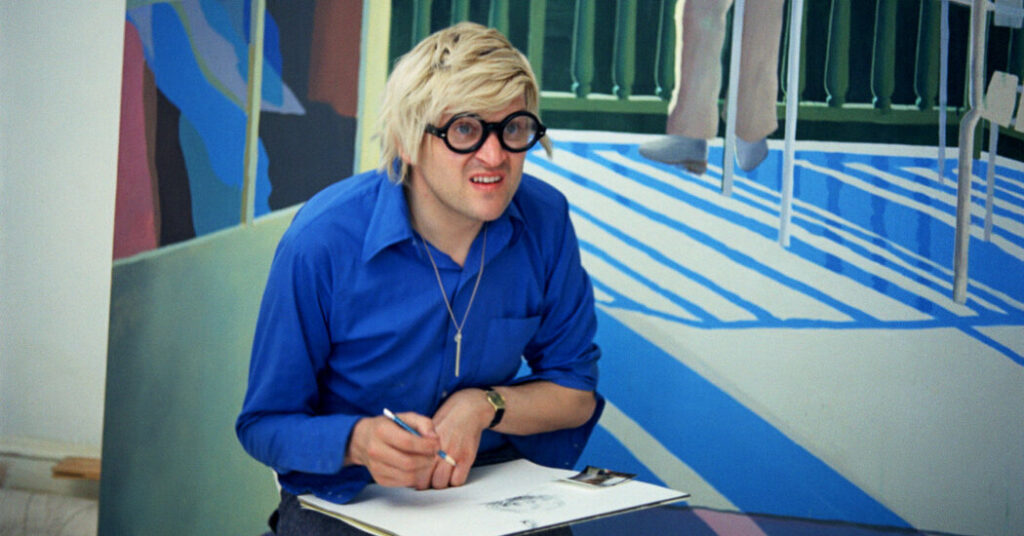
The director Jack Hazan’s film about the painter David Hockney is sometimes described as a documentary, though it is more correctly categorized a dramatized work that casts Hockney and his associates as versions of themselves. One tipoff is the stable camera setups: At various points, Hazan cuts in for tighter views or dollies alongside the artist, who died this month at 88, in ways that require advance preparation. They wouldn’t be possible for a filmmaker acting as a fly on the wall. And that is to say nothing of the frankly depicted gay sex (quite daringly filmed for the early ’70s) or the lengthy scene in which Hazan watches Hockney bathing (the shower has appropriately Hockney-esque blue tiling). The filmmaker supplies a close-up that emphasizes Hockney’s rear tan line.
Writing in The New York Times in 2019, J. Hoberman noted that when “A Bigger Splash” was first shown, critics compared it to Andy Warhol’s films, and said that Hockney was initially unhappy with the project. As in Warhol’s movies, the line between performing and existing is blurred into illegibility. A loose narrative thread traces the end of Hockney’s relationship with his frequent subject Peter Schlesinger.
But in the end, this is still a movie that shows Hockney at work — during the creation of “Portrait of an Artist (Pool With Two Figures),” perhaps his most famous painting — and offers glimpses into his creative process. Hockney cuts up a canvas that isn’t working. Photographs taken at the filmmaker Tony Richardson’s house in the South of France serve as studies for the painting (although it’s noted that the British-born Hockney has, by this point, become closely identified with scenes of Southern California — an aesthetic for which Hazan’s dreamlike style seeks a sort of a cinematic correlative). And when a gallerist tells Hockney that it’s been too long since he’s delivered, Hockney replies that the slow process of experimenting and rejecting is what gets him where he’s going: “The one picture that took two weeks really took six months and two weeks.”
In “André Is an Idiot,” André Ricciardi, a genial goofball in San Francisco who parlayed his upbeat attitude and unflagging curiosity about life into a career in advertising, decides that he’s going to document his death from colon cancer. He got his colonoscopy too late, he explains at the start. It was the biggest mistake of his life, he says — and it’s one that, over the course of this documentary, directed by Tony Benna, viewers are urged not to repeat. (The screening recommendation is now age 45 for people with average risk of colorectal cancer.)
Still, making a documentary about your imminent demise is, to put it mildly, an atypical choice. (“André being André, you never know what is serious and what is not,” his brother says of Ricciardi’s attitude generally.) Ricciardi visits a specialist in “death yells” and considers his last words. He reflects on how others have approached life with disease and debilitation. (A collector of vintage photographs of strangers, Ricciardi shows one image to the camera, to explain how a woman and her family appear to have tried to hide the effects of polio in a Christmas portrait.) He goes on a road trip with a friend to a desert stop that is, he says, “probably the farthest I’ve been from a city in my entire life.”
There is a point when it becomes difficult for Ricciardi to remain irreverent about what’s happening to him. Benna makes clear that Ricciardi’s family members struggle with that approach, too. His wife, Janice, suggests that if her husband turned earnest about his situation, none of them would know how to deal with him. Ricciardi tells his therapist that if he can no longer make his daughter Tallula laugh, he will feel like he has crossed a line. His father, who is said to be intensely private, does not appear in the project, so in an odd interlude, Ricciardi casts Tommy Chong — a colorectal cancer survivor — to play his dad. “André Is an Idiot” is not always a comfortable film to watch, but it is, in its eccentric and extremely personal way, a daring one.