


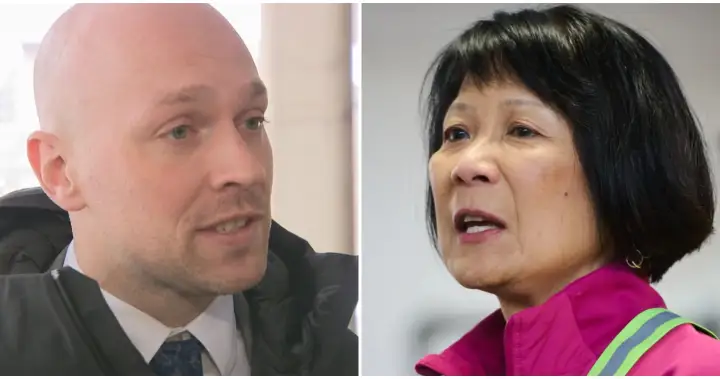
A new poll released Friday suggests Olivia Chow is holding a decisive lead over Brad Bradford in Toronto’s mayoral contest.


The Pollara Strategic Insights’ survey indicates the incumbent leads her main challenger 55 per cent to 44 per cent among decided voters, including those who have already voted.
The online poll suggests 48 per cent of respondents have positive feelings about Chow, while only 36 per cent feel the same about Bradford.
Chow leads Bradford on working with other levels of government, affordability, safety and taxes, and there is no consensus on which candidate will bring change or who will be best for the economy and jobs.
Several polls recently have put Bradford slightly ahead of Chow. Others still place her ahead of Bradford – including a Pollara survey released Tuesday – indicating there is no clear favourite, according to the research firms that publish the polls.
A Liaison Strategies survey released Wednesday puts Bradford at 49 per cent support and Chow at 47 per cent among decided and leaning voters, with three per cent choosing someone else.


Get daily National news
Get daily Canada news delivered to your inbox so you’ll never miss the day’s top stories.
In this most recent poll, Chow has lost a five-point lead she had in a Liaison Strategies poll published Oct. 13.
Another poll published Tuesday by Mainstreet Research also revealed a very narrow race with a slight advantage for Bradford. The firm put Bradford’s support at 48.9 per cent support and Chow at a “nearly equal” 47.5 per cent, Mainstreet said in a statement.
Both candidates have been hitting the pavement daily in the final week before the Oct. 26 election to reach those precious undecided voters who may push the vote slightly more on either side.
Chow is looking to secure her first full term after winning the 2023 mayoral byelection, while Bradford is seeking to become Toronto’s sixth mayor since amalgamation on Jan. 1, 1998.
Between Oct. 16 and 21, Pollara conducted a hybrid online and telephone survey of 1,094 Toronto residents aged 18 and older who are eligible to vote: 697 online panel completes and 397 live telephone interviews. Data was weighted to reflect the age, gender and regional composition of Toronto’s adult population, based on the most recent census figures. While online surveys cannot be assigned a margin of error, a probability sample of this size would be accurate to ± 3.0%, 19 times out of 20. Vote results include those who have already voted at the advance polls (26%), who were asked how they voted. This research was commissioned by CUPE Local 416 (Toronto Civic Employees’ Union).
Liaison Strategies surveyed a random sample of 1,000 Toronto residents from Oct. 18 to Oct. 19, 2026, using conventional phone and Interactive Voice Recording (IVR) technology. The margin of error is +/- 3.1 percentage points, 19 times out of 20. The margin is higher for subsamples, including decided and leaning voters.
Mainstreet Research conducted its survey between Oct. 16 and Oct. 18, 2026 with a sample size of 1,000 adults, 18 years of age or older, living in Toronto. The survey was conducted using conventional phone Interactive Voice Response (IVR) technology. The margin of error for the poll is +/- 3.1% at the 95% confidence level. Margins of error are higher in each subsample.
The Pollara Strategic Insights survey was fielded Oct. 13 to 19, 2026. It surveyed Toronto residents aged 18+ eligible to vote (695 online panel, 404 live telephone). The poll was commissioned by CUPE Local 416 (Toronto Civic Employees’ Union). It was weighted to census data by gender, age and region. It states that “because the sample includes an online panel, no margin of error applies”. A probability sample of 1,099 would carry a margin of error of +/- 3.0 percentage points, 19 times out of 20, and more for subgroups. Subgroups with an unweighted base under 100 should be read with caution, it says.
© 2026 Global News, a division of Corus Entertainment Inc.