


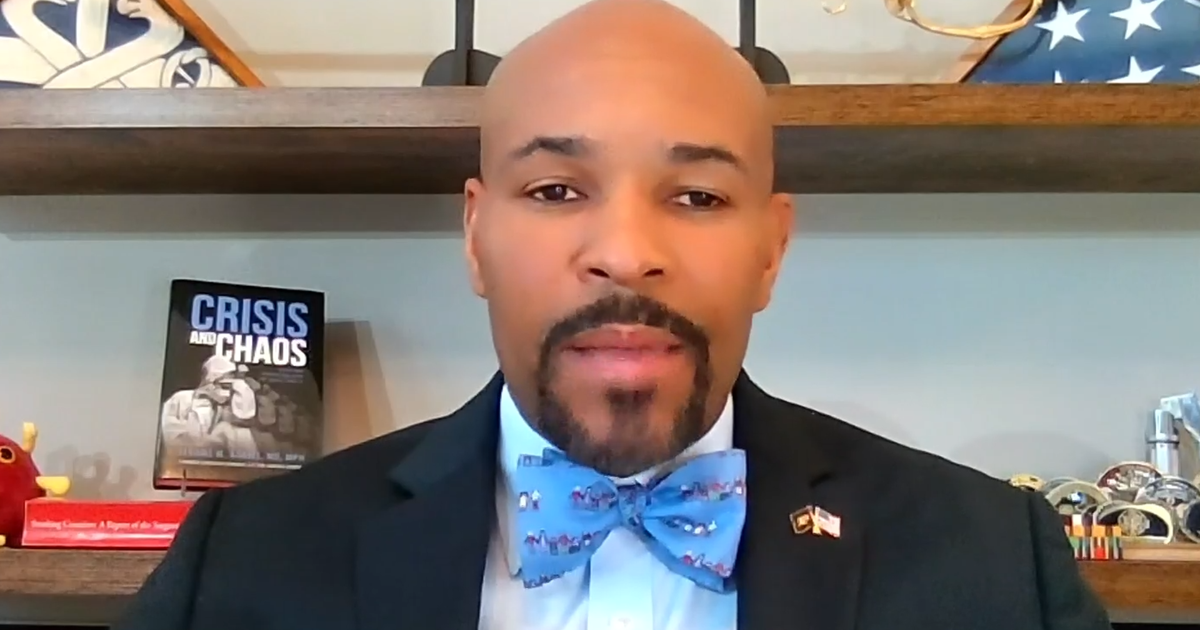
The following is the transcript of the interview with first Trump administration surgeon general Dr. Jerome Adams that aired on „Face the Nation with Margaret Brennan“ on April 19, 2026.
MARGARET BRENNAN: We turn now to former U.S. Surgeon General, Dr. Jerome Adams, who joins us this morning from Indianapolis, good to have you back, doctor. The country has been without a Senate confirmed CDC director since Secretary Kennedy fired Dr. Monarez just a month into her term. But this past week, the president nominated Dr. Erica Schwartz to lead the CDC. I know she worked as your deputy surgeon general. Do you see this as a deliberate choice by the White House to pick someone who actually does support vaccines?
DR. JEROME ADAMS: Well, absolutely. And again, we’ve talked in the past about the fact that the Fabrizio and Ward poll showed that Republicans were going to pay in the midterm elections if they continued on an anti-vaccine push. But I want to say Dr. Schwartz is a home run pick. She has an MD, a JD and an MPH and more than two decades of public service in the Coast Guard, where she was chief medical officer and in the Public Health Service, as you mentioned, which she retired from as a Rear Admiral, and it’s why I personally selected her to be my deputy surgeon general.
MARGARET BRENNAN: Do you have concerns that she will be able to, you know, conduct herself without political interference?
DR. JEROME ADAMS: Well, it’s a great, and it’s a fair question, Margaret. I’d say she is objectively the most qualified health nominee we’ve seen from this administration so far, and I want to give the President and senior HHS adviser Chris Klomp credit for tapping her, but that said, my optimism as yours comes with a healthy dose of caution about the environment around Dr. Schwartz. We’ve seen this before, as you mentioned with Susan Monarez, and just last week, the acting CDC director held back an MMWR report showing COVID vaccines reduced ER visits in healthy adults this winter. Further, Dr. Schwartz still has to get through Senate confirmation, where she will clearly be pitted against RFK on vaccines. And recent history tells us, if she’s confirmed, she will be under real threat to follow ideology over evidence in what is a vaccine skeptical HHS, while also confronting a growing measles outbreak, low CDC morale and ongoing DOGE cut impacts.
MARGARET BRENNAN: Well, the secretary will be before Congress again this week. You mentioned measles. The U.S. is already at over 1,700 measles infections in the first four months of this year. We did note that when Secretary Kennedy was under oath this past week, he seemed to change his rhetoric around the MMR vaccine. That’s the vaccine that prevents measles infections. Take a listen.
[START SOUND ON TAPE]
REPRESENTATIVE MADELEINE DEAN: Can you tell me, can you tell all of us, is the MMR vaccine safe and effective, yes or no?
HEALTH AND HUMAN SERVICES SECRETARY ROBERT F. KENNEDY JR.: The MMR vaccine–
REP. MADELEINE DEAN:Yes or no?
SECRETARY ROBERT F. KENNEDY JR.:Yes.
REP. MADELEINE DEAN: Thank you.
SECRETARY ROBERT F. KENNEDY JR.: It’s safe for most people.
REP. MADELEINE DEAN: Can you agree that getting the vaccine is a lot safer than getting measles?
SECRETARY ROBERT F. KENNEDY JR.: Yes.
[END SOUND ON TAPE]
MARGARET BRENNAN: So that was a qualified response, but it was still an endorsement, it seemed. Is he persuaded by the evidence, do you think?
DR. JEROME ADAMS: Well, he also acknowledged under oath it was possible vaccination could have saved the life of a child who died in the recent Texas outbreak. So these statements represent his strongest public endorsement of the measles vaccine to date. Not coincidentally, as you mentioned, this tepid support comes after reports the White House has instructed him to stop talking negatively about vaccines and head of- ahead of midterms. But the qualified and tempered answer he gave, it still risks, Margaret, sending mixed messages at a time when we’re facing our worst measles resurgence in decades, falling vaccination rates, preventable outbreaks, incurring millions in state and local costs and thousands of days of school missed.
MARGARET BRENNAN: Yeah, and I know that CDC data shows that the vaccine rate- the vaccination rate has been sliding. I did note this one exchange that I also want to play for you here, because the secretary was asked a few times about past statements both he and the president of the United States have made linking Tylenol use in pregnant women to autism in their children. A Republican lawmaker Blake Moore of Utah told Kennedy that his own 10-year-old son Winnie is neurodivergent, and he said that Kennedy’s remarks were hurtful. Listen to this.
[START SOUND ON TAPE]
REPRESENTATIVE BLAKE MOORE: I was underwhelmed with what we ultimately put out. My wife was hurt, and she felt for a split second until she came to her senses and we talked about this, that there was any way she was responsible. We don’t even know if she took Tylenol during her pregnancy, but that- that was a hurtful moment for her.
[END SOUND ON TAPE]
MARGARET BRENNAN: But on this, Kennedy did not give ground. He is still saying that studies showing there is no linkage are, quote, garbage. What is the reality?
DR. JEROME ADAMS: Well, the reality is that for pregnant women dealing with fever or significant pain, Tylenol remains one of the safest and most studied options we have. And suggesting otherwise without evidence, is dangerous. It’s irresponsible, and as you heard the Congressman say, it is extremely stigmatizing towards parents and risks real harm to moms and babies. The science moves forward with data, not with dogma and with dismissal and the garbage he was referring to was a Danish study of 1.5 million children that came out, and it presents queer- clear, high quality evidence that pregnant women who use Tylenol do not have an increased risk of autism. In fact, in that study, they had a lower risk of autism.
MARGARET BRENNAN: I want to ask you about what the president announced yesterday in the Oval Office. He was surrounded by podcaster Joe Rogan, a number of Navy SEALs, and he said he wants to boost federal research into psychedelic drugs and make them more available.
Specifically, they were touting this one drug, ibogaine, I believe, is how you say it.
DR. JEROME ADAMS: Correct.
MARGARET BRENNAN: What do Americans need to know about this particular drug and the uses of it?
DR. JEROME ADAMS: Well, first of all, almost 15 million Americans experience serious mental illness every year, and among veterans, that burden is about one in four. So it’s clear we do have to accelerate rigorous evidence based research into promising treatments. Early studies of psychedelics such as ibogaine and psilocybin have shown potential for rapid improvements in symptoms and functioning in treatment resistant cases. So yesterday’s executive order, it directs 50 million in research funding, instructs the FDA to prioritize reviews for vouchers for breakthrough- breakthrough therapy, and directs the FDA and DEA to ease barriers under Right to Try. Also, importantly, it maintains full FDA and DEA oversight, so it’s not legalization or reclassification of psychedelics, but the content, while reasonable, was- was overshadowed by the rollout, as you mentioned with Joe Rogan, it was a spectacle resembling a WWE promotion. And people such as Kevin Sabet actually have said, well, this actually overshadows the substance that we’ve seen, and what I think could be a productive EO.
MARGARET BRENNAN: Okay, executive order. All right, thank you there, Dr. Adams, always good to get your insights. We’ll be right back.