


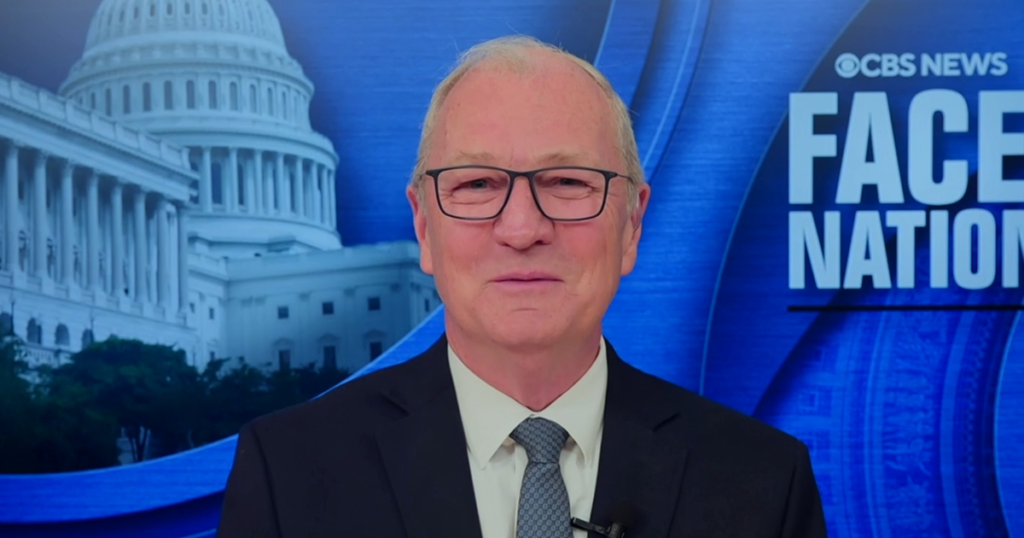
The following is the transcript of the interview with Sen. Kevin Cramer, Republican of North Dakota, that aired on „Face the Nation with Margaret Brennan“ on Oct. 18, 2026.
MARGARET BRENNAN: Welcome back to Face the Nation. We go now to North Dakota Republican Senator Kevin Cramer, who joins us from Bismarck. Good morning to you, Senator.
SENATOR KEVIN CRAMER (R-ND): Good morning. Good to be with you.
MARGARET BRENNAN: I want to ask you about Ukraine. I know you just recently traveled there. A number of your departing, some retiring, Senate Republican colleagues have made clear they were very upset with President Trump’s decision to waive the Lindsey Graham sanctions off of Russia and buyers of Russian oil. Senator Cornyn said Lindsey would be appalled. Senator Tillis said it is beyond irresponsible, unconscionable to capitulate to Vladimir Putin. Where do you stand?
SEN. CRAMER: Well, Margaret, on this topic and a whole bunch of others, I think capitulating to a bully generally means they’re going to make more demands going forward. That’s the problem with taking sort of a business negotiation approach to negotiating with a thug, which is what Vladimir Putin is. So I share those colleagues‘ positions on it. However, I also have to acknowledge that we are few weeks or a couple weeks from an election. One of the important topics of the election is the cost of diesel fuel. It’s really an important issue here in North Dakota.
As Representative Turner pointed out, and I was cheering him on, our allies throughout Europe have been buying energy from Vladimir Putin and funding his war machine for decades and they should stop right now. Having said all of that, I expect this will be a short-term pause, and I certainly hope so, because one of the things that President Zelenskyy asked of us when I was with him on last Thursday, I think it was Thursday or Friday, was that the president would fully enforce the Lindsey Graham sanctions bill. And I still take that position.
MARGARET BRENNAN: Yeah. And some European Union countries do continue to buy fuel products. India and China would be the largest purchasers who would be hit by these tariffs. So do you think the president would actually even post-election trigger the tariffs on China?
SEN. CRAMER: Well, I certainly hope that he does, Margaret. Again, speaking of thugs who will never agree to terms, or at least not continue to agree to terms that would be negotiated, Xi Jinping is another one. I think we have to start approaching our geopolitical negotiations the way that we ought to, and not the way that you do in a boardroom. You know, this is not a finality outcome to a dictator. The outcome of a negotiation with a dictator is more, you know, asking for more demands. And we have to start playing nice with our friends and treating our adversaries like they are adversaries.
MARGARET BRENNAN: You just met with President Zelenskyy. As you know, President Trump publicly blasted him again this week and said Ukraine needs another new president. Let me ask you something specific about how they defend themselves and conduct this war. Starshield is a U.S. military program which Ukraine says that they use to fire into Russian-held territory. Last night, Secretary Rubio said Ukraine does not currently have access to it, but they have asked to use it to fire deep inside of Russia. When you were in Ukraine, as I understand it, you were presenting a proposal to President Zelenskyy to allow for Starshield access expansion if Ukraine stops striking Russian energy assets. What can you tell us about that proposal and what is the status of it?
SEN. CRAMER: So that, you’re right, that was a proposal we brought to President Zelenskyy. Senator Wicker, Roger Wicker, the chairman of the Armed Services Committee, came up with that idea. President Zelensky was enthusiastic about it. He said, I’d do that tomorrow. I would absolutely stop attacking Russia’s energy facilities if I could have access to targeting capabilities, which is what Starshield would provide them, to go deep into Russia and attack their attackers, in other words, their launch facilities, kill the archer, not the arrows. Of course, the third thing he asked for was the capacity to get licensed to jointly produce, co-produce Patriot missile interceptors, which would help him defend against these much faster now jet-powered drones and missiles coming into Ukraine.
So his requests were three. They were simple. And I agree with all three of them. So I would hope we can get to that point where- remembering that what President Zelenskyy is protecting are civilians. Russia has chosen to go after civilian populations, while President Zelenskyy has simply gone after the launchers and, more importantly, the war machine’s funding source, which is energy.
MARGARET BRENNAN: Right, bringing us back to where we started here. Ukraine has resumed, just even overnight, hitting Russian oil refineries. They hit the St. Petersburg oil terminal. Russia has been targeting the energy infrastructure inside of Ukraine. Secretary Rubio said there are talks ongoing. Have you talked to Secretary Rubio about your exchange with President Zelenskyy? Who in the administration is actually trying to bring this to a close?
SEN. CRAMER: So I have not talked to Marco, although as I was watching your previous segment, I just said to my staff, I wish I would have called Marco. But obviously he and others are involved with it, including Steve Witkoff and Jared Kushner. I thin– but I worry, Margaret, that there’s a disconnect. Once again, I go back to my earlier illustration. There’s a disconnect between traditional, mutually beneficial negotiations between business people and the difference between somebody’s protecting humanity itself versus somebody who wants to take humanity down. And so I worry about that. So who exactly is negotiating these things? I don’t know who’s calling shots. But at the end of the day, I think the president is, you know, it’s where the buck stops. And I think he accepts that.
MARGARET BRENNAN: So is Senator Wicker presenting this deal to the White House? What are you doing with what you negotiated?
SEN. CRAMER: Oh yeah, yes, for sure. I mean, we had talked to people in the White House at the Department of War and to the State Department even prior to meeting with President Zelenskyy.
MARGARET BRENNAN: So do you join your colleagues, Senator Tillis and Senator Shaheen, in calling for an investigation of what has happened here in terms of whether U.S. government officials knew that Starlink was going to be interrupted, which impacts Ukraine’s ability to use its drones and defend its people?
SEN. CRAMER: Well, I certainly support investigating what was the source of that decision, if in fact it was a decision at all. It may very well have been some sort of a technical glitch. I don’t know for sure or whose call it was. So far, nobody’s taking credit for making that call or the blame for it. So I do support some sort of an investigation. Certainly Congress itself could and should investigate. I think the letter that Senator Shaheen and Senator Tillis are talking about would be an inspector general investigation, perhaps.
But, sure, we want to get to the bottom of it. In the meantime, what’s more important is that that power is put back on full scale and that we actually enhance Ukraine’s ability to hit these launch facilities inside of Russia, deeper inside to like 300 kilometers, I think is what President Zelenskyy was asking for.
MARGARET BRENNAN: Yeah. President Zelenskyy said today that it has been restored, but has been throttled back. And in terms of that Starshield expansion, as you say, no deal yet. Let me ask you about something closer to home. You said this summer that you „hate,“ that was the word you used, President Trump’s decision to import foreign beef tariff-free because it’s not America first, wrongheaded and threatens the future of U.S. food production. The White House did not reverse course, despite those tough words from you. How negative has that been for your state? And is that going to infect- affect- I should say, the enthusiasm for voters to show up in November? Are these ranchers just so ticked off they’re not going to vote?
SEN. CRAMER: Well, first of all, Margaret, it won’t have any effect in North Dakota in the election cycle. We don’t have a governor up. The president’s obviously not up. We don’t even have a senator up. And we’re gonna have an overwhelming Republican victory here. Having said that, it’s very discouraging to our ranchers. Again, I think there’s a misunderstanding of commodity cycles, commodity economic cycles. Ranchers rebuild their herds when prices are high. Their herds are obviously made much smaller when prices are low. That’s why- that’s why the countercyclical effect of commodity prices are well known to us, and why it’s discouraging when we reduce or eliminate the barriers to to importing somebody else’s beef, which is not nearly as safe or as high quality, at the cost of- at the cost of- our local ranchers. They rely on these higher prices. And by the way, I doubt that bringing in a bunch of Argentine beef is going to bring the price at the grocery store down–
MARGARET BRENNAN: –It hasn’t–
SEN. CRAMER: –It has not. But it will hurt the market price of the cattle themselves. Now, ranchers are going up against lots of other problems as well, including the concentration of meat packing in the United States, where about a third or more is literally owned by the Chinese and the Brazilians. So they’re going up against a lot of things, but their input costs are also higher. They don’t come down because the price of a cow goes down. But yeah, so I still strongly oppose it, and I think it was wrongheaded.
MARGARET BRENNAN: Right. Well, I wanted to get your insight on that because we’re seeing that dynamic in other states as well, including Kansas. So, Senator, thank you so much for your time today. We’re going to have to leave it there. We’ll be right back.