


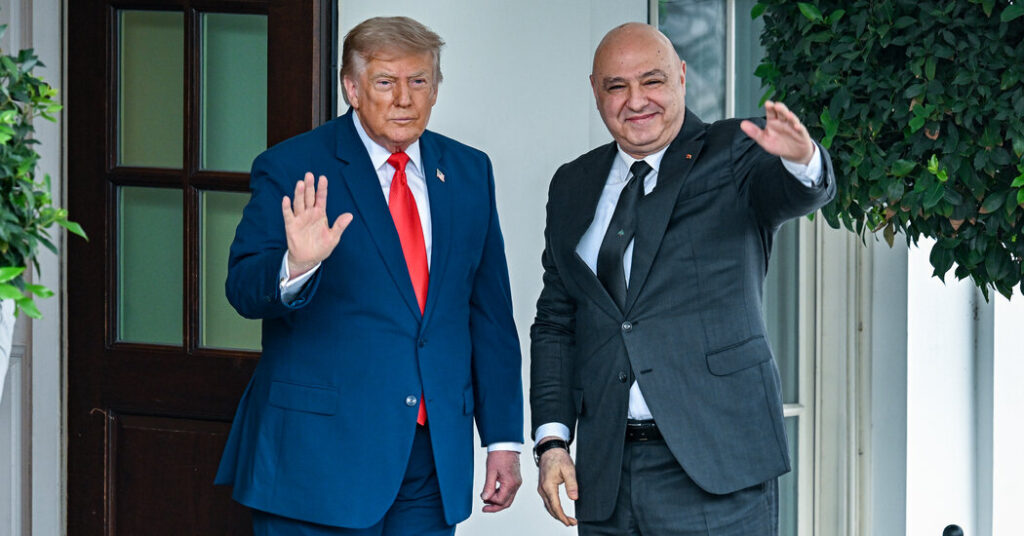
President Trump said he was ordering his administration to allow direct flights from the United States to Lebanon, ending a prohibition that has been in place since Hezbollah hijacked a flight in 1985.
The surprise announcement, which Mr. Trump made on his social media platform after visiting with President Joseph Aoun of Lebanon, comes as the war with Iran escalates. It ends a restriction imposed by the Federal Aviation Administration that banned U.S. carriers from flying directly to Lebanon after Hezbollah hijacked TWA Flight 847, which started a 17-day standoff in which a U.S. Navy sailor was killed.
“I am hereby directing my Administration to allow all U.S. airline carriers to fly directly to Lebanon so that Americans can easily visit this beautiful land,” Mr. Trump wrote in a post that made no mention of the reason for the initial ban. “Hopefully, other Countries will do the same.”
It was not immediately clear when the Trump administration would formally undo the ban, or whether U.S. carriers would take advantage of the policy change to schedule flights to Beirut.
The F.A.A. said in a statement that it “looks forward to working with airlines and our interagency partners to advance the president’s directive and support the safe return of flights to Lebanon.”
Mr. Trump’s decision potentially increases the American footprint in Beirut amid an uncertain security situation. Lebanese and Israeli leaders are working under a U.S.-brokered framework to negotiate a withdrawal of Israeli troops from areas occupied as part of a campaign against Hezbollah that Israel waged in parallel with the war in Iran. The U.S. State Department said on Monday that withdrawal operations had begun in three “pilot zones,” though by Tuesday, both sides acknowledged that Israel had resumed gunfire.
Hezbollah, a militia backed by Iran that has long functioned as a de facto government within Lebanon, has rejected the U.S.-backed peace process, which would involve its disarmament.
The U.S. efforts to end hostilities between Lebanon and Israel, which have vacillated between states of frozen conflict and all-out war for nearly 80 years, are currently at odds with Mr. Trump’s more dour outlook for Iran, where peace talks have broken down and regular bombardment has resumed. But the two spheres of conflict remain linked, given Iran and Hezbollah’s ties, and the influence that the militia group wields in Lebanon’s internal affairs.
On Tuesday, Mr. Trump said he “would speak to Hezbollah” to help advance a resolution to the conflict, particularly if Mr. Aoun requested it.
“I will speak to people that a lot of people think I shouldn’t be speaking to and things work out,” he added.