


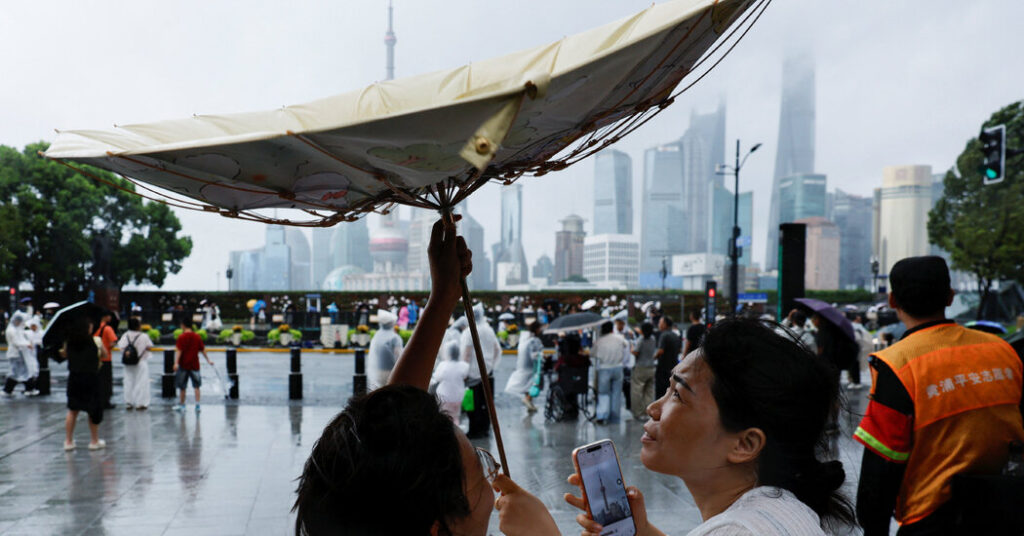
A powerful tropical cyclone buffeted China on Sunday evening, prompting the authorities to evacuate more than a million people on the country’s eastern coast and cancel hundreds of flights, as the storm continued its long path of destruction across the Pacific Ocean.
After forming near the Marshall Islands last month and traveling what meteorologists said was an unusually long distance, Dolphin pummeled Okinawa, Japan, injuring six people and cutting power to thousands over the weekend.
It made landfall on Sunday evening near Yuhuan, a city in Zhejiang Province on China’s southeastern coast. The storm had winds as strong as 94 miles per hour, or 151 kilometers per hour. More than 1,000 flights in Shanghai were canceled as the authorities warned that the eastern coast would continue to experience heavy rains this week.
As residents wrangled umbrellas that were being flipped inside out by the powerful winds, the Shanghai Tower — the third-tallest building in the world — was stabilized by a mass damper, an ornate pendulum-like weight suspended on one of its upper floors, according the Chinese state broadcaster, CCTV.
The storm also intensified monsoon rains in the Philippines, disrupting maritime transportation and causing some areas to flood.
In some parts of Manila, residents waded through waist-deep waters, where some children also played, while others sheltered in emergency evacuation centers.
The Philippine meteorological agency warned in a Monday advisory that certain regions could still get up to 200 millimeters, or about eight inches, of rain that day.
“Numerous flooding events are likely, especially in areas that are urbanized, low lying, or near rivers,” the agency said. “Landslide likely in moderate to highly susceptible areas.”
Dolphin, which takes its name from the Chinese white dolphins that live in Hong Kong’s waters, is one of three tropical storms currently active in the northwest Pacific. Joining it are Chan-hom (a type of sandalwood tree in Laos) and Peilou (a migratory bird in Macau).
All three monikers were picked by an international typhoon committee that allows its 14 member countries to take turns naming storms.