


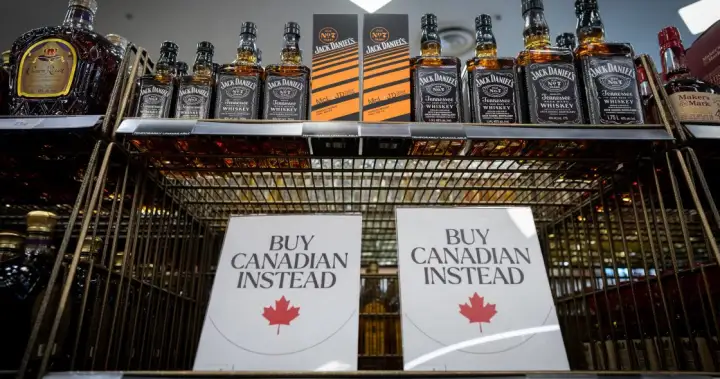
The future of U.S. booze in Canada is being seen by many as a key bargaining chip ahead of critical trade negotiations in Washington focused on U.S. tariffs, after boycotts that have kept American booze off most Canadian store shelves for over a year.


That leverage, experts say, isn’t just about finances, but also political pressure.
“There seems to be some political angst in the United States from those senators and members of Congress hearing from their local businesses that these sales are down significantly. Canadians are the number one customer,” says Andrew DiCapua, principal economist at the Canadian Chamber of Commerce.
“So that is a point of leverage, for sure, and at the end of the day, this is a political decision.”
Last month, U.S. President Donald Trump announced a fresh round of 50 per cent tariffs in response to “discriminatory” measures by Canada. Trump signed three executive orders to justify the tariffs, including for the provincial and territorial boycotts on American alcohol products.
Those tariffs are scheduled to go into effect on Aug. 19.
As Prime Minister Mark Carney works ahead of that deadline, Conservative Leader Pierre Poilievre this week criticized Carney, saying he “backed down” to multiple American demands, including splitting of net revenues from the Gordie Howe Bridge, which Canada paid to build.
Poilievre urged Carney not to give any more concessions to the U.S., including pushing provinces and territories to put American booze back on store shelves.
The majority of Canadians have supported keeping U.S. alcohol off Canadian store shelves, according to the latest survey data.
“If you are an absolute devotee of Kentucky bourbon or wines from the Willamette Valley in Oregon, then you might be a bit grumpy about it,” says Karl Littler, senior vice-president of public affairs at the Retail Council of Canada.
“I think most Canadians understand that this is a pretty existential set of negotiations for the Canadian economy, at least for the near term. And so I broadly get a sense that there’s public backing for [the boycotts].”
Related Videos
But how much money is at stake if Canada were to make further concessions on U.S. alcohol in these trade negotiations?
How much U.S. booze does Canada buy?
In early 2025, virtually all alcohol retailers regulated by individual provinces and territories were told to remove those U.S. products from store shelves, as the “buy Canadian” movement saw Canadians prioritize locally made options in response to Trump’s tariff policies and repeated suggestions that Canada should become the “51st state.”
At first, this led to many empty shelves, and millions of dollars in products not available for sale, though Alberta and Saskatchewan have since reversed those measures.


Get breaking National news
Get breaking Canada news delivered to your inbox as it happens so you won’t miss a trending story.
The specific executive order Trump signed on U.S. alcohol products said, “comparing the period from March 2025 through February 2026 to the same period in 2024-2025, Canadian imports of U.S. alcoholic beverages decreased by approximately 81 percent (from approximately US$718 million to approximately $137 million).”
“We’re talking a total value from a U.S. exporter’s perspective of about a billion dollars Canadian that’s dropped to more like a couple of hundred million. So those are big numbers,” says Littler.
A statement from the Liquor Control Board of Ontario (LCBO) in March 2025 said “LCBO is the importer of record for all U.S. alcohol products into Ontario, with annual sales of up to $965 million.”
British Columbia’s annual sales of U.S. booze was about $220 million in 2024, according to a statement from the Liquor and Cannabis Regulation Branch in response to a Global News request sent Monday.
The Nova Scotia Liquor Commission and New Brunswick Liquor each confirmed to Global News Monday that their annual sales from U.S. alcohol totalled roughly $42 and $40 million respectively in the fiscal year leading up to U.S. tariffs being imposed in 2025, while the Prince Edward Island Liquor Control Commission confirmed sales of U.S. alcohol topped about $10 million for the fiscal year 2024-25.
The Newfoundland and Labrador Liquor Corporation said Monday in response to Global News that their annual sales of U.S. booze totalled roughly $26 million before being removed from store shelves, and the Yukon Liquor Corporation sold approximately $2.3 million in U.S. alcohol products during the 2024 calendar year.
Other provinces and territories either did not respond to requests from Global News by publication or were not able to provide figures.
But these quoted dollar amounts, although representative of sales lost from U.S. alcohol products, are not necessarily losses to Canada’s economy and local retailers. That’s because, in many cases, those empty shelves have been filled with other products.
In its 2025 annual report, the Societe d’alcool du Quebec said that after it removed U.S. alcohol from store shelves in March 2025, “we took advantage of this opportunity to feature Quebec products in the freed-up spaces.”
Quebec has since said the province is open to allowing U.S. alcohol back, but only if there are trade concessions from the U.S. such as reductions in tariffs for key sectors such as forestry, aluminum, and manufacturing.
“It definitely is a boon to Canadian winemakers and Canadian spirits distillers as well and even some of it may spill over to Canadian brewers as people make sort of substitutional choices,” says Littler.
Although this means Canadian retailers likely aren’t feeling the financial hit as much as producers in the U.S., the longer those products are kept off stores shelves on this side of the border, the more tense negotiations may become with the U.S.
“The longer that the Canadian and provincial governments can sort of put up with these restrictions politically with the United States, the more impact that they will have. But of course, this seems to be a significant irritant,” says DiCapua.
“If it doesn’t mean securing a new trade agreement, which would be very important to the Canadian economy in terms of reducing or lifting uncertainty, allowing the investment to come in as well as getting tariff-free or at least low tariff access to the United States, then maybe that is a decision that might need to be considered, for sure.”
© 2026 Global News, a division of Corus Entertainment Inc.