


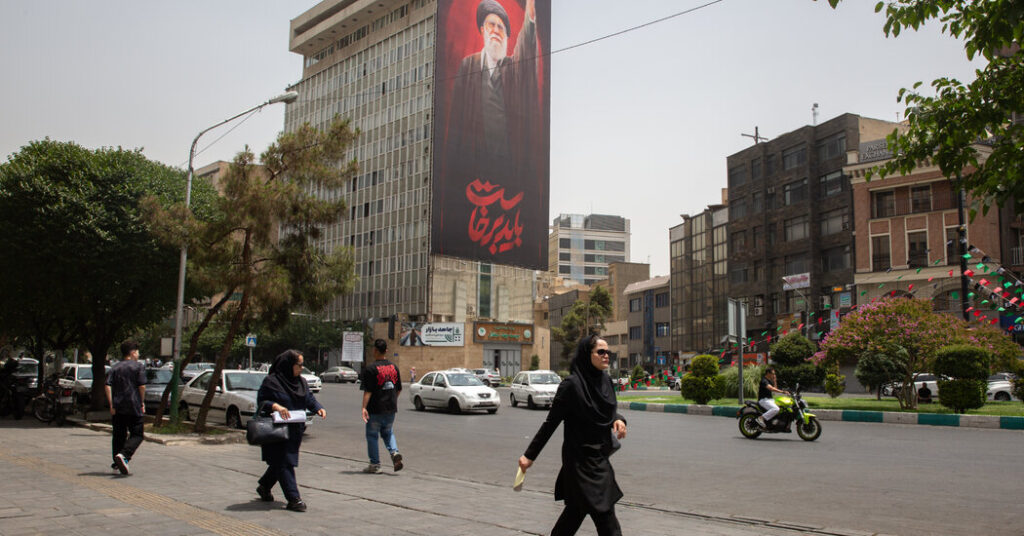
The United States carried out airstrikes against several targets in Iran on Tuesday, hours after revoking a waiver allowing the sale of Iranian oil around the world, in a dual response to what the Pentagon said were Iranian attacks on three commercial ships transiting the Strait of Hormuz.
The military’s Central Command said on social media that it had hit more than 80 targets with precision munitions.
“U.S. forces struck Iranian air defense systems, command and control networks, coastal radar sites, anti-ship missile capabilities, and more than 60 Islamic Revolutionary Guard Corps small boats in and near the strait to degrade Iran’s ability to continue attacking international commerce flowing through the international trade corridor,” the military’s post said.
The attacks on the commercial ships, including a Saudi oil tanker and a Qatari liquefied natural gas carrier in waters off the coast of Oman, threatened to disrupt the resumption of energy supplies from the region and derail the preliminary accord between Washington and Tehran to reopen the strategic waterway.
President Trump approved and ordered the Iran strikes while attending a NATO summit in Turkey, according to a U.S. official who spoke on the condition of anonymity to discuss the conflict. The official confirmed that Mr. Trump had met with senior U.S. officials in Ankara, including Gen. Dan Caine, the chairman of the Joint Chiefs of Staff; Defense Secretary Pete Hegseth; and Secretary of State Marco Rubio. They reiterated that the attacks were a result of Iran’s attacking nonmilitary ships, and asserted that the Iranians had chosen the path of aggression despite being well aware of the consequences.
Tehran has not claimed responsibility for the ship attacks. After the U.S. strikes and re-imposition of sanctions on oil sales, Iranian officials announced in a series of statements that the United States had violated the June 18 agreement intended to end the war.
Negotiations between Iran and the United States have been paused until after the multiday funeral ceremonies for Ayatollah Ali Khamenei, the supreme leader who was killed on the first day of the war.
Although the United States and Iran have agreed to restore access to the strait — with Mr. Trump declaring the waterway open to unrestricted navigation — the preliminary accord does not stipulate exactly how that should happen, and assigns to Iran the task of allowing the long-blocked traffic to get through. Iran has insisted that commercial ships sail near its shore, in a channel under Iran’s control, but many vessels are using American help to take a route near the Omani coast.
Without the waiver, which was issued by the U.S. Treasury, Iran can no longer sell its oil on the open market for dollars — at least not openly. The exemption was supposed to last for 60 days, the length of the cease-fire that Mr. Trump has celebrated, prematurely, as a peace agreement.
The United States long relied heavily on sanctions in an effort to limit Iran’s nuclear development. The waiver was part of a strategy to boost the accord’s chances of success by giving Iran a taste of the riches it could bring in from resumed oil sales around the globe. The theory was that those inside Iran seeking a peace deal would gain leverage over the military leadership that has opposed any agreement that might limit the country’s nuclear options.
Earlier on Tuesday, after the ships were attacked but before the American response, Mr. Trump seemed to downplay the conflict with Iran as he met with NATO leaders in Ankara, Turkey.
“The war with Iran — or whatever you call it, it’s not even a war,” Mr. Trump said. “It’s a military operation. It’s a denuclearization, that’s really what it is.”
Iranian state media reported early Wednesday that sounds of explosions were heard in Bandar Abbas, Qeshm and Sirik, all in Hormozgan Province along Iran’s southern coast near the Strait of Hormuz. The province is central to Iran’s military and commercial presence around the strait, a key global shipping route.
Iran’s state broadcaster said the locations that had been hit appeared to be the same ones targeted in earlier attacks during the conflict. The Hormozgan governor’s office said there had been no reports of civilian injuries so far.
The attacks on the three ships and the American military response on Tuesday threatened to tilt the region back into a spasm of violence that last surged nearly two weeks ago. The back-and-forth also laid bare the challenges to restoring prewar levels of traffic through the strait, a crucial conduit for oil and gas shipping.
The U.S. military conducted strikes on Iran on June 26 in retaliation for an Iranian attack in the Strait of Hormuz a day earlier, hours after Mr. Trump called the Iranian action a “foolish violation” of the fragile cease-fire between the two countries.
U.S. Central Command said in a statement at that time that it had struck Iranian missile and drone storage locations and coastal radar sites as a “powerful response” to the Iranian attack. The American strikes concluded after about 90 minutes, and included attacks by American fighter jets against four Iranian sites along the Strait of Hormuz and on Qeshm Island, a U.S. official said.
Mr. Trump said earlier in a post on social media that Iran had launched at least four one-way-attack drones on June 25, one of which hit the upper deck of a “large and very expensive Cargo Carrying Ship,” adding that the United States had knocked down three other drones. He added that the ship, though damaged, was able to continue on its way.
Iran’s strike on the vessel, the Ever Lovely, a container ship that was passing near the Omani side of the strait, appeared to be the first known Iranian attack on a commercial vessel since the signing of a preliminary peace agreement between Tehran and Washington.
David E. Sanger, Tyler Pager, Erica L. Green and Shirin Hakim contributed reporting.