


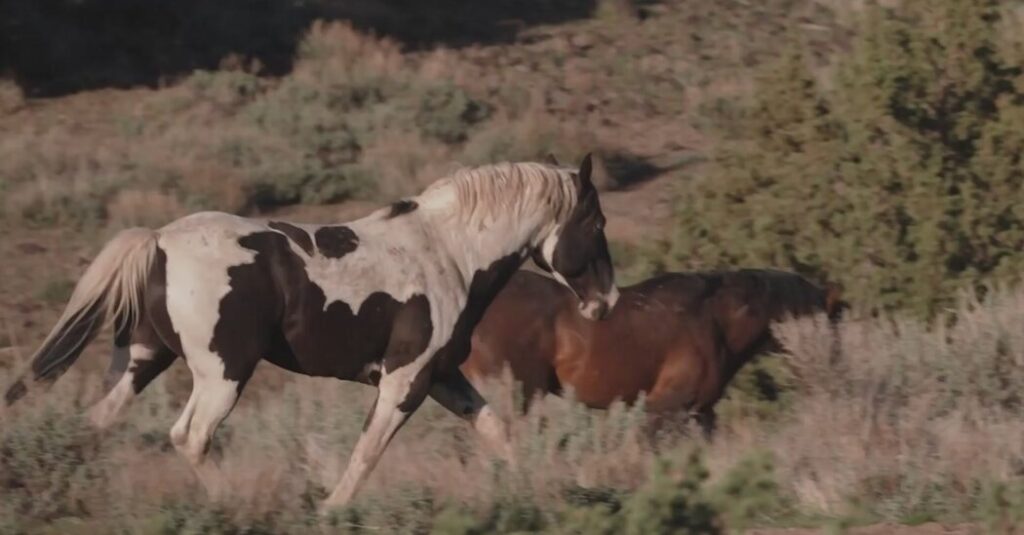
They once had run free through the desert mountains of the West, a multicolored band of 68 wild mustangs that had never been saddled or corralled.
Then the federal government rounded them up with helicopters, as it has with tens of thousands of other mustangs, in an attempt to control wild populations on public lands. The horses were held for years in a feed lot in Idaho while the government tried to find them what it called “loving homes.”
Abruptly this March, the government found a home. Whether it was loving didn’t seem to matter.
The horses were packed into echoing metal trailers and trucked 1,800 miles east to the pens of a hard-luck livestock trader in Ohio named Brandon Jones, who bought them for $25 each.
A day later, two double-decker cattle trucks pulled up at midnight, loaded the mustangs and quickly drove off into the night.
From there the mustangs disappeared. They never appeared at a public auction. The trader won’t say where they went. Wild horse advocates suspect the horses were shipped to slaughter.
But that’s not the government’s concern — it got what it wanted: two more trucks of wild horses off its books.
It wasn’t the first time, or the last. In the past year, the government has shipped the trader one truckload of mustangs after another. And not just him.
An examination of government records by The New York Times found that all over the country the Bureau of Land Management, the agency in charge of protecting wild horses, is quietly selling thousands of horses to buyers like the one in Ohio. Slaughtering wild horses is illegal, but the bureau’s actions create a loophole that enables people to get mustangs on the cheap and then quickly resell them to be exported alive, processed into cuts of meat and sold abroad.
Livestock inspection records show mustangs sold by the government soon ended up on trucks bound for slaughter plants in Canada.
The U.S. government’s sales of wild horses were once rare, but started to rise after President Trump took office. In 2025, they more than doubled to 3,700 horses, according to bureau records.
In that time, the bureau has sent about 500 horses to Mr. Jones. They came from all over the West — the windswept ridges of Cedar Mountain in Utah, the canyons of the Clan Alpine wilderness in Nevada, the high meadows of Twin Peaks, Calif., and the carved red rock hoodoos of Adobe Town, Wyo.
In an interview, Mr. Jones said he was able to resell the horses quickly though he didn’t advertise online or even post a FOR SALE sign at his corral. He would not say where the horses went and denied selling any to slaughter.
The government can spend more than $3,000 to capture a mustang and bring it to market, but sells each for as little as $25. A horse can fetch up to $750 at a slaughter plant. The potential for profit keeps buyers coming.
By selling mustangs at a huge loss, animal welfare organizations say, the agency in charge of protecting wild horses is, instead, subsidizing their destruction.
“The B.L.M. is saying to the public that slaughter is off the table, but they’re doing it in plain sight using a third party,” said Clare Staples, who runs a wild horse sanctuary in Oregon called Skydog Ranch. “There are simple steps the bureau could take to end this, but they are turning a blind eye. And the only ones getting punished for what is going on are the horses.”
The bureau did not respond to questions about its sales or make leaders available for comment. An unattributed statement from the agency said it “remains dedicated to placing animals into good homes, protecting their welfare and upholding its statutory responsibilities on behalf of the American public.”
About 73,000 wild horses roam federal public lands in the West, where they are protected from hunting or capture. For decades, in an attempt to keep the population sustainable, the bureau has rounded up 9,500 on average each year and offered them for adoption. But it finds adopters for only about half.
The rest go into a labyrinth of feedlots and pastures that the bureau calls “the holding system.” The system now stores 58,000 wild horses at an annual cost of $100 million. Caring for them eats up most of the bureau’s $142 million wild horse budget.
Over the years, bureau leaders have floated various lethal proposals for reducing the herds, including using sharp shooters, selling horses directly to slaughterhouses and building a gas chamber. But Congress — aware that the public wants mustangs protected — has barred the bureau from spending any money to kill healthy wild horses.
The recent surge in sales is not the first time the Trump administration has taken actions that indirectly enable horses to be sent to slaughter. During Mr. Trump’s first term, a program that paid people $1,000 to adopt a wild horse had similar results.
Project 2025, a policy paper by the Heritage Foundation that in many ways has acted as a blueprint for the second Trump administration, has argued that the bureau needs to be able cut costs by killing horses and said that Congress “must enact laws permitting the B.L.M. to dispose humanely of these animals.”
There are alternatives to the roundups that have left so many horses in storage. For 20 years, the bureau has had access to inexpensive fertility-control drugs delivered by dart gun. They have been used effectively to control a few wild herds, and the government’s own experts have repeatedly urged the bureau to use them more widely.
But because the bureau is spending so much on storage, it has little left to make the changes that would save it from storing more.
From wild horses to domestic livestock
Because the bureau has been unable to stop horses from coming into the storage system, it is now focused on getting them out.
While the bureau can’t kill wild horses, it can use a series of bureaucratic maneuvers and financial transactions to transform them on paper into domestic livestock, stripping their legal protections.
Here’s how it works.
First the bureau has to show a wild horse can’t be adopted. It does this by posting hundreds of horses at a time on its online adoption site. After a horse has three one-week listings with no takers, the law permits the government to designate it as unadoptable.
Then it can be put up for sale.
That’s an important legal distinction because a wild horse that is adopted retains its federal protections. One that is sold loses those protections immediately.
A sold horse still can’t be legally killed — at least not yet — because the buyer is required to sign a contract promising not to slaughter the horse or “knowingly” sell it to anyone who intends to resell it for slaughter.
But if the buyer resells to a middleman without asking questions, the buyer is safe from prosecution.
The middleman has not signed a contract with the bureau and is free to legally sell the mustang to slaughter.
The bureau is outspoken that it does not let horses go to slaughter, even through middlemen. But it has a big incentive to get mustangs off its ledgers.
The government estimated that not having to provide years of care for the 3,700 horses it sold in 2025 saved about $56 million.
While quietly selling truckloads of horses to private traders, the bureau plasters its website with photos of loving owners hugging and kissing their mustangs.
“Every wild horse or burro placed into a good home represents a win for the animals, the American taxpayer and our public lands,” the acting division chief of the bureau’s National Wild Horse and Burro Program said in a news release this winter praising the surge in sales. “We’re not only saving millions in taxpayer dollars, we’re also helping ensure our wild herds have the resources they need to thrive.”
Wild horse welfare organizations said the sales undercut the intent of the law.
“The B.L.M. is using sales in a way that was never intended by the law to send young, healthy wild horses into the slaughter pipeline,” said Patricia Miller, the director of American Wild Horse Conservation.
The Ohio horse trader
Brandon Jones appeared out of nowhere in the wild horse world last spring and quickly became the bureau’s biggest buyer, bureau records show.
He got his start in mustangs after two of his previous livestock auction businesses folded, leaving a string of debts.
On a weekday this spring, a dozen newly arrived mustangs grazed in his pasture near the town of Wauseon, Ohio. Mr. Jones, 35, was working outside his barn in dirt-crusted boots and a worn ball cap.
When approached by a reporter from The Times, he was at times friendly and at times agitated. He spoke for two hours but refused to say specifically what had happened to the horses he purchased from the government, other than to insist that none had gone to slaughter.
He said he sold horses only two or three at a time to good owners. “I’m not dealing with traders,” he said. “I’m dealing with a farmer, come up the road, who wants to buy a horse.”
Shown photos and video of the trucks of horses that left his property at midnight — taken by a local wild horse lover and shared with The Times — he questioned whether it had happened.
“Could have been cattle,” he said.
To buy large numbers of mustangs, Mr. Jones had to get approval from top officials in the bureau. His application stood out.
Nearly all of the other buyers who have qualified over the years have well-established mustang sanctuaries. Not Mr. Jones.
He had no ties to the wild horse world and no history of working with mustangs. The application asked what veterinarian would care for the horses. He listed an office an hour away from his land with a website that says it treats only small animals.
On Facebook, he was friends with a number of livestock dealers, but no wild horse rescues.
For a year his application sat at the bureau with no action. Then, in March 2025, a federal court ordered an end to one of the bureau’s leading ways of offloading horses — the program that paid adopters $1,000 per horse.
A few weeks later, Mr. Jones’s application was approved.
During the interview at his corral, he declined to share sales records showing where the hundreds of horses he received went. Over the course of discussing his business, he did not mention any training or the challenges of finding owners for wild mustangs, but he spoke about five of the region’s slaughter traders, who he knew by name, and the current price of horse meat.
He denied selling mustangs to the traders.
He said it was wrong to see him as a bad guy. By reselling mustangs, he said, he had saved the government millions.
“Shouldn’t I be getting a thank you?” he asked.
All the missing horses
Other people all over the country are flipping sale horses at a smaller scale.
In April, the bureau trucked 200 mustangs to a dusty fairground in Poteau, Okla., for a two-day “adoption event.”
“This is a great opportunity to find your next partner and give a good home to a wild horse or burro,” the bureau said on Facebook.
A few people showed up to adopt a companion animal, but most gravitated to mustangs the bureau had already designated “unadoptable” and bought bunches of large horses that could be quickly resold.
There is no official tracking mechanism for these horses, but the bureau brands every horse it captures with a distinctive serial number on its neck, so there are ways to identify where some end up.
The brands of at least 55 of the mustangs sold at the Oklahoma event showed up a few days later in Kansas and Texas, where the horses had been resold to large livestock auctions frequented by slaughter buyers, according to sales records gathered by wild horse protection groups.
The pattern has repeated at more than a dozen events. Wild horse organizations say they have documented more than 250 mustangs that were bought from the bureau and quickly dumped in the past 12 months but said they have most likely missed many more.
The average age of the horses they documented was 5 years.
“It used to be rare that we’d see a mustang at the auctions, and if we did, they were usually old,” said Ms. Staples, from the Skydog Ranch sanctuary. “But now we’re seeing a huge influx, and most of these horses are young — 2 or 3 years old. They are the easiest to train and should be easy to adopt.”
She bought three mustangs at one of the auctions and put them on her Oregon preserve.
“We are only able to save a few,” she said. “Most go to the kill buyers.”
Tracking the sales
There are small clues to what may have happened to the wild horses sold to Mr. Jones.
Four showed up late last fall at an auction in Tennessee frequented by slaughter buyers, and a local mustang trainer alerted the bureau.
The bureau did not pause sales to Mr. Jones after the alert. About a week later, records show, it shipped him 68 more horses
Mr. Jones said the horses in Tennessee were the result of just one bad sale to an irresponsible buyer.
Another clue emerged at the Canadian border.
The United States has no horse slaughter plants. The industry here was shut down in 2011, so horses are now exported to Canada. Until June, when exports were stopped amid concerns over a New World screwworm outbreak, they also went to Mexico.
Mr. Jones lives about an hour from the main Canadian horse export crossing.
For years, Canadian border inspection records show, trailers going through that crossing had no evidence of mustangs.
Last summer, a few weeks after Mr. Jones received a load of 97 mares, export records show that one of the largest exporters of slaughter horses to Canada, an Ohio man named Fred Bauer, shipped two trucks of horses to Canada. Grainy photos of the trailers’ interiors taken by border inspectors show some of the horses had distinctive government wild horse brands.
Mr. Jones denied that his horses went to Canada through the exporter, saying, “I’d never deal with Freddy Bauer. Me and Freddy Bauer don’t get along.”
Reached by phone, Mr. Bauer declined to say whether he had bought mustangs from Mr. Jones. When asked where Mr. Jones’s horses were going, Mr. Bauer said, “We all know what Brandon Jones is. Where do you think they’re going?”
He would not elaborate but added that it would be simple for the authorities to track the horses.
“The government put Brandon Jones in charge of this whole wild horse situation,” he said. “There’s all kinds of records. So they ought to be able to find out what he’s doing if they want to.”