


We arrived at sunset and the seaside town of Pizzo was at full tilt — families wandered the main piazza in their best outfits, locals packed the church, street cats nibbled scraps outside restaurant kitchens preparing for the summer evening rush.
I had traveled by train to Calabria, the southernmost tip of Italy’s boot, with my husband, Pontus, his camera in hand. It was a region that, despite our many years living in Italy, remained largely unknown to us. Its reputation abroad has been overshadowed by stories of the ‘Ndrangheta, Calabria’s organized crime syndicate, and the exploitation of migrant farmworkers.
Yet Calabria possesses an alluring, kaleidoscopic culture, compounded over thousands of years by successive arrivals: the ancient Greeks and Romans, Byzantines, North African Arabs, Normans, medieval monks and pilgrims, and Spaniards, all leaving traces in the region’s architecture, dialect, cuisine and celebrations.
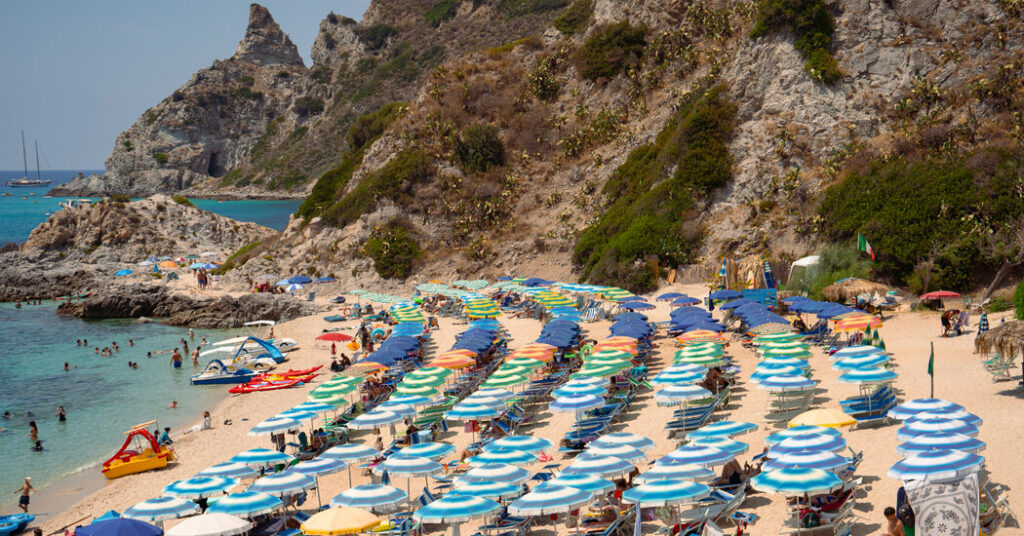
For my own visit, I chose the most traveler-friendly part: the Costa degli Dei, or the Coast of the Gods, so named by the ancient Greeks, who believed such exquisite gem-colored seas and rugged cliffs must be home to the gods themselves.
Fortresses, Cliffs and Tartufo
Pizzo was our first stop — the northernmost of a string of beachside towns with train stations. The town’s piazza is flanked by a monolithic Aragonese fortress from the 14th and 15th centuries — Castello Murat, named after the Napoleon-appointed king of Naples who was executed there. Below it, the Gulf of St. Euphemia stretches to the horizon. It was a short walk down to the Seggiola beach where, the following morning, we swam in the limpid water.
Afterward, we hailed one of the open-air, three-wheeled utility trucks known as Apes that serve as cash-only taxis, and rode to the Church of Piedigrotta. The cave church was carved from the cliff, legend says, by shipwrecked sailors in the 1600s. A local artist later filled it with haunting religious sculptures carved from sandstone.
Pizzo has two delicacies: tuna and tartufo — chocolate-covered hazelnut ice cream with a liquid chocolate center. Invented decades ago, the treat is served at every gelateria in town, and proved impossible to stop eating.
Festivals, Caves and a Custodian of Tradition
A canceled train the previous day had foiled our visit to Vibo Valentia, with its Norman castle, archaeological museum, Greek walls and a music festival where I’d hoped to see tarantella, the ecstatic dance ubiquitous at Calabrese celebrations. In theory, the Costa degli Dei is well-suited to car-free travel, with rail stations close to town centers and beaches. In practice, four of our trains were canceled over six days. The region is courting tourism, but mostly with added flights rather than improved train infrastructure.
Celebrations punctuate the year in Italy, but in August, Calabria is saturated with them. After another train cancellation, a taxi drove us to Parghelìa and its fish sagra, a local food festival. Throngs at picnic tables in the street dined on abundant seafood, with a wait staff and cleanup crew composed entirely of children. But the last train was leaving before the band and any tarantella got going.
The next morning in Zungri, an inland town, we wandered through an otherworldly settlement of caves. A micro-version of Matera without crowds, the village has a mill, a wine press, barns and homes chiseled into the mountainside’s sandstone. Scholars generally believe the homes were occupied between the seventh and 12th centuries.
On a rural road near the caves, we arrived at a gate with a hand-painted sign: Asfalantea. This sanctuary of Calabrian traditions is the creation of Franca Crudo, a champion of the region who, in her trademark kerchief and apron, has become a social-media celebrity.
“It’s about preserving the traditions of our grandparents and great-grandparents, and bringing this land the recognition it deserves,” said Ms. Crudo, surrounded by hanging ropes of red Tropea onions and pink Papaglionti garlic.
Many seek her out for lessons in ancestral bread- and pasta-making; the day includes preparing dough with heritage grains, cooking together and visiting Zungri’s cave village — rounded off with singing and tarantella. “And absolutely everyone wears the kerchief and apron like me,” she beamed.
Cruising the Coast of the Gods
Arriving by sailboat, the ancient Greeks were staggered by Costa degli Dei’s beauty. The best way to appreciate this coastline remains from the sea. Pontus and I headed to the Port of Tropea, catching the Costa degli Dei Tours boat, captained by a pair of wisecracking brothers. They navigated our mostly Italian group along the mesmerizing waters and jutting cliffs bristling with Mediterranean scrub, pointing out caves and sandy coves linked to legend. As the boat dropped anchor by Riace and Praia i Focu — Platonic ideals of Mediterranean beaches — everyone on the boat cannonballed, dived or jumped into the turquoise sea.
Back on the boat, the brothers served aperitivo: bruschetta and a plastic cup of white wine. With Calabrese folk music playing, one brother took me by the hand and led me through my poor impression of tarantella. A more informed pair demonstrated, and our boat-mates burst into applause. Pretty festive for 11:30 in the morning.
Tropea, Ravishing and Touristy
We docked back in Tropea, a town so ancient that its origins are shrouded in legend: Its purported founder is Hercules. The centuries-old Santa Maria dell’Isola sanctuary is Tropea’s awe-inspiring landmark, a striped church enthroned atop a promontory in the sea, beaches flanking either side.
At Stella del Sud, a no-frills fish stall in the town’s produce market, we feasted on garlicky mussels and fried seafood, and visited Donna Maria for gelato and granitas with local fruits like mulberries and bergamot. We stocked up on provisions at Enogastronomia Lorenzo — a purveyor, since 1905, of high-quality Calabrese wines and regional specialties, such as the fiery ’nduja and chiles that define Calabria’s spicy cuisine.
Tropea is lined with 17th- and 18th-century patrician villas, many built flush at the town’s precipice edge, alongside monuments like a commanding Norman church from 1163. In its cliff-top landscape and aristocratic architecture, the town is ravishing. Yet it’s smothered by spritz bars, flip-flop shops and rip-off restaurants, making it hard to register its beauty amid the sun-tanned hordes snapping up Tropea fridge magnets and chile charms.
Close to midnight, Tropea’s center remained shoulder-to-shoulder, but by the sea, the beach was nearly deserted. A half moon, deep orange, was low on the horizon, and the Santa Maria dell’Isola promontory was illuminated in a sulfury spotlight like an old movie set. We waded into the still-warm, transparent water: a transcendent night swim.
Twirling Giants and a Magical Dance
We’d wanted to stay at an agriturismo, a farm stay in Ricadi, which encompasses the most emblematic stretches of the Costa degli Dei, like the rocky Capo Vaticano headland, and is the agricultural heartland where Tropea’s famous onions actually grow.
Agriturismo Pinturicchio, close to Ricadi’s train station, turned out to be more of a bare-bones house with a vegetable patch. Yet like a chummy youth hostel for grown-ups, guests formed friendships in the restaurant garden, and the owner, Alfredo Ferraro, proved to be an indefatigable resource, ferrying guests all over the area and whisking us off to Byzantine towers, little-known lookout points and the spectacular beaches of Grotticelle and Formicoli. Fortunately, he strong-armed us into a day trip to Scilla — home, in myth, to the six-headed Scylla who attacked Odysseus’s crew, now a fishing town of medieval homes on the water’s edge, with a long beach and famed swordfish sandwiches.
Salimora was another reason we were drawn to Ricadi. The lush garden restaurant and bar overlooks the sea — a paradise of rustic minimalist design and local-ingredient cooking. Stylish couples claimed spots in the field for a sunset aperitivo, as we shared wood-fired sourdough bread with figs and Parmesan.
“This place is one of many projects where young people are returning from northern Italy to create something new in Calabria,” said the owner, Vittoria Artesi. “Many more would like to return, but it’s a difficult choice, because Calabria invests in tourism but doesn’t invest in health care, schools and transport.” La Meridiana Residence, where Ms. Artesi maintains simple guest rooms by the sea, is next in line for her contemporary reinvention.
At dark, we headed to our last sagra. In tiny Carìa, a crowd of thousands was eating terracotta-cooked local beans, as giants danced through the streets. The twirling giants, with drummers marching behind them, are a fixture of Calabria’s festivals, representing the thousand-year-old legend of Mata and Grifone — a Sicilian princess and an exceedingly tall Arab warrior who married and became the mythical parents of the population of Messina.
On a stage, a band began to play new Calabrian folk songs on an organetto accordion, a battente guitar, a lyre, castanets and a tamburello — all regional instruments. Barbecue smoke and children’s soap bubbles drifted through the air, illuminated by string lights. At last I had found what I’d been chasing all week — the buoyant crowd linked arms to dance a chaotic but heartfelt tarantella.
It was a summer evening belonging wholly and gloriously to Calabria.