


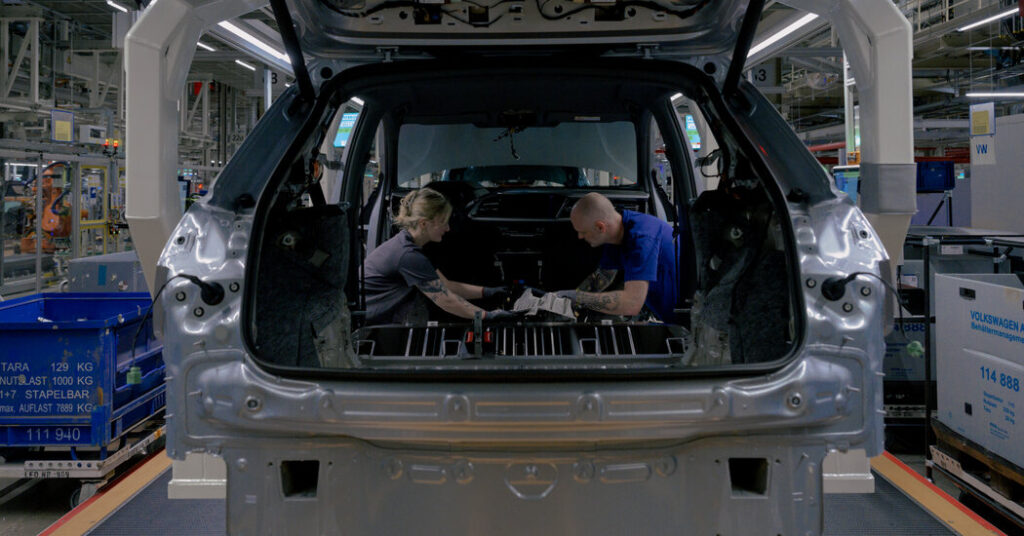
Volkswagen said Thursday that it would cut the number of models it offered by as much as half to reduce costs and better compete with Chinese companies. But the German carmaker did not say what those changes would mean for workers who have been bracing for large job cuts and factory closures.
The plan, released after a board meeting, seemed to be a tacit acknowledgment that the company had gotten too big and complicated and needed to slim down to survive the global shift from fossil fuel cars to electric vehicles. That transition has upended many established carmakers and enabled the rise of Chinese automakers.
In recent days, German press reports had suggested that the company was preparing to lay off 100,000 workers by the end of the decade and close four factories in Europe.
Such drastic cuts would be out of character for Volkswagen and German industry, which tend to prefer gradual changes. Labor representatives and political leaders from the German state of Lower Saxony have a majority on the company’s 20-person supervisory board and had signaled that they did not support deep cuts.
Still, some pain seems inevitable. The company said it would aim to produce nine million cars a year, compared with a goal of 12 million before the Covid-19 pandemic and 10 million more recently. In a video statement, Oliver Blume, Volkswagen’s chief executive, said there was a need to “get rid of excess capacity,” implying that the company could still close factories.
“The geopolitical situation has become more critical in the last 12 months,” Mr. Blume said, adding, “The next few years will decide who will play a decisive role in the automotive industry.”
But he provided few specifics, including whether or how the company would aim to remain the world’s second-largest automaker after Toyota, as measured by cars sold.
“The urgent questions were not answered by the supervisory board today,” Ferdinand Dudenhöffer, director of the Center Automotive Research in Bochum, Germany, said in an email. “The insecurity remains.”
Volkswagen has 111 production facilities on every continent except Australia and Antarctica, according to the company’s website. Its brands include Audi, Porsche, Skoda, Lamborghini and Bentley. Volkswagen also owns 88 percent of Traton, which makes MAN, Scania and International trucks.
Some of Volkswagen’s brands offer very similar cars with slightly different designs and features, a practice that can increase costs and complexity. General Motors and Ford Motor retired brands like Pontiac, Oldsmobile, Saturn and Mercury years ago to simplify production and marketing.
In Neckarsulm, in southwestern Germany, where some 15,000 workers assemble models for Audi, residents fear a plant closure would devastate a local economy built around the rhythms of factory shifts.
“If Audi dies, everything here dies,” said Cayli Halin, 54, who works in the plant’s testing center.
Left unclear by Thursday’s announcement was how many of Volkswagen’s 657,000 employees worldwide could lose their jobs as the company reduces production. The company’s profit fell 28 percent in the first quarter to 1.6 billion euros, or $1.8 billion, and its sales were down 2 percent.
Porsche, which has usually provided a large share of Volkswagen’s profits, has suffered from President Trump’s 25 percent tariffs on imported cars. Porsche sports cars and sport utility vehicles are manufactured in Germany and exported to the United States, one of the brand’s most important markets.
Volkswagen’s troubles are an ominous sign for established Western and Japanese carmakers. To varying degrees, all of them are grappling with changing technology and competition from Chinese manufacturers, like BYD and Geely, that are selling cars packed with luxury features for relatively low prices.
In the European Union and Britain, Chinese automakers sold more vehicles in May than Japanese carmakers, according to data from the European Automobile Manufacturers’ Association.
Encouraged by government subsidies, Chinese carmakers began focusing on electric vehicles years ago, investments that have given them a strong advantage as more Europeans buy such models. About one in five new vehicles sold in Europe is electric, and sales have surged this year because of the increase in fuel prices caused by the war with Iran.
Volkswagen is particularly vulnerable because for many years a lot of its profit came from selling cars in China, where it was once the top automaker. The company’s sales in China plunged 20 percent in the first quarter after falling significantly for several years.
Fears of plant closures have rattled Germany, where the automobile industry — and Volkswagen in particular — occupies a hallowed space in the national consciousness and is a pillar of the economy.
Chancellor Friedrich Merz and his government have tried to boost the industry with new subsidies and by pushing European Union officials in Brussels to relax some automotive regulations, among other steps, in hopes of helping German automakers compete better with Chinese rivals.
Mr. Merz did not address the rumored Volkswagen layoffs before Thursday’s board meeting, but a spokesman, Stefan Kornelius, told reporters last week that “our goal is to prevent plant closures in Germany.”
Ali Alp Cagan, 31, has worked as an information technology professional at Audi for almost two years and isn’t personally worried about layoffs, because he considers his job prospects to be strong.
“Overall, however, the situation is already nervous,” he said.
Mr. Cagan and other workers leaving the plant for a recent shift change blamed the company, saying that it had failed to innovate and that China now builds cheaper and better cars.
The plight of the German auto industry has empowered far-right and far-left political parties in the country. At the Audi plant in Neckarsulm, members of the Marxist-Leninist Party of Germany were recently passing out fliers urging workers to participate in an unauthorized pre-emptive strike against any closures.
Civic leaders and business owners in the city worry for their community. Pauline Spies, 56, said the company’s troubles were already hurting business at her travel agency, Michigan Tours.
Harry Leinmüller, 67, has similarly noticed a drop in spending at his wife’s tea shop, Teecultur, which is positioned to catch workers on the side of the street they usually take when walking home from the plant. He worries layoffs will hurt even more.
“There are so many young people here; some have bought building plots in the countryside. Many won’t be able to pay for their houses anymore,” he said. “The Chinese are faster than us and have more know-how.”
The mayor, Steffen Hertwig, 56, said a plant closure would be “fatal” for the area. But he was adamant that Volkswagen wouldn’t close this Audi factory because it was too innovative. The situation, he said, “is in no way comparable to Detroit in the 1980s.”