


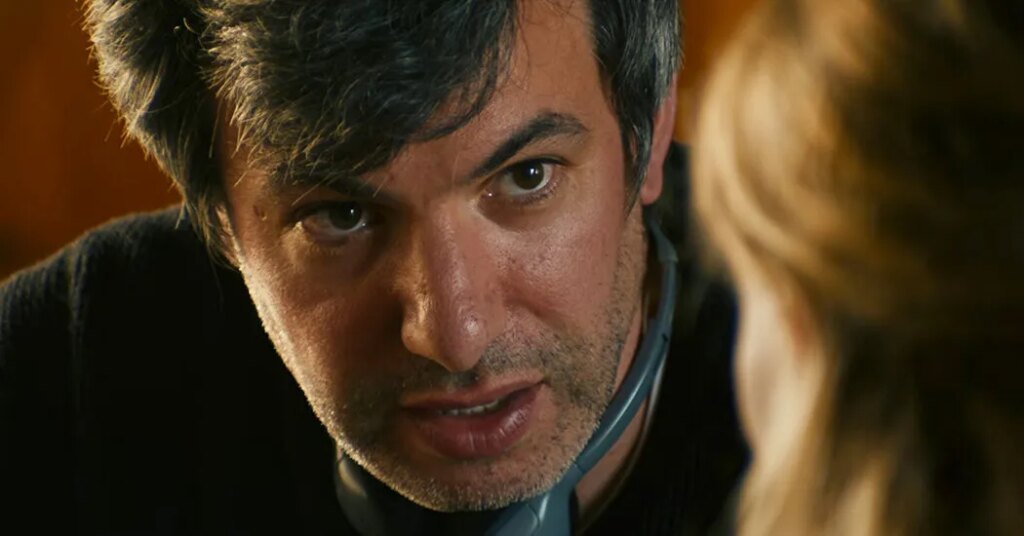
When the surprise premiere of “You Can See Everything” upended the Telluride Film Festival in September, gobsmacked attendees described the film as bonkers, to use the word our reviewer does. Now that it’s finally hitting theaters this weekend, we can finally see for ourselves what everyone is talking about.
In it, the disgraced Theranos founder Elizabeth Holmes and her romantic partner, Billy Evans, have invited the comedian Nathan Fielder, who co-directs alongside Lance Oppenheim (“Primetime”), to film them in the 34 days before she is due to report to prison. She doesn’t understand why she has been convicted on charges of fraud for deceiving investors. Or does she?
The New York Times movie critic Alissa Wilkinson and comedy critic Jason Zinoman have their own thoughts, which they’re sharing in a conversation below. Let us know your take on the film in the comments section.
Spoiler alert! It’s hard to talk about this film without revealing key details. Be aware that this conversation as well as the comments section will contain spoilers.
JASON ZINOMAN Alissa, we’ve already talked about this movie, but in the spirit of Nathan Fielder, let’s consider that a rehearsal. Luckily, there’s so much to unpack in this brilliant mind-bender.
The premise is a face-off between two master manipulators, Fielder, perhaps best known for docu-comedies like “The Rehearsal,” and Elizabeth Holmes, but it unfolds as a seduction as much as a battle. We learn through his interrogation that her flirtation technique is to hold eye contact — and she does this with Fielder quite a lot. Her eyes are the stars of this show. They are so unblinking that every flip of the eyelid is dramatic. In an incredible shot in the car on her way to prison, they flutter.
Fielder clearly wants us to think that he was hypnotized, and then there’s the tension he has with her partner, Billy Evans, that carries the charge of a rival.
One of the things I love about the documentary is how it keeps dabbling in different genres, hitting notes of cringe comedy, spy thriller, horror. The vanishing blond protagonist and themes of voyeurism and doubling made me think of “Psycho,” and there’s even a shocking shower scene. But Fielder and his co-director Lance Oppenheim commit to romance, with a stunningly dreamy visual vocabulary. Documentarians often fall for their subjects, but it’s built into this story.
You are a longtime student of the Fielder method of reality-blurring. I am curious what you make of this? Did Fielder really fall for those long lingering stares? And does that even matter?
ALISSA WILKINSON I have gone back and forth on that very question. On the one hand, having seen a lot of Fielder’s work, I’d like to think I can tell when he is playing “Nathan Fielder” and when he has gotten walloped by reality. There are moments during “The Rehearsal” where it feels like the artifice he constructed has unexpectedly cracked him open, and by the end of this film, I thought that might be what happened.
On the other hand, a lot about that final sequence — a conversation in which he and a key interlocutor discuss whether Holmes is for real — feels staged. Did they create this ending for the film? Or …?
Readers, you probably have your own answers to this question. I’m comfortable not knowing; clearly the ambiguity was on purpose.
What’s more interesting to me is that this made me think about my relationship to what I just watched. It made me aware of my presumptions that what I see onscreen is “real” unless I’m told otherwise.
I keep saying that I think Fielder is best understood as a performance artist, by which I mean the sort who confronts you with something about the world or yourself that usually stays hidden. A lot of the time I see performance art in museum settings, but Fielder’s work comes to us through screens, in the form of movies and TV, because that is what his art is about: the ways we watch our entertainment today, especially reality TV and now, documentary.
Of course, this is far from the first documentary to do this sort of thing. Filmmakers have been doing this in nonfiction for a century. I think of Luis Buñuel, Shirley Clarke, Orson Welles, Sarah Polley, Robert Greene — I could go on. Yet it’s also clear to me that Fielder is bringing some kind of secret sauce to the mix. What do you think makes this movie so watchable, and so buzzy?
ZINOMAN As complex as Fielder’s work can be, the secret sauce, to me, is something simple: a radical commitment to surprise. Last time we saw him, in “The Rehearsal,” the man flew a damn plane. That’s quite a coup de théâtre. This documentary repurposes many elements we have seen from him before — re-enactments, boundary-blurring investigations of truth and fiction — but in the past, he was playing off ordinary people; now he is focusing on another star, a notorious tech entrepreneur. We’ve seen so many portraits of these people in features and documentaries recently, as you have written. But none so intimate and mysterious.
What’s riveting is that Holmes comes off as either impossibly naïve or spectacularly manipulative, without much room for anything in between. While she seems to win over Fielder (or the version of him in the movie), the filmmaking also points you in a direction to question her. It highlights extreme, implausible comments. At one point, she says she has never told a lie. I have never seen Fielder so flummoxed. “Liz, what?” he blurts out. His whole career is premised on investigating the ways we all perform, so seeing him confronted with this statement is hilarious.
Then there’s her fairy-tale story of meeting her partner, Billy Evans, a character out of reality television (he even says “the council has spoken,” a paraphrase of the “Survivor” catchphrase). Evans says he is aiming for “radical transparency” but spends much of the first half of the movie evading or interrupting Fielder. One of the surprises of this movie is how much it focuses on Evans. What do you make of him and why do you think he plays such a large role?
WILKINSON I thought a lot about him in terms of certain documentaries about “villains” — the kind Errol Morris makes — where you start out feeling, well, this guy seems kind of normal, and by the end he’s become terrifying just through what he’s said. Evans is obviously in this film so much to tug at one strand in the mystery of Elizabeth Holmes: Is she an innocent victim of a controlling man (as she implies onscreen in reference to her ex-fiancé and ex-business partner, Sunny Balwani, who was sentenced to nearly 13 years in prison for defrauding investors and patients), or is she using that as an escape hatch for the responsibility she bears as well?
I thought I knew the answer going into this film; now I’m not so sure. She does seem like a person who could be easily manipulated by someone like Evans. The choice to include the scene where the couple is making scrambled eggs (when Evans corrects Holmes) suggests that the directors want us to feel uncertain. On the other hand, isn’t that just what she wants us to believe?
Jason, this movie has tied me in knots, and though I know that it will infuriate some people, I find that to be delicious. I suppose that makes me like Fielder, in some ways: He has suggested that he made this film because he wanted to explore the pleasure of being deceived, as we are when we go to a magic show. I think that might mean he’s succeeded.
ZINOMAN Evans could be manipulating her, but there is also the possibility that she is manipulating him. And Fielder. The delirious fun of the movie is how it sends you down conspiratorial rabbit holes. I do think Billy Evans plays one other role. As Fielder shifts his sights to him, I couldn’t help but see some projection in the accusation that Evans is manipulating or using Holmes for his own ends. Isn’t Fielder doing the same thing? He’s made this buzzed-about movie, a career breakthrough already earning Oscar chatter, in part by inviting us to look at a variety of angles on Holmes. I see what you mean about the fun of being tied in knots.