


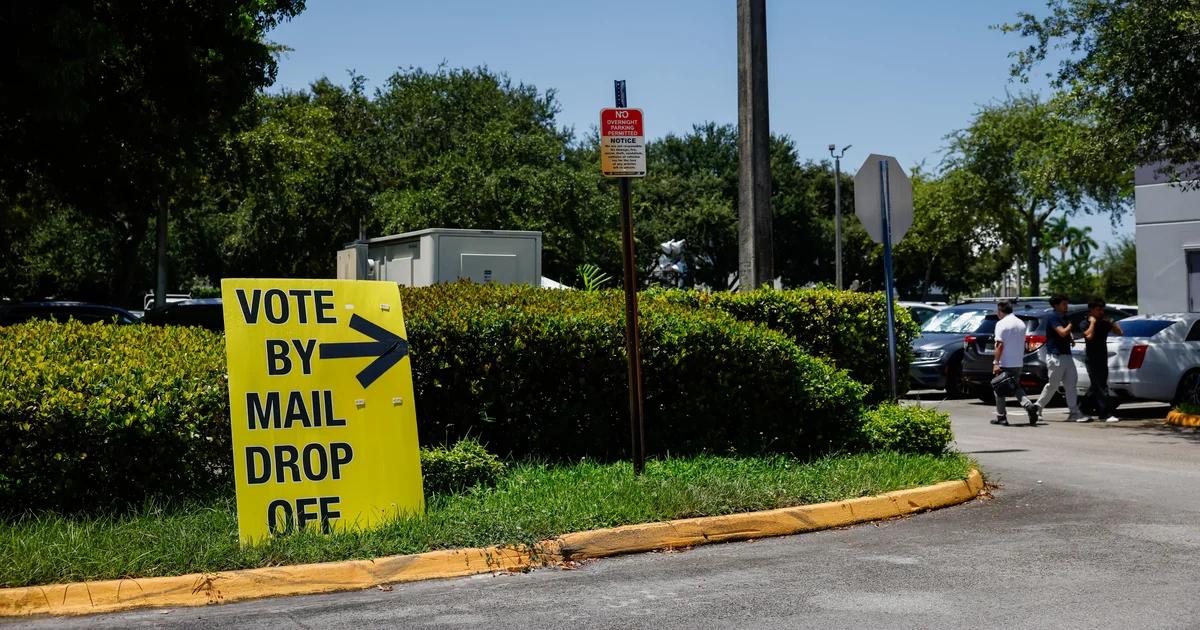
Washington — A whistleblower is warning of „potentially catastrophic problems“ with the U.S. Postal Service’s new system for handling mail ballots. The whistleblower is accusing the agency of flouting court rulings by continuing to work on implementing a Trump executive order to tighten mail voting rules before the November midterm elections.
Described by lawyers as a federal official, the anonymous whistleblower revealed the information about the Postal Service’s mail-voting procedures in a disclosure provided to Democratic Sen. Richard Blumenthal of Connecticut that was made public Tuesday. In response, Blumenthal is now questioning Postmaster General David Steiner about the Postal Service’s development of a new online portal to house information about voters and their mail ballots.
„The main takeaway for me is that the Postal Service has designed a system to disenfranchise millions of Americans,“ Blumenthal told reporters. „One third of all Americans cast their ballots by mail, and the USPS puts all of their votes at risk.“
The Postal Service did not immediately return a request for comment.
Mr. Trump has sought to exert more federal control over U.S. elections ahead of the November midterms, including through his executive order imposing new restrictions on mail ballots. The president has also pushed Congress to approve a package of voting regulations that would outlaw mail voting — with some exceptions — and impose new proof-of-citizenship requirements to register to vote.
As Mr. Trump signed his executive order in March, he claimed that „the cheating on mail-in voting is legendary,“ and said new mail voting rules were needed to ensure the integrity of federal elections. But his administration has not put forth evidence of widespread voter fraud, and the president himself has cast ballots in Florida’s elections by mail.
As part of its implementation of the president’s directive, the Postal Service published a final rule last month laying out its new requirements for mail voting. A federal judge temporarily blocked its enforcement last week, and the Justice Department has appealed that decision.
Currently, six states conduct their elections entirely by mail. There are also four states, plus the District of Columbia, that have not yet eliminated in-person voting but also send ballots to all of their voters. In a CBS News poll in March, 77% of Democrats said anyone should be allowed to vote by mail, while just 25% of Republicans also felt that way. Independents were split, with 49% backing mail voting by anyone.
The new Postal Service rule imposes new design standards for outbound and return mail ballot envelopes, including the addition of a unique barcode. Under the new rule, state election officials must submit to an online „Federal Ballot Mail Portal“ the names and addresses of voters receiving mail ballots, as well as the unique barcodes on the mail ballot envelopes.
Once that information is provided through the portal, those voters would be considered enrolled with the Postal Service on their state’s „Mail-In and Absentee Participation List.“
Most states led by Democrats oppose the rule, arguing that the Constitution gives states the authority to set election rules, not the federal government.
Blumenthal described the Postal Service’s actions as „sabotage.“
In a letter to Steiner dated Monday, Blumenthal said the agency’s implementation of Mr. Trump’s executive order has been „perilously rushed and potentially unlawful,“ and he urged the Postal Service to walk back its new mail-voting plans for the upcoming elections.
He wrote that the whistleblower’s allegations show that „USPS lacks the technical or operational capability needed to effectively implement the EO’s provisions in a way that safeguards every citizen’s right to vote in the upcoming midterm elections.“
According to the whistleblower disclosure provided to Blumenthal by lawyers with Whistleblower Aid, the new portal is „untested“ and will have „significant operating problems“ when released, given its „rushed“ development.
The federal official also warned that the new verification process could keep large numbers of mail ballots from being delivered to voters.
For instance, the Postal Service has what the whistleblower claims is a „zero percent failure rate.“ Mail workers would scan a sample of a batch of mail ballots — about 400 out of a batch of 10,000 or more — to verify it matches what is in the federal mail ballot portal. Under the policy, if even one barcode on a single ballot in the batch doesn’t scan properly, the entire batch would be rejected and returned to state election officials so the problem ballot could be addressed, and then the verification process would have to be started again.
The whistleblower’s lawyers said that the way the process is designed is „entirely unforgiving.“
„It could delay ballots by the thousands in repeated verification cycles — and thus prevent states from mailing enormous numbers of ballots,“ the lawyers said.
David Becker, executive director and founder of the Center for Election Innovation and Research, warned that the process raises „tremendous“ concerns for disenfranchisement of voters.
„Are Americans clamoring for the Postal Service to have this added responsibility as they’re hoping that their ballots are just seamlessly sent to them?“ Becker, a CBS News election law contributor, asked.
He also said that the new Postal Service rules „would undoubtedly create a tremendous number of hoops that are completely unnecessary and do nothing for election integrity.“
Publication of the final rule came days before the Supreme Court intervened last week in a case brought by 23 Democratic-led states that challenged key provisions of Mr. Trump’s executive order. U.S. District Judge Indira Talwani had blocked the Trump administration from implementing those portions of the directive in June, including plans for the Postal Service, but the Supreme Court lifted that lower court decision.
The high court’s order was procedural: The majority found that the states‘ lawsuit was premature. The Supreme Court said its decision „does not mean that any measure taken by the Government to implement the Order will necessarily be lawful. On that score, time will tell.“
In addition to expressing concerns about the Postal Service’s new requirements for mail voting, the whistleblower’s disclosure also contends that the agency violated court orders by implementing Mr. Trump’s executive order.
After the district judge issued her order blocking implementation of the president’s directive, Postal Service workers resumed work on the portal, the official said, and work continued even after the judge’s latest ruling last week.
The Postal Service aims to have the portal ready to be rolled out to the public by Sept. 1, according to the disclosure.
„Our client, a lawful anonymous whistleblower, has come forward to flag a foreseeable catastrophic disruption to our coming nationwide elections based on the reckless pursuit of readying a new, insufficiently tested, poorly planned mail-in ballot screening system,“ the whistleblower’s lawyers wrote.