


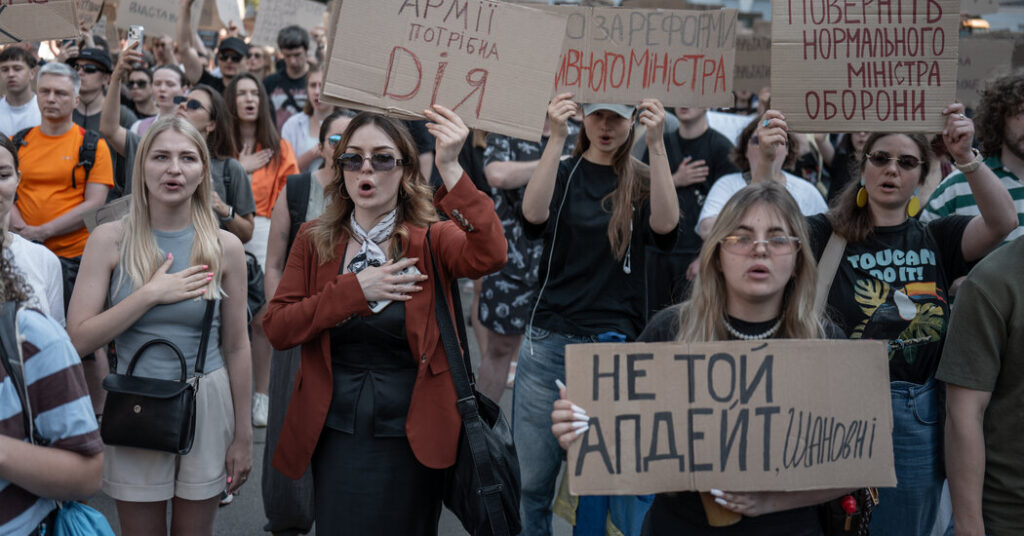
Pressure mounted on President Volodymyr Zelensky to dismiss Ukraine’s top commander on Monday, as a growing number of active-duty soldiers and veterans joined the chorus of protesters who have taken to the streets calling for a military overhaul.
Mr. Zelensky was scheduled to hold a meeting with top security officials on Monday, and speculation was swirling in Kyiv, the capital, that General Oleksandr Syrskyi’s fate could soon be sealed.
Last week, Mr. Zelensky fired Defense Minister Mykhailo Fedorov, ripping the lid off a bitter rift between advocates of technology-driven reform in the armed forces and the entrenched military establishment led by General Syrskyi.
For only the second time since Russia’s full-scale invasion in 2022, thousands of people have joined mass demonstrations to pressure Mr. Zelensky to change course and reaffirm Mr. Fedorov’s vision of warfare as increasingly dominated by drones and robots.
The swelling public anger threatens the national unity that has sustained Ukraine through nearly four and a half years of fighting. It comes just as the country had found success in the war with a campaign of long-range drone strikes.
In recent days, Mr. Zelensky has met with a string of commanders, as well as with Mr. Fedorov, 35, and General Syrskyi, 60. “Decisions regarding the army will be worked out,” the president said in a statement on Saturday night.
After he was fired, Mr. Fedorov issued a scathing public indictment of the military high command. He accused it of blocking his efforts to modernize the armed forces, including through resistance to a data-driven approach and engaging in political intrigues that divided the nation.
Mr. Fedorov said a constructive dialogue had since emerged to address the issues he had raised. “There will definitely be changes,” he said in a statement.
Junior Sgt. Eduard, a 28-year-old soldier fighting in southern Ukraine, said he worried that the power struggle could pose a greater danger to his country than anything Moscow could throw at the Ukrainian military.
“Right now, we are facing the enemy,” he said. “We believed that there were no enemies behind our backs, in our rear. As it turns out, there are.” Sergeant Eduard’s last name is being withheld in keeping with Ukrainian military protocol.
He was not alone in feeling a sense of betrayal following the sudden dismissal of Mr. Fedorov. In interviews with a dozen soldiers fighting in positions across the 750-mile front, most expressed support for the protesters and anger at the military high command.
“Almost all conversations right now are about this,” said Andrii, the commander of a drone unit in eastern Ukraine. “So far, I haven’t met a single serviceman who has expressed support for Syrskyi.”
While soldiers acknowledged General Syrskyi’s intelligence and expertise, they expressed frustration that he continued to operate using outdated methods and appeared to reward loyalty more than proven combat effectiveness.
The general has remained largely silent publicly, posting videos of himself meeting with commanders on the front, but his allies have fiercely rejected the criticism.
An officer in the military’s General Staff headquarters dismissed the outrage as a “vortex of manipulation” designed to pit “progressive” youth against military conservatives.
The officer said that Mr. Fedorov, who has a background in digital marketing and has not served in the military, had not fully understood many of the tasks entrusted to the armed forces. The officer made his remarks on the condition of anonymity because he was not authorized to speak publicly.
Yet General Syrskyi has struggled with public perception and popular support since becoming the military’s top commander in 2024. While praised for his role in the defense of Kyiv early in the war and the counteroffensive in the Kharkiv region, he is dogged by a reputation for accepting staggering casualties for minor gains.
During the bloody battle for Bakhmut, soldiers began calling him “the Butcher.”
More recently, he drew criticism over a video of soldiers raising a flag in the embattled city of Kostiantynivka, intended to rally support and undermine the Kremlin’s claim of control of the city. Soldiers likened the move to hollow Russian propaganda, underscoring criticism that General Syrskyi is wed to a rigid Soviet-style command where the safety of fighters is secondary.
Military analysts generally agree that the city remains a killing zone not under the firm control of either army.
On Monday, Russian Telegram channels broadcast videos that they claimed showed the soldiers who raised the flag as prisoners of war. The Ukrainian General Staff acknowledged that some Ukrainian soldiers were captured in the ruined city but declined to say if they were the ones involved in the flag-raising operation.
“For the regiment, the capture of our brothers-in-arms is extremely painful news,” the General Staff wrote. “But the most important thing is that our soldiers remained alive.”
The 425th Separate Assault Regiment, whose soldiers posted the video, was already under investigation for noncombat deaths of newly mobilized recruits and widespread abuses.
The brigade, known as Skelia, has fought in some of the most difficult sectors of the front. But unlike typical Ukrainian units tied to regional operational commands, the brigade answers directly to the General Staff, and it is unofficially referred to as one of “Syrskyi’s regiments.”
Lt. Yurii, a company commander fighting in eastern Ukraine, described the current leadership’s approach as one in which commanders pointed to a map and ordered troops forward, ignoring the realities of a drone-saturated, highly lethal battlefield.
Ultimately, he said, the responsibility for the crisis in the military leadership lies in the office of the president. He said he believed that the office wanted to protect its direct role in shaping battlefield decisions.
General Syrskyi, the soldier said, was prized by Mr. Zelensky because he had no political ambition and could be relied on to carry out orders.
While many soldiers spoke with The New York Times anonymously for fear of reprisal, a growing number of senior commanders are speaking out publicly.
Col. Sviatoslav Palamar, the deputy commander of the 1st Corps of the National Guard of Ukraine “Azov,” warned the government to listen to the protesters.
“History teaches us that countries do not lose only because of the strength of an external enemy,” he wrote. “Sometimes they lose far more when society’s internal exhaustion is turned into a tool for political manipulation.”
Brig. Gen. Serhii Sobko, the deputy Commander of the 11th Army Corps, said in a statement that top leaders were stripping the military of the agility that saved it in 2022.
“Today, an increasing number of commanders are forced to think not only about accomplishing their combat mission, but also about how to avoid punishment,” he wrote.
Maj. Gen. Mykhailo Drapatyi, the commander of Ukraine’s ground forces, who has clashed with General Syrskyi and is considered a contender for his job, said public discussion of problems was essential.
“Silence does not protect the armed forces; it merely allows mistakes to accumulate until correcting them becomes far more difficult,” he said in a statement.
Despite the tension, soldiers said they remained cautiously optimistic that public pressure would force reform.
“The main thing isn’t changing the name of the commander,” Andrii, the drone commander, said. “The real question is whether the new person will be allowed to come in with their own team and be empowered to act.”