



It’s no secret that Venice wrestles with tourism. But, even with a ban on large cruise ships, a fee to enter the historic center and local protests, the crowded, centuries-old city still entices travelers.
But the Veneto region, which hosted the 2026 Winter Olympics, is much more than Venice, its capital. Wedged between the Dolomites and the Adriatic Sea in northeastern Italy, Veneto is rich with possible itineraries.
For a week, I explored Veneto from the medieval town of Treviso, 30 minutes from Venice. My forays around the region, teeming with nine UNESCO sites, included bike routes, boats, city tours and trains — and avoided the throngs. The three excursions below focused on Veneto’s cultural wealth, beyond Venice.
Excursion 1: Treviso to the Lagoon
In the 14th century, after the Treviso area joined a rapidly expanding Republic of Venice, its canal-powered windmills began supplying the growing Venetian population with flour and olive oil. Treviso’s inland position 20 miles to the northwest provided fresh water and a connection to the continent. The highway upon which these necessities flowed was the Sile River.
My first itinerary took me along this ancient highway by bicycle and then boat from Treviso into the Venetian Lagoon. I started the two-day trip with a Treviso Bike tour. The four-hour, 25-mile ride followed the serpentine Sile River to the village of Caposile on the northern shore of the lagoon — where Venice, and more than 100 islands are clustered between the mainland and the Adriatic — and provide a peek into Veneto’s less-frenetic side.
On the morning of the tour, I walked through the 16th-century Porta Santi Quaranta, one of Treviso’s three gates, and crossed the city’s cobbled center — with palaces, loggias and churches from the 11th century on — to meet up with the group at Treviso Bike’s office. We then pedaled a flat path along the Sile through villages and the River Sile Regional Natural Park. Swans glided by as we rode where oxen once pulled flat-bottomed boats, called burci, loaded with goods. Hikers and cyclists followed boardwalks over a partly submerged cemetery of these abandoned wooden skiffs, river grasses poking through their ribs.
“We call this area around Treviso the Venetian Garden,” said Giovanni Dal Poz, Treviso Bike’s owner. “It’s where Venetian nobility escaped to the countryside. This is still a place to leave the chaos and discover a slower version of Venice.”
The next day, I took local bus No. 108 back into the “garden” to the village of Portegrandi, where the river becomes a delta of canals feeding into the lagoon, and boarded a boat for a three-island tour of the lagoon and Venice’s northern suburbs. As we entered open water — following wooden pilings, or briccole, marking navigable channels — the snow-capped Alps came into view, a reminder of how close we were to recent Olympic venues like Cortina d’Ampezzo.
Torcello, our tour’s first island, is among the lagoon’s oldest, most tranquil settlements. The site of the seventh-century Byzantine Basilica of Santa Maria Assunta, it’s also where Hemingway wrote the novel “Across the River and Into the Trees” while staying at the Locanda Cipriani inn. In 1291, Venice moved its glass furnaces to Murano, our next port. That tradition continues at factories lining the Rio dei Vetrai canal, and at the Murano Glass Museum.
It’s hard to snap a bad photo on Burano, the final stop: Shots of the kaleidoscopic rowhouses seemed to take themselves. The island’s calling card, however, is lace-making, dating to the 1500s. Visits to the Lace Museum and shops provided insight into the intricate “Punto di Burano” style.
Excursion 2: Tiramisù and Prosecco
This two-day itinerary focused on food and wine, especially tiramisù and Prosecco. The dessert and the internationally protected sparkling wine, both from Veneto, are on nearly every menu.
By many accounts, tiramisù was invented at Treviso’s Le Beccherie, a bistro that is tucked into a lively courtyard. In 1955, Alba Campeol, who was then an owner, began eating a new dish as a pick-me-up (tira-mi-su) during her pregnancy. Added to the menu in 1972, the confection (made of egg yolks, sugar, mascarpone, ladyfingers, coffee and cocoa), now recognized as a “traditional food product” by the Italian government, has become so popular that an adjoining cafe, Tiramisù Le Beccherie, recently opened to sate dolce-focused pilgrims.
After visiting the birthplace, I walked across the Piazza dei Signori, in front of the 13th-century Town Hall, to Treviso Tiramisù for seconds. Opened in 2023 in a 15th-century palace with a restaurant, shop and cooking school, the enterprise is a shrine to the layered dessert that’s fluffy and dense, savory and bitter. “Tiramisù connects us to our roots,” said Elisa Menuzzo, the chief executive, as cooking-school participants toiled over their creations.
By late afternoon, Trevisani were filling cafes and clinking aperitivi between mouthfuls of Venetian hors d’oeuvres called cicchetti. At the canal-side Osteria Muscoli’s, near the city’s fish market, celebrants toasted the evening and nibbled on crostini loaded with olive tapenade, Brie and caramelized onion. Under sausages hanging from the ceiling at Hostaria Dai Naneti, a 130-year-old wine bar and shop, I ordered an unfiltered style of Prosecco called “col fondo” for inspiration and opened a map of Prosecco Hills, an undulating swath of Veneto that’s responsible for some of Italy’s most famous wine.
The next day, I took a train 20 minutes north to Conegliano, one of the Prosecco Hills’ two main towns. There, I met Federico Della Puppa, site manager of the UNESCO World Heritage site, which spreads across the hills to the other main town, Valdobbiadene. We drove the Prosecco Wine Road across the 35.5-square-mile “core zone,” which UNESCO included in 2019 because of the “conservation techniques that comprise the viticultural practices using Glera grapes to produce the highest-quality Prosecco wine.”
Outside a 1,000-year-old church, Pieve di San Pietro di Feletto, Mr. Della Puppa pointed across the hills, where villages perched above vineyards. Known as “hogbacks,” these hills are so steep they must be worked by hand. Beyond, the Piave River wound through the Alpine foothills, which provide a protective buffer for the more than 400 producers who create the dry, fruity Prosecco D.O.C.G., the highest-quality classification. Farther still, the Dolomites towered.
I asked Mr. Della Puppa about what Prosecco’s popularity means for the area. “Last year the UNESCO site had 500,000 overnight visitors — a sustainable number,” he said. “But we don’t want monoculture. Travelers should also come to cycle, walk and learn about our culture.”
Excursion 3: The UNESCO Railway
For my final itinerary, I hopped on a train rolling west across Veneto. My first layover, Padua, has been a university town since 1222. Galileo and Copernicus spent pivotal points in their academic careers there. The city’s youthful buzz is apparent as you cross arcaded piazzas crowded with food vendors. Unsurprisingly, Padua’s UNESCO contributions reflect its cutting-edge creativity.
Spread across eight sites, Padua’s 14th-century fresco cycles make Padua the original Urbs Picta, or “painted city.” In the Scrovegni Chapel, the artist Giotto Di Bondone’s gold stars fleck a lapis ceiling over walls depicting the spiritual and secular, heavenly and hellish. I then walked to the nine-acre botanical garden, the world’s oldest, founded in 1545, with 6,000 international plants, a museum, open spaces and greenhouses.
Vicenza, my next stop, owes its UNESCO listing to the 16th-century architect Andrea Palladio, who designed 23 of the city’s most vaunted buildings, including Teatro Olimpico, the world’s oldest indoor theater, and dozens of villas around town and the region. His masterpiece, surrounded by groves and flower beds just outside Vicenza’s center, is the domed Villa La Rotonda. If a visit here feels familiar, it’s because Palladio’s meticulous symmetry and temple porticos have been imitated countless times, notably for Jefferson’s Monticello and the White House.
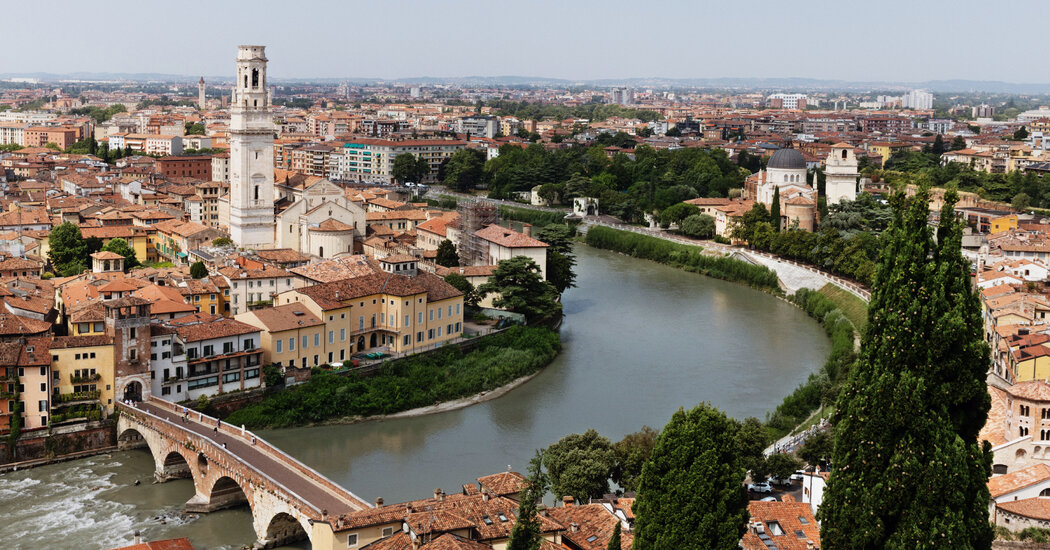
Tucked into a bend along the Adige River, Verona, like Vicenza, has a citywide UNESCO designation. The town retains elements of its first-century B.C. Roman layout — interspersed with medieval and Renaissance architecture — including a 2,100-year-old bridge, two gates and even a mosaic in a Benetton store on the main shopping street, Via Mazzini.
All roads, however, lead to Arena di Verona. Built in A.D. 30, this wonderfully preserved Roman amphitheater held the Winter Olympics’ closing ceremony and hosts a summer-long opera festival.
On Lake Garda’s southeastern shore, at Veneto’s western edge, Peschiera del Garda was my train’s terminus. The canal-bordered town was UNESCO-inscribed for its centuries-old fortified walls.
The day was clear and crisp as I pedaled a rented bike along the lake and under the fortification’s bastions. “It’s a pity you aren’t here longer,” Nicola Verdolin, the owner of the nearby Garda Bike Hotel, told me. To the east, the Veneto hills and the Alps spread before us. “But you’re getting a taste now. You’ll be back.”
Follow New York Times Travel on Instagram and sign up for our Travel Dispatch newsletter to get expert tips on traveling smarter and inspiration for your next vacation. Dreaming up a future getaway or just armchair traveling? Check out our 52 Places to Go in 2026.

