



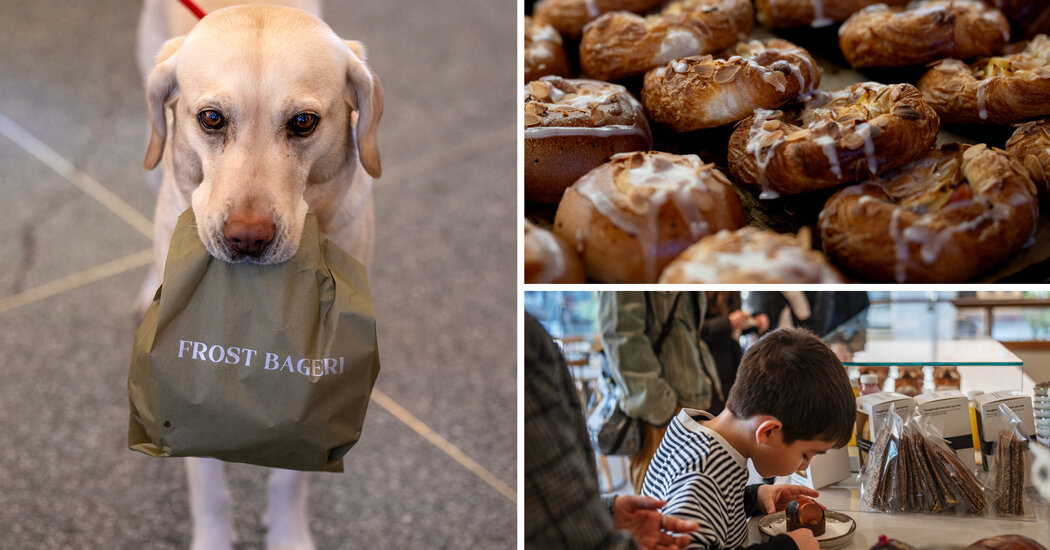
It’s hard to overstate the cultural significance of fika in Sweden. A daily (or twice-daily) custom at most workplaces, fika is simply a coffee break with something sweet to eat in the company of colleagues or friends. Outside the office, it’s an occasion to catch up with grandparents or neighbors, sharing a pot of coffee or tea and some fragrant cinnamon buns, spiced apple cake or pearl-sugar-crusted almond cookies.
The Swedish appetite for both caffeine and baked goods has led to an abundance of excellent coffee shops and cafes throughout Stockholm. But for me, the ideal fik (a place serving fika) is a bakery. While I’ll always be loyal to 10-year-old Lillebrors Bageri, where the soft cardamom buns are always warm from the oven, what’s most exciting right now are newer spots that are doing something different, whether it’s returning to ancient grains and long-forgotten recipes, or spicing up familiar favorites with unexpected flavors. Over a recent week of intense fika-ing, I focused on the city center (with one worthwhile exception). Here are my top five.
French-Inflected and Family-Friendly
Håkan Johansson Frost said that he and his wife, Sacha Dahlström, wanted to downsize after selling Skeppsbro Bageri, a sprawling bakery on the waterfront in the Gamla Stan district, last year.
“Our plan was to open a really small place, just the two of us,” said the baker who once won a World Championship in pastry (in Paris, no less). But when the opportunity arose to open something much grander in scale at Garnisonen, a former military garrison-turned-office-complex in the Östermalm neighborhood, they pivoted.
“I fell in love with all the windows and open space,” he said about the place, which now includes a bright cafe area and ample baking facilities spanning two levels.
After opening in October, Frost Bageri became an instant hit among office workers. It’s equally popular with the stroller crowd, with plenty of tables to linger over a leisurely fika.
“If we didn’t let in dogs and children, we wouldn’t have any customers,” joked Mr. Johansson Frost, who is well-known among local sourdough enthusiasts for his long-fermented croissants and breads baked with ancient grains — like spelt, emmer and rye — that he mills on site.
In addition to offering croissants and pains au chocolat, the bakery has earned fans with his fresh-baked baguettes, selling for only 17 Swedish kronor (about $1.85), or as the sign says: “samma pris som i Paris” (“same price as in Paris”).
An Italian Interpretation
As someone who lived in Italy for 14 years and dearly misses the coffee bars, I was delighted to discover Francesco, an Italian bakery and cafe that opened in November, serving cappuccini and cornetti up the street from my apartment on Södermalm. Step inside the sunny space to find the man himself: the owner, Francesco Giudice, a mustachioed young chef from Napoli with “P-I-Z-Z-A” and “P-A-S-T-A” tattooed across his fingers, in the open kitchen pulling pans of focaccia from the oven or stirring a simmering pot of ragù Napoletano.
But it’s the maritozzi for which Mr. Giudice is best known. “A masterpiece from Rome” is how he described the soft brioche buns filled with whipped cream. Every morning he bakes the traditional version along with a weekly special, some with Italian ingredients, like pistachio, and others inspired by Sweden, such as saffron-flavored buns topped with drottningsylt, a classic Swedish jam.
The morning pastries were long gone when I went for an afternoon fika with my neighbor Sofie, but the cannoli that I paired with tea — crisp house-baked shells freshly filled with citrusy ricotta cream — tasted like a bite of Sicily in Stockholm.
Swedes know Frida Bäcke as a world-champion pastry chef who, for the last two years, has created intricate desserts for the annual black-tie Nobel Prize banquet. She also worked for years as head pastry chef at the Michelin-starred restaurants Frantzén and AIRA, before opening a patisserie in 2022 called Socker Sucker (a wordplay on Swedes’ sugar cravings) with her former colleague Bedros Kabranian.
On a quiet corner in the Vasastan neighborhood, the modern space has windows facing the street where one can spot Ms. Bäcke and Mr. Kabranian at work in separate areas.
“We like to experiment a lot with pastries,” said Ms. Bäcke, who explained that her domain is high-end patisserie, while Mr. Kabranian specializes in laminated croissant pastries. A long glass counter displays their creations: neat rows of brightly-colored fruit tartlets beside elegant croissant confections.
I stopped there en route to a hair appointment and struggled to choose two pastries for fika with my longtime stylist, Elin. The first was almost too beautiful to eat: an oblong sliver of lemon pound cake topped with yuzu mousse, blood-orange-and-grapefruit curd, Italian meringue and an apple-citrus glaze. It turned out to be a delectable delight, as was a round croissant filled with twice-baked cheesecake, apple compote and crunchy cardamom crumble.
Levantine Crescents
One does not stumble upon Habajit, despite its central location off Nybrogatan, a bustling pedestrian thoroughfare in the city center. Behind a tall metal gate inside a Jewish community center (with strict security), the bakery reopened to the public in 2025 after an extended closure following the Hamas-led attacks in Israel on Oct. 7, 2023.
On a recent afternoon, after answering a few questions and passing through security, I joined crowds of children buzzing around the central atrium, a sunny hub anchored by the bakery and its glass cases filled with freshly baked delicacies rarely found at this northern latitude: pita with za’atar, soft khachapuri (a cheese-filled bread), flaky borek pastries stuffed with potato and cheese, sesame-crusted Jerusalem bagels and rows of chocolate rugelach.
When Habajit first opened four years ago, 90 percent of the customers were not from the Jewish community, said the owner, Felix Ankri. But now very few come from outside. “It’s just a small percentage of people that heard about the place and want a good pita or nice rugelach,” he said.
Flaky and intensely chocolaty, the rugelach were also my reason for visiting. But I’ll be back for the Friday babka.
Ten years was enough for Petrus Jakobsson, one of the city’s most beloved bakers, who closed his Södermalm bakery in late 2022 and decamped to Årsta partihallarna, an industrial zone south of the city center. The new bakery, called Dåndimpens, primarily supplies Stockholm restaurants, but also began quietly selling bread, bagels and cardamom buns from a loading dock to anyone able to find it (look for the Nordisk Transport sign). Eventually a cafe opened, reminiscent of an American-style sandwich shop with a pinball machine in the corner, though much of the inspiration is as old-school Swedish as it gets.
“I never want to make something new,” said Mr. Jakobsson, who instead honors traditional Swedish baking culture, tweaking and improving upon classics like Milanopinnar (small almond-paste-filled cookies), so they won’t die out.
“This is just for fun,” he said of the easygoing shop, where the chalkboard menu always includes a sandwich with egg and “kaviar,” but might also feature fried Falukorv (sausage) sandwiches or smörgåstårta (a savory Swedish “sandwich cake”). For fika, there’s fresh filter coffee and the cardamom buns for which he earned a devoted following, as well as an array of raspberry jam cookies, pastéis de nata, strawberry cream buns or whatever delight the bakers dreamed up.
“I still don’t know my idea,” he said, “but the door is open.”

