



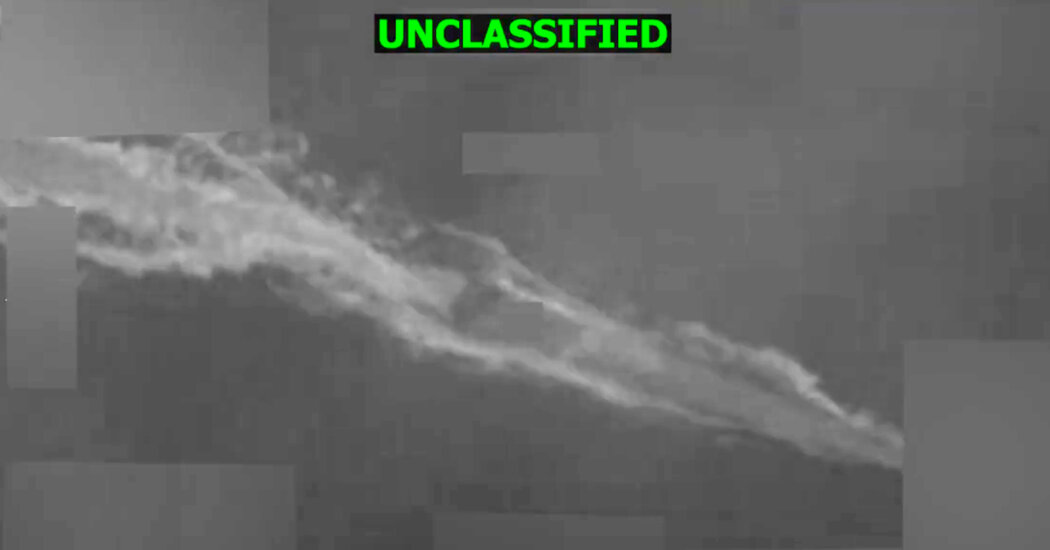
The U.S. military killed two men in a strike against a boat in the eastern Pacific that it said was transporting narcotics, U.S. Southern Command announced early Monday. It was the first such strike by the military since June 21.
The United States began a campaign of boat strikes last year in the run-up to the military operation that seized Nicolás Maduro, the president of Venezuela. The military has continued the operations in the Caribbean and the eastern Pacific, killing at least 223 people in 67 strikes that it said were involved in the narcotics trade.
But narcotics experts say the boat strikes have failed to slow the smuggling of cocaine from South America to the United States. According to Brown University, the costs of the operation were at $4.7 billion as of March 31.
Legal specialists also have said that the strikes are illegal extrajudicial killings because the military is not permitted to deliberately target civilians — even suspected criminals — who do not pose an imminent threat of violence.
Southern Command provided little detail about the strike that took place on Sunday but noted that intelligence reports said the vessel was trafficking narcotics and traveling on a route used by drug smugglers.
“Joint Task Force Western Hemisphere executed a lethal kinetic strike on a low-profile vessel operating along established narco-trafficking routes in the Eastern Pacific,” Southern Command said in a statement, referring to a new military unit set up to expand the Pentagon’s war against drugs in cooperation with regional allies.
Gen. Francis L. Donovan, the head of Southern Command, said in the statement on social media announcing the strike, “When I ordered the establishment of Joint Task Force Western Hemisphere, it was precisely for this purpose: to accelerate, synchronize, and execute lethal actions against these destabilizing narco-terrorist networks.”
Southern Command did not explain the two-month lull in strikes since an attack on a boat in the Caribbean killed eight people on June 21. Military officials have attributed the pause at least in part to planes and other equipment being diverted to help victims of the recent earthquake in Venezuela.
The Trump administration has in recent months stepped up its cooperation with allies across Latin America to combat the drug trade. It created the coalition, part of the regional Shield of the Americas alliance, and convened its first meeting in March.
That month, Ecuador and the United States launched joint military operations against designated terrorist groups. In May, the Pentagon pressed Guatemala to agree to joint U.S. airstrikes and other military action inside its borders to target suspected drug groups.
Defense Secretary Pete Hegseth said earlier this month that Honduras and Colombia had also agreed to allow joint operations.

