



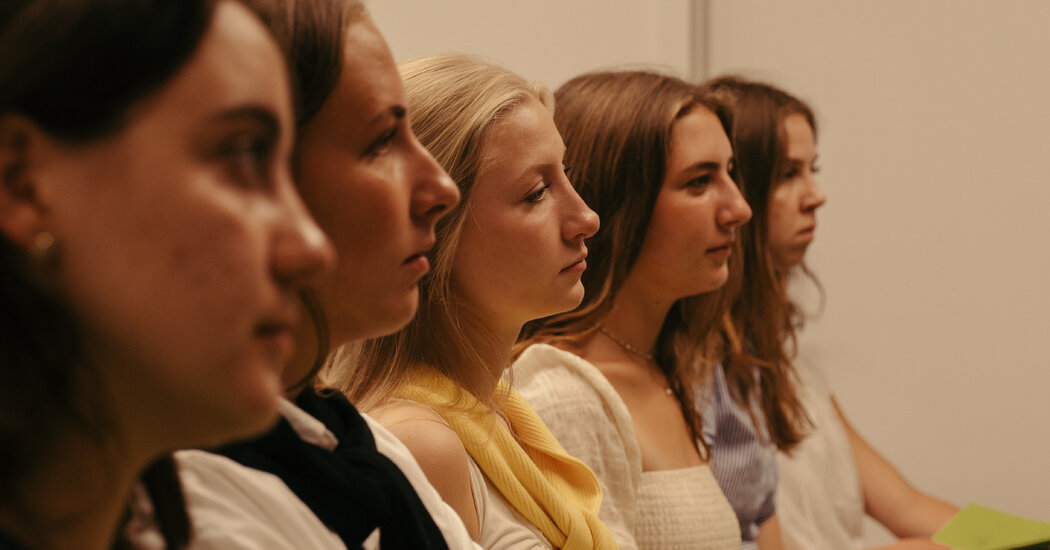
The young women bent their heads over their books one morning in July — studying, if such things can be studied, how a woman should be.
One of them read aloud from a passage about Mary Wollstonecraft, the early women’s rights advocate, who had slammed the Swiss philosopher Jean-Jacques Rousseau for writing, in her words, that “man was made to reason, woman to feel.”
Kimberly Begg, the president of the Clare Boothe Luce Center for Conservative Women, stood at the front of the conference room, leading one of her periodic book club sessions for summer interns and young staff members.
She had designed this discussion of 18th-century ideas specifically to confront a charged new political movement.
“I actually hear this a lot right now, that women are ‘feelers’ and men are ‘thinkers,’” Ms. Begg said. “Wollstonecraft is saying if we embrace this,” she added, “we are going to be not just harming women, but all of society.”
For the women listening, Rousseau’s assessment did not match reality. But it did sound familiar.
These days, the idea that women are intellectually inferior leaches steadily from manosphere podcasts, influencers who promote traditional gender roles and ultraconservative pulpits.
Ms. Begg, a lawyer with five children who often draws on her Catholic faith, has heard some conservatives pushing for a return to rigid gender norms, with women firmly planted at home. One of her sons told her that some of his male high school classmates have openly questioned whether women should be able to vote.
From a squat brick office park in Northern Virginia, the Luce Center is staking out what seems like a fraught position these days: that it is possible to be a conservative woman who values motherhood and family, but one with a career, an egalitarian marriage and a voice.
High-powered women are not exactly missing from the conservative world. President Trump has hired women for prominent positions, including his chief of staff and press secretary, as well as several in his cabinet (though many have left or been fired). Erika Kirk has led Turning Point USA since her husband and the group’s founder, Charlie Kirk, was assassinated last year. Many of the Make America Healthy Again movement’s biggest stars are women.
Yet such women, even those encouraging conventional gender roles, are often told to be quiet. Some red-pill conservatives have rebuked Ms. Kirk for her public role away from her children. They have chastised Alex Clark, a star MAHA podcaster, and Brett Cooper, a YouTube commentator, for having a platform.
And every summer, it seemed to Ms. Begg, more Luce Center interns have stories about coming face to face with open sexism from classmates, friends and boyfriends.
Mary White, an earnest 19-year-old bookworm in Invisalign braces, found herself debating a male classmate at the University of Dallas about the 19th Amendment, which gave women the right to vote.
Women tend to lean liberal, he told her. Replacing women’s suffrage with “household voting,” in which husbands cast ballots for their wives and families, would fix that, he said, echoing arguments that have circulated online and in far-right circles.
Another intern, Lucy Carney, 19, a forthright politics and government major, was the only woman in her class to serve last year in student government at Benedictine College in Kansas.
She said she once confronted a male classmate when she heard that he had quoted Andrew Tate, the manosphere influencer accused of rape and human trafficking: “So I guess women just want to be raped.”
Anastasia Leffas, 22, a junior staff member and former intern, also had a story from college. At coffee with a male classmate, she mentioned being interested in law school. “I don’t know if women should be lawyers,” he said, casually.
“I really think he just wanted women to thrive, and very faultily thought that that’s how women best thrive,” she said. She retorted, “That was truly absurd of you to say, because I think I’d be a much better lawyer than you would be.”
It isn’t only men. Anastasia Shanahan, 22, Ms. Begg’s assistant and another former intern, was startled when two female friends said they were unsure whether women could lead. “Of course they can,” she said.
The Luce Center, a donor-funded nonprofit, says its mission is to mold young women into “strong, conservative leaders” like the center’s eponym, the congresswoman, diplomat and conservative activist Clare Boothe Luce.
With a new book, campus events and other programming, Ms. Begg is trying to offer a vision of womanhood and marriage that she says avoids the “false choices” presented by conservatives and liberals.
From some conservatives, including people Ms. Begg considers ideological allies on other issues, the message is “a diminishing of women’s intelligence and a discouraging of women from using their gifts, their God-given gifts,” she said.
From some on the left, young women hear “the denial of biological sex and the devaluing of marriage, motherhood and family,” Ms. Begg said. (Many liberals, however, say conservatives like Ms. Begg are limiting women by emphasizing motherhood’s importance and de-emphasizing the right to bodily autonomy, including for transgender people.)
The summer internship program, which is paid, offers Ms. Begg another avenue to counter what she sees as harmful messages.
The interns don’t fetch coffee or answer phones. Instead, they receive a crash course in practical and professional skills, alongside tutelage in conservative principles. One day is dedicated to media training and public speaking, another to constitutional law. In July, the interns visited the United Nations in New York. A National Review columnist, Caroline Downey, came to speak about what she described as Gen Z’s dangerous embrace of socialism. Later came training in self-defense and firearms and a tour of the Museum of the Bible.
One morning in July, an etiquette expert, Lynn Williams, gave a lecture on silver table settings (asparagus servers, tomato servers, five-o’clock teaspoons), what to carry to your gala dinner table (“a lady does not walk with a cocktail”) and when to blot your lipstick (before you sit down, lest you smear the linens, and before every sip, lest you sully the crystal).
They practiced introducing parents to their future bosses — perhaps a politician or a judge, she suggested. They discussed sending thank-you emails after job interviews.
“Given some of the careers that you all are pursuing, if you’re here in Washington, chances are you will be invited to black ties and white ties and other very special events where you’re expected to know what to do,” she told them, before elucidating the proper writing of a thank-you note.
As the summer went on, as the 13 interns debated their majors, next internships and careers, their conversations sometimes brought to mind the mid-2010s, when “The Future is Female” T-shirts and tote bags seemed to be everywhere — not so improbable, perhaps, given that these interns were raised in a world that had long accepted women in the workplace. Trading tips on hot yoga studios, gossiping about Taylor Swift’s wedding and comparing beauty products, they didn’t sound so different from many liberal young women.
But they were different. At a time when Gen Z women have become the most progressive group in America, these young women largely supported Mr. Trump’s conservative policies, if not his character or the often-misogynist views of the manosphere, which has flourished with Mr. Trump’s rise.
Many young liberal women want partnership and children someday. But at the Luce Center, marriage and family were far more likely to be concrete, near-term goals: Financial stability and career success need not come first.
At a time of falling birthrates, several of the young women said their faith and upbringings taught them that large families were beautiful. They embraced the idea that life was seasonal, saying that they would happily have their careers take turns with child-rearing.
Their aspirations, they said, could feel strangely lonely. They felt themselves scraping, sometimes painfully, against expectations and stereotypes on both sides.
Mary White was debating whether to major in English or political philosophy; law school or academia might be next. She wasn’t waiting around for a diamond ring. But Ms. White could also see herself following her mother, who postponed her law career to raise eight children.
“I would love to be a stay-at-home mom, but I feel like a lot of times, girls are belittled for wanting that,” she said. Then again, she added, “On the right, there’s this idea that women shouldn’t work.”
She liked a “middle ground,” she said, “where it’s actually a beautiful thing to be a mother, but it’s also a beautiful thing to share your talents with a wider public spirit.”
That was exactly the message Ms. Begg hoped the interns would absorb.
During the book discussion, Ms. Begg invoked Mary Wollstonecraft’s argument that education in critical thinking would train girls for the professions, as well as to be wives capable of raising virtuous children.
The women’s rights advocate, she told her audience, said that “we should never understand domestic life as inferior.”
The young women nodded, taking notes. They were only on Chapter 1.

