



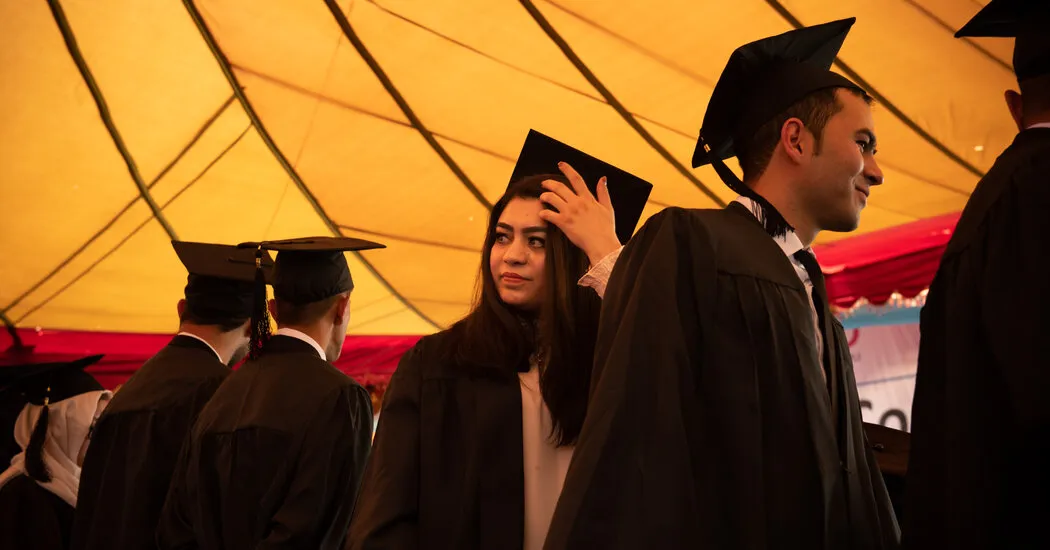
The American University of Afghanistan, one of the most potent symbols of the United States’ decades in the country, has lost its State Department funding, putting the education of hundreds of Afghan women was at risk, the school’s president said.
The State Department on Tuesday denied the university’s application for $25 million in funding for the next two years, according to David Edwards, a professor and the interim president of the university. As a condition of remaining open, it must partner with the American University of Central Asia, based in Kyrgyzstan.
Professor Edwards said he would work with the university in Kyrgyzstan, even though that campus does not offer remote instruction, the only way women in Afghanistan can receive higher education. The American University of Afghanistan serves about 1,000 students, all online, three-quarters of whom are women. About 90 percent of the students are in Afghanistan, with teachers in the country and abroad.
“We are the only venue for education for a whole generation of Afghans, and this point seems to be lost on the current administration,” Professor Edwards said.
The State Department said in a statement that the U.S. government would stop dedicating any funds to the university at the end of the year, citing a “history of repeated lack of accountability for millions of American taxpayer dollars.”
The university faced allegations of mismanagement in 2019, under previous leadership, when U.S. officials said that more than $60 million had gone missing.
Professor Edwards said the university had addressed those issues, and that all of its audits have been clean since 2021.
The State Department described the university as a “private entity.” It said the United States remained dedicated to supporting Afghan women and girls’ education through remote education programs. “We are currently working to identify implementing partners who can responsibly administer these programs,” it said.
An anthropology professor who assumed the university’s interim leadership in March, Professor Edwards visited British and German universities this summer to seek alternative funding and said he didn’t know how the university would finance the next semester.
The American University of Afghanistan was established in 2006 as a liberal arts college to train the next generation of Afghan leaders. Based in the capital, Kabul, it was one of the U.S. Agency for International Development’s largest civilian projects in Afghanistan, receiving more than $225 million since its founding.
When the Taliban overthrew the U.S.-backed Afghan government in 2021, the university’s foreign staff were evacuated and some students fled to Iraq, the United States and other countries. Others remained in Afghanistan but went into hiding. The Taliban had condemned the university, calling it a place where Americans tried to corrupt the minds of Muslims.
A large chunk of U.S.A.I.D. funds had gone into building the university campus in the heart of Kabul. But the Taliban seized it and established their own institution there, the Afghan International Islamic University, where 1,000 students now study Islamic law, engineering, medicine and other subjects.
All of them are men.
More than 2.6 million Afghan girls and women have been barred from formal education beyond sixth grade under the Taliban, according to UNESCO. Some study in secret schools that the Taliban tolerate but can close at any time.
The Taliban have so far allowed the American University to provide education to Afghan women as long as they study at home.
The university suspended operations for one semester last year after the Trump administration announced the dismantling of U.S.A.I.D. It also closed a satellite campus in Qatar. This year, it laid off more than 40 employees and downsized admissions because of funding cuts, Professor Edwards said.
With the university’s future in doubt, students say they may lose their best opportunity to study in Afghanistan under the current Taliban government.
Sara, a computer-science student, went back to her studies last year after an eight-year gap, when she started a family. She studies Python code, business and Afghan history in the afternoon and at night, once she has put her 7-year-old daughter to bed.
“This is the only place where I see a future for myself,” said Sara, 26. Tuition fees at other online institutions are too high, she said, and most jobs are out of reach because she lacks an undergraduate degree.
Sara spoke on the condition of using only her first name, for fear of reprisal by the Taliban.
Katayoon Sultani, 28, said that the funding cuts at the university made her feel powerless. In the meantime, she balances five courses, including political science, accounting and creative writing, while freelancing as a digital marketing consultant.
About 200 of the 980 current students are men.
Mohammad Numan Zullal, 29, obtained his M.B.A. from the university in May and plans to start a job with the Japan International Cooperation Agency in Afghanistan later this year. He said his master’s degree led to the job, and that his monthly salary of $2,500 would help support his parents and two younger brothers.
He said there would be other opportunities for male students if the university closed, but very few options left for Afghan female students.

