



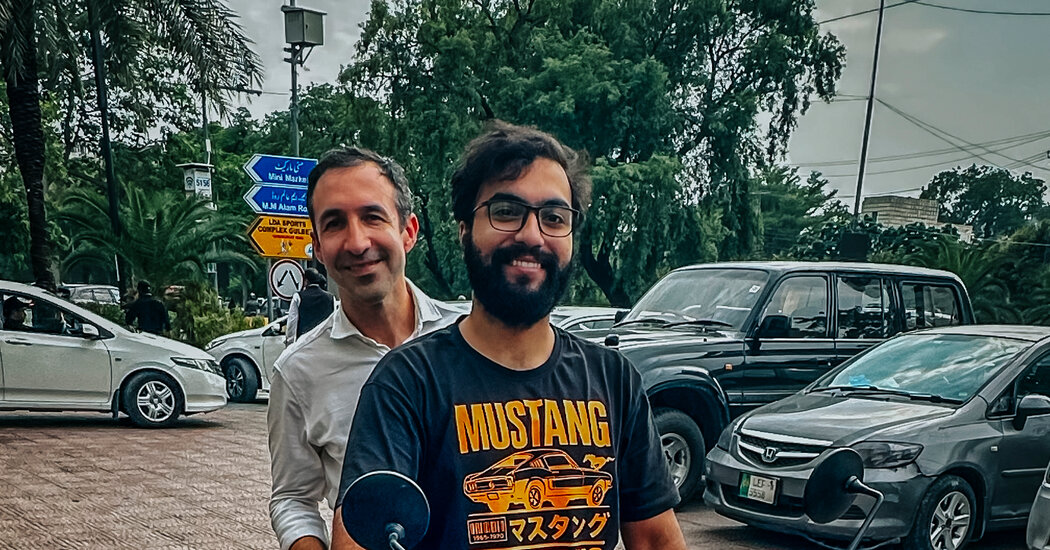
I went to Pakistan last month to write an article about the country’s electric motorcycle boom. I visited showrooms, toured an assembly plant and interviewed company founders and would-be bike buyers. As the trip neared its end, I figured I’d learned just about everything I needed to know.
Except what it feels like to actually ride one.
And then came my moment of fortune. Or maybe misfortune. Depending on how you feel about Lahore’s roads.
“Do you want take it out for a drive?” Abdul Rafay, the owner of a new Vlektra electric motorcycle, asked after we finished an interview.
I looked out at a nearby intersection in this city of 14 million, as motorbikes pinballed around rickshaws and four-wheelers, and muttered something about journalists not making themselves a part of the story.
But OK, I’d accept a ride. So I borrowed a helmet and climbed on the back of Rafay’s bike, just one among the hundreds of thousands of newish, gasoline-free vehicles humming along across Pakistan.
As my article, which came out today, shows, all those motorcycles are emblematic of the big global changes spurred by the war in Iran. By jacking up oil prices, the war has unintentionally accelerated the clean energy transition in developing countries, particularly by influencing the decisions people are making about what kind of vehicle to purchase.
In many of the nations most vulnerable to higher gasoline prices, the most common vehicles tend to have two wheels, not four. And so, in those countries, the electric motorcycle era seems to have arrived.
‘You got scared, didn’t you?’
As I hung on tight, Rafay, 24, took off from the coffee shop where we’d had our interview and merged into a roundabout. We were in a relatively upscale part of the city, with painted lane markers and smooth roads. But drivers in Pakistan, I think it can be said, have a strong stomach for adventure. They are undeterred by streets that can be clogged with traffic or flooded, and often both.
And Rafay clearly wanted to show off his new bike’s power. So he seized on a small opening and accelerated past a rickshaw.
Then, on a long straightaway, he wove past bikes and cars. He zipped toward two orange vehicles, two or three feet apart. Just as Rafay darted between them, the gap opened just enough to let us through.
I was taking a video with my iPhone, and can see in retrospect that the whole maneuver was beautifully orchestrated. But video doesn’t convey my sense of visceral certainty that one of those orange vehicles was going to clip my knee.
I’d clenched my legs hard enough that Rafay could feel it.
“You got scared, didn’t you?” he asked, looking back.
“Yes,” I said, heart racing a bit, but happy.
Hey, who says reporting on climate change has to be grim?
‘If I can save a few rupees, I’ll do it.’
Oh, and the motorcycle: The ride felt smooth. And it surely had enough juice.
Now, I don’t exactly have the résumé to work at Car and Driver. I haven’t driven a motorcycle since 2012, during a vacation misadventure in Vietnam. And even though I live in Italy, the land of the Vespa, I exclusively operate a hatchback with two child car seats.
But that’s why I’d wanted to talk to Rafay. He’s a gearhead who said he’d loved his previous motorcycle, a Honda CD 70, Pakistan’s most popular gas model. He’d driven it 40 miles each day to his job as a software engineer and back home. That is, until gasoline costs soared and he started thinking about the math.
“If I can save a few rupees,” he said, “I’ll do it.”
So after the energy shock driven by the Iran war, Rafay started visiting showrooms of electric motorcycle and scooter brands. He described staying in dealerships sometimes past his welcome, speaking not just with employees but also with other buyers.
He ultimately selected a motorcycle model that he thought could handle all the challenges of Pakistan’s roads. And to be sure, I saw those challenges during my time in Lahore. Some afternoons, monsoon rains would water-bomb the city, inundating lower-lying areas, or any zone with poor drainage, with shin-high water. Life went on during these floods, as did the motorcycle traffic. But it became clear during those moments that motorcycles, whether gas-powered or electric, have big disadvantages. Drivers get soaked.
After my ride with Rafay, I thanked him for driving so capably and handed back the helmet.
Then, before the next rains came, I returned to the Toyota I’d been using for the week. It was a vehicle that never made me clench my knees.
Read the full story.
Brutal heat in Europe, and maybe a respite in the U.S.
Temperatures are set to soar this week across large parts of Europe, in the fifth heat wave to hit the continent since May. Officials have warned that the relentless heat, combined with persistently dry conditions, could worsen the already severe threat of wildfires.
Forecasters are predicting temperatures as high as 104 degrees Fahrenheit, or 40 degrees Celsius, initially across parts of France, Spain and Italy, and then in Central Europe. Here’s what to know.
The Eastern United States is generally hot and stormy, but forecasters say the heat should retreat across most of the country starting on Wednesday. Get updates.

