



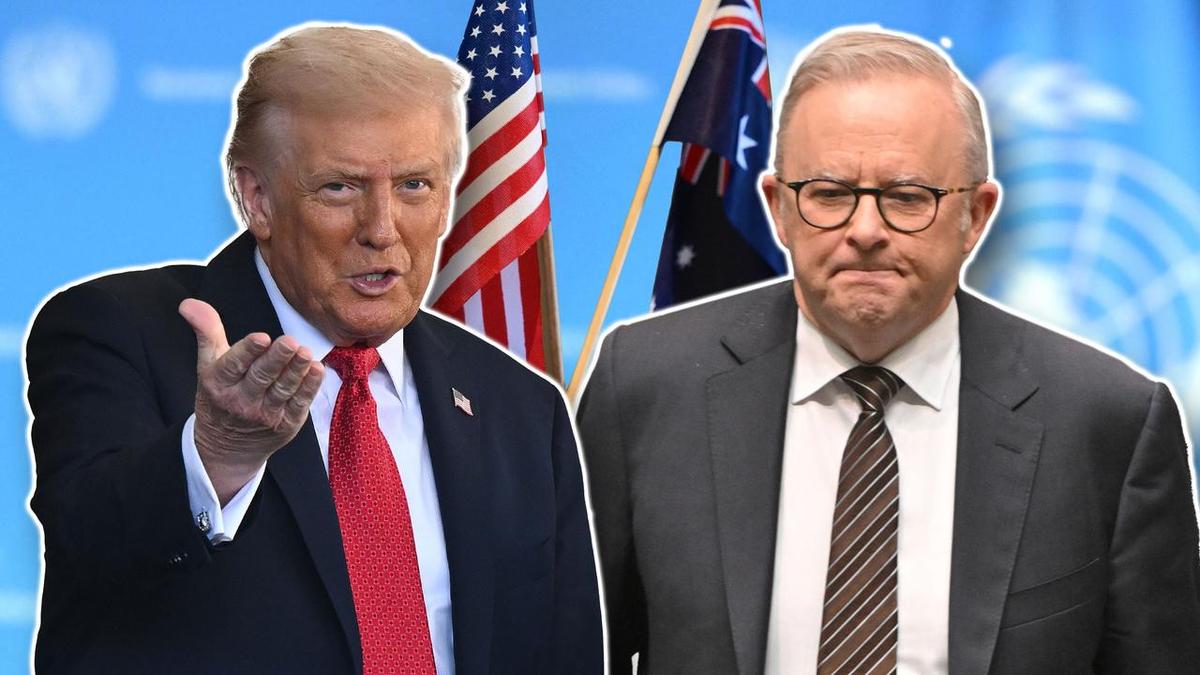
Anthony Albanese’s face-to-face meeting with Donald Trump in New York during the UN General Assembly was fleeting.
The prime minister was at the UN headquarters when the US president gave an almost 40-minute speech in which he threatened to annihilate Iran and proclaimed the US was still the “hottest” country.
However, the two leaders’ only interaction was a brief meet-and-greet – not a formal bilateral meeting – at a gala dinner on the sidelines of the summit.
The president loomed large over most of the prime minister’s week-long visit to the US as an inflection point emerged between middle powers and global giants over how to handle the growing technological force of artificial intelligence.
As he began his week in the US, Mr Albanese was one of more than 20 signatories to a joint statement urging extra safeguards for AI and to keep it firmly under human control.
He was joined by Canada’s Prime Minister Mark Carney, Spanish Prime Minister Pedro Sanchez and German Chancellor Friedrich Merz in the call, which invited other nations to join.
“Australians do want to know artificial intelligence won’t be in control of us,” Mr Albanese told reporters.
“We need to shape how it rolls out, rather than have artificial intelligence shape the way our society functions.”
Less than 24 hours after the statement was released, Mr Trump used his speech to the UN General Assembly to slap down efforts to put the brakes on AI’s rapid expansion.
He said AI should be renamed “super intelligence” and could be bigger than the Industrial Revolution or the arrival of the internet.
“The United States also totally rejects any attempt to construct a globalist scheme to control the artificial intelligence being spoken of,” he told the UN.
“The very same people who said we’ll all be dead in 12 years because of global warming … are the same people that are now saying that AI is going to kill us all.
“Whoever wins super intelligence wins.”
Some estimates have forecast spending on data centres and related infrastructure in the US to reach more than $10 trillion between 2025 and 2032, with economic growth tied to the technology.
As middle powers tried to use their voice at the UN to push for extra protections around AI, traditional superpowers China and the US were thrashing out how to expand it.
Mr Albanese’s address to the UN was overshadowed by Mr Trump holding talks the same day with Chinese President Xi Jinping in Washington DC, where AI was front and centre of the agenda.
Speaking during a state dinner in his honour, President Xi said China and the US had “reached common understanding on many issues”.
In his second speech to the UN since becoming prime minister, Mr Albanese sought to highlight national AI standards for data centres set to be legislated in parliament.
Concerns over AI closer to home were further compounded when Mr Albanese revealed on Thursday, Australian time, that an OpenAI agent had hacked a Medicare statistics website.
The website was hacked on June 18 but the company did not notify the federal government of the breach until September 10, via a public email inbox.
Mr Albanese discussed the incident with OpenAI chief executive Sam Altman over the phone while he was in New York, where the tech boss also addressed the UN Security Council.
Mr Altman, who admitted the company had not done enough, has been among AI executives calling for international standards for the technology.
Mr Albanese said in his UN speech the hack demonstrated the dangers AI posed globally.
“This is unacceptable and it is why Australia has been leading the way in establishing Australian standards for AI,” he said.
“We can’t ignore AI or prevent it, and it’s why we joined with other nations this week to call for action to shape AI development, rather than be passively shaped by it.”
The divide between middle powers and superpowers on how to deal with AI was part of a changing global environment, Mr Albanese said.
While accepting a Global Citizen Award from think tank the Atlantic Council, the prime minister told an 800-strong room that included movie stars Keanu Reeves and Cynthia Erivo the international world order that led to the creation of the UN was no longer fit for purpose.
He said shared ties were more necessary than ever in a rapidly changing and increasingly polarised world.
“The post-1945 world order is no longer fit for purpose. Universal institutions that remain necessary are now not always sufficient for the challenges we face,” he told the council.
Mr Albanese highlighted partnerships with Pacific and ASEAN nations, and like-minded countries in Europe, as ways Australia has expanded ties in a changing world.
The prime minister’s week-long visit to the US marks the start of a busy summit season.
He will rub shoulders with world leaders at the pre-COP31 summit in the Pacific in October and at the 33rd APEC meeting in China in November before he comes face-to-face with Mr Trump again in Miami in December at the G20, to be held on a golf course owned by the president.
The summit will be yet another chance to gauge what influence middle powers can exert on the global stage as the traditional world order is tested.

