



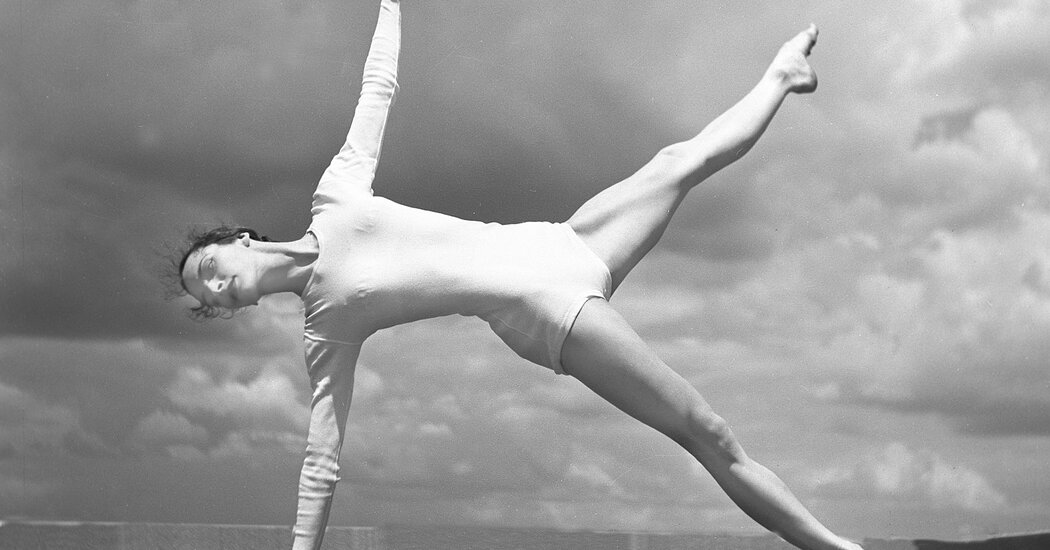
In the fall of 1951, the Juilliard School of Music, then located on Claremont Avenue and 122nd Street, opened its doors to its inaugural class of aspiring dancers. The implication was clear — that dance was a serious pursuit, deserving of professional training and a diploma, just like music. And that a shared space for both would benefit musicians as well as dancers.
“Dancers would be closer to music and get a better education in music, and the musicians would learn something about dance,” the composer William Schuman, then the president of Juilliard, later said about his decision to invite dance into the cloistered world of classical music.
This fall, the dance department, now called the Dance Division, celebrates its 75th anniversary. The anniversary is an opportunity to “look back and consider what a dance education can be,” Damian Woetzel, Juilliard’s president since 2018, said in a recent video call. “It’s about learning how to learn.”
A perusal of the archives shows how rich the Dance Division’s history has been, with a roster of teachers and students that reflects the arc of American dance in the 20th century. And the curriculum, a mix of ballet and modern dance, once seen as eccentric, now is the norm.
The dance holdings, on the fifth floor of Juilliard’s Lincoln Center headquarters, are the largest of the school’s collections, in part because the department’s founder, Martha Hill, “was very much an archivist,” Jane Gottlieb, director of Juilliard’s library, said on a recent visit. “She kept every scrap of paper.” Jeni Dahmus Farah, director of the archives, opened box after box after box, containing photographs, scrapbooks and memos.
In the early 20th century, modern dance had defined itself in opposition to ballet. But Hill was convinced that it was time for the two disciplines to make peace and begin learning from each other. Hill’s biographer Janet Mansfield Soares wrote that “this combined training became Hill’s mantra for developing the complete dancer.”
The goal is to create dancers — and future choreographers and directors — who understand movement, independent of style, and can work anywhere. Risa Steinberg, a former Juilliard student who danced for José Limón and then returned to Juilliard to teach, said that by the time students graduate, they will have learned not only ballet and contemporary work, but also the techniques of Limón, Martha Graham, Merce Cunningham and Lester Horton.
“That’s how you build a dancer today who can go out into the world,” Steinberg said, “all those pieces on the chessboard.”
The stress on versatility also reflects the way most dance companies function today. Dancers are expected to be conversant in many techniques. Melissa Toogood, Juilliard’s dean and director of dance since last year, said, “Contemporary companies have ballet classes, and ballet companies are commissioning contemporary and modern work.”
Hill had studied both ballet and modern dance before beginning her career as a member of Graham’s company. In 1934, she founded the Bennington School of the Dance, a summer program where modern-dance pioneers like Graham, Doris Humphrey, Charles Weidman, Hanya Holm and Limón taught and created dances. It is now recognized as having been one of the most important incubators of American modern dance.
Hill invited these and other leading figures in modern dance like Donald McKayle and Anna Sokolow to join the faculty at Juilliard, working side by side with ballet luminaries including the choreographer Antony Tudor. For artists in the eternally financially strained dance field, Juilliard became an anchor and a place to create; for the students it was an opportunity to learn from some of the biggest names in their field.
These big names did not always get along. The choreographer Pina Bausch, who spent a year as an exchange student from Germany in the late ’50s, once recalled that Tudor and Limón, eminences in different realms, ignored each other, “two kings who passed each other without looking.”
It is not surprising, given the larger-than-life personas of the people who circulated the hallways. In her book about dancing for Merce Cunningham, “Chance and Circumstance,” Carolyn Brown (who attended in 1952-53) described Martha Graham, an infrequent presence in the studios — a member of her company usually taught her class — as “a sorceress wielding magic powers over her subjects.”
Other faculty members were less theatrical, if still inspiring. The choreographer Robert Battle, who attended in the early ’90s, found a mentor in Carolyn Adams, who had spent several years as the only Black dancer in the Paul Taylor Dance Company. Adams joined the Juilliard faculty in 1982.
When he first arrived, Battle felt out of place, he said in an interview. Then he took a class with Adams. “There was something about the way she distilled information about movement, about a gesture, about dance, that was so compelling to me,” he said. “It took me to another spiritual place, a place of belonging.”
Battle went on to found a company, then became director of Alvin Ailey, where he introduced Paul Taylor’s works into the repertory. He is now a choreographer in residence at the Paul Taylor Dance Company. As he put it, “It’s all part of the continuum.”
In many cases, the students turned out to be as remarkable as their teachers. The list of alumni includes Taylor and Bausch, both of whom went on to create important companies; the famed Ailey dancer Dudley Williams; and Sylvia Waters, who danced for Ailey before becoming artistic director of its second company. A significant number became major choreographers, including Lar Lubovitch, Martha Clarke, Ohad Naharin, Robert Garland, Jessica Lang, Bobbi Jene Smith and Shamel Pitts.
As the profession has evolved, so has Juilliard.
Alicia Graf Mack, who directed the Dance Division from 2018 until 2025 when she left to become the artistic director of Alvin Ailey, made a series of adjustments to the curriculum meant to reflect the greater diversity of dance today, requiring West African dance and hip-hop, and allowing dancers of any gender to take pointe classes. A lot of what she did, “was informed by where the field is now,” she said in a phone interview. “We wanted to create an environment that allows each dancer to thrive in their unique identity, and that they would be encouraged also to pursue different paths upon graduation.”
As solid as the program appears today, the future of dance at Juilliard was not always assured. The most difficult period was the mid-60s, when Juilliard was invited to be part of the new arts complex that would become Lincoln Center. It was a big step up for Juilliard, but it soon became clear that the dance department might not survive the move.
Juilliard’s director at the time, Peter Mennin, a composer, quietly began making arrangements to allow the School of American Ballet — the training arm of New York City Ballet — to take over dance education at Lincoln Center. The school had the glamour of being led by the superstar choreographer George Balanchine (and his right-hand man Lincoln Kirstein), as well as being the recipient of a large grant from the Ford Foundation. This plan would have meant the end of dance as a division of Juilliard and would have given up on modern-dance training altogether.
“It felt like the idea of modern dance was insignificant, and we were insignificant,” Steinberg said. She spearheaded a letter campaign to save the department.
The struggle to save dance at Juilliard lasted years. In the end, it survived, even if it was made to share its new quarters, a hulking building of travertine and glass facing West 65th Street, with the School of American Ballet, which got four dance studios to Juilliard’s two.
The two programs shared the third floor, separated by a glass door. At one point a typewritten note posted on the Juilliard side read “The glass doors are to be kept LOCKED AT ALL TIMES.” This uneasy coexistence continued until 1990 when a new high rise was built just west of Juilliard on the same block. It now houses both the School of American Ballet and dorms for both institutions.
Some things haven’t changed at Juilliard. Students still take classes in anatomy, stagecraft, acting, dance history, music and liberal arts. Most performances are accompanied by live music, played by Juilliard musicians.
And, perhaps most importantly, the school continues to stress creation. Students are required to take two years of composition classes, where they learn the basics of how to put together a dance. In their third year, dancers can apply to participate in a class in which they are paired with a Juilliard composer to make a piece. It is the clearest manifestation of Schuman’s hope that musicians and dancers might learn from each other.
The dance field has broadened dramatically since 1951, and with it the demands of a dance education. Meeting the profession where it is today is often a balancing act. “My concern,” Mack said of her tenure, “was always for the dancers to build their toolbox and to strengthen their bodies so that they became the most fluent vessel to express themselves.”
It’s easy to think that Martha Hill would have approved.

