



There was no disguising the gaps in the usually well-stocked shelves of the Silpo supermarket in Kyiv, the Ukrainian capital, this week. They had no barley, buckwheat, quinoa or rice. No spring onions or packaged lettuce, and just one lonely, wilted bunch of cilantro.
For the first time since the initial months after the 2022 invasion, the city’s residents are experiencing shortages of a wide range of grocery staples because of Russian ballistic missile strikes on critical distribution centers.
“It’s a nightmare, a nightmare,” said a Silpo shopper, Nina Kirichuk, 67, a retired hairdresser, her cart carrying bread and two kinds of herring. “I’m horrified. I wanted to buy sugar, but I looked and there wasn’t any. And there’s an entire section over there that’s completely empty. I didn’t even go in there. I don’t want to look at it and upset myself.”
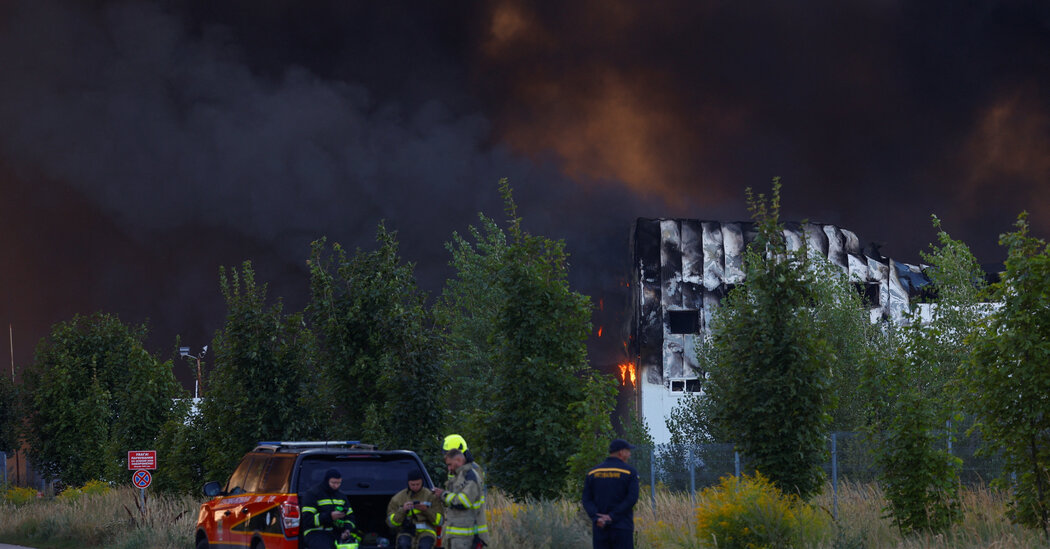
Moscow’s missiles struck at least four warehouses for one supermarket supply company on Aug. 5, killing at least six workers and severely disrupting the supply of food to multiple store chains. The effects have been felt mainly in the capital, but also in far-flung places like Zaporizhzhia in southeastern Ukraine.
Early Thursday, Russia again targeted food warehouses near Kyiv, although the extent of the damage from the missile strikes was not yet clear.
Missiles have also destroyed a warehouse for another supermarket chain; a distribution center for Rozetka, on online shopping site; and a sorting center for Ukraine’s national postal service. Warehouses of major Ukrainian book publishers have been repeatedly hit this summer.
The attacks have come as the air war has intensified, with Ukraine building up its offensive capabilities and Russia taking advantage of Ukraine’s dwindling air defenses.
In the first few years after Russia’s full-scale invasion in February 2022, the Kremlin asserted that it hit only military-related targets in Ukraine, even as it pummeled cities and the power grid. Now it has dropped that pretense.
Ukraine still maintains that it avoids civilian targets, though it has deployed its long-range drones against Russia’s oil industry, the engine of the Russian economy. Recently, it has also hit warehouses of Wildberries, Russia’s version of Amazon, claiming many of its products have military applications.
For years, fully stocked Ukrainian supermarkets have been a symbol of how the country has done its best to preserve normal life through Russian bombardment.
Got a confidential news tip? The New York Times would like to hear from readers who want to share messages and materials with our journalists.
But over the past week, grocery chains admitted shortages. Supplies of dairy products, meat and fresh produce have dwindled. At a corner shop in Kyiv, the only produce remaining were six mushy avocados and the papery skins of a few onions and garlic bulbs. Specialty items like ramen had disappeared from another store, along with paper plates and plastic cutlery.
“Am I the only one these empty shelves are starting to make panic?” an aspiring beauty influencer posted on social media, adding that she had bought the last four packs of baby formula at one store after striking out at another.
Svitlana Petrychuk, 56, said she was most worried that she would not be able to buy a certain brand of dog food for her Yorkshire terrier, Lord. Ms. Petrychuk got Lord about two and a half years ago, after suffering a stroke in the aftermath of three nearby Russian drone strikes. Her doctor suggested that a dog might relieve stress.
“The shortages in warehouses and the fact that some food is currently missing from supermarket shelves worries me much less,” Ms. Petrychuk said. “We, as people, can easily make do with whatever food is available.”
Luckily for Lord, she found the dog food at the second store she checked.
Grocery chains said they hoped to fully restock their inventory by Monday, Ukraine’s Independence Day, although Thursday’s attacks may make that difficult.
On social media, some Ukrainians joked about the return of the Soviet Union. Before its breakup in 1991, such shortages were common.
Some older customers remember famines throughout Ukraine’s history as if they happened yesterday, and have stockpiled canned foods and staples like sugar, pasta and flour.
“I could live for an entire month without buying anything, except bread,” said Olha Sliusarenko, 76, who made a practice of stockpiling well before the war.
The Silpo supermarket chain has tried to address the shortages with Ukraine’s typical stoicism and dark humor, blaming Russia while also telling people to just hold on. Orange-and-white signs display poems about the hardship, with blank spaces in each line where customers can write their own reactions.
“Russia ___ probably ___ hoped this would be our end ___ and bring only sorrow but here we have anger ___ new ideas and ___ gratitude ___ for our people,” one sign said.
Another said: “#@%# who know only how ___ to burn things unfortunately ___ they burned these products but everyone who creates ___ and nurtures is already bringing ___ new ones here.”
Novus, another supermarket chain, posted a simpler sign near its empty shelf of milk in a store in Kyiv. “This product has been destroyed from russia,” it said, not even granting that country a capital R. “New packages are on the way.”

