



The Federal Reserve has an inflation problem, but officials differ on what needs to be done to resolve it.
A growing cohort of policymakers believe the central bank should have already raised interest rates to speed up the pace at which inflation falls back to a more palatable level. Others remain confident that price pressures will ease on their own as temporary factors caused by tariffs and the war with Iran fade.
But even those officials appear to be losing patience, having stipulated that they are ready to act if inflation does not soon show signs of abating.
The latest Consumer Price Index report, set to be published by the Bureau of Labor Statistics on Wednesday, will either help to reinforce that patience or compel those officials to more readily consider lifting borrowing costs. Rates are now set in a range of 3.5 to 3.75 percent, a level they have been at since January.
The Fed’s preferred inflation gauge is the Personal Consumption Expenditures Price Index, of which the C.P.I. data is a crucial input.
On Wednesday, economists expect the latest data to show a modest improvement. Officials pay closest attention to the so-called core measure, which strips out volatile food and energy prices and is thought to be a better measure of underlying inflation. In July, those prices are forecast to have risen just 0.2 percent from the previous month, or 2.5 percent compared with the same time last year.
Officials have suggested that this kind of monthly pace is consistent with inflation’s eventually retreating to the Fed’s target — something that has been missed for five years. The central bank’s goal is 2 percent, as measured by the P.C.E. index. As of the latest data in June, it was running at 3.7 percent.
The Fed next votes on rates in mid-September, and a string of benign inflation reports from here on out would help to alleviate pressure on the central bank to take action. The central bank is also paying close attention to the labor market, which showed some signs of lost momentum even as the unemployment rate ticked down.
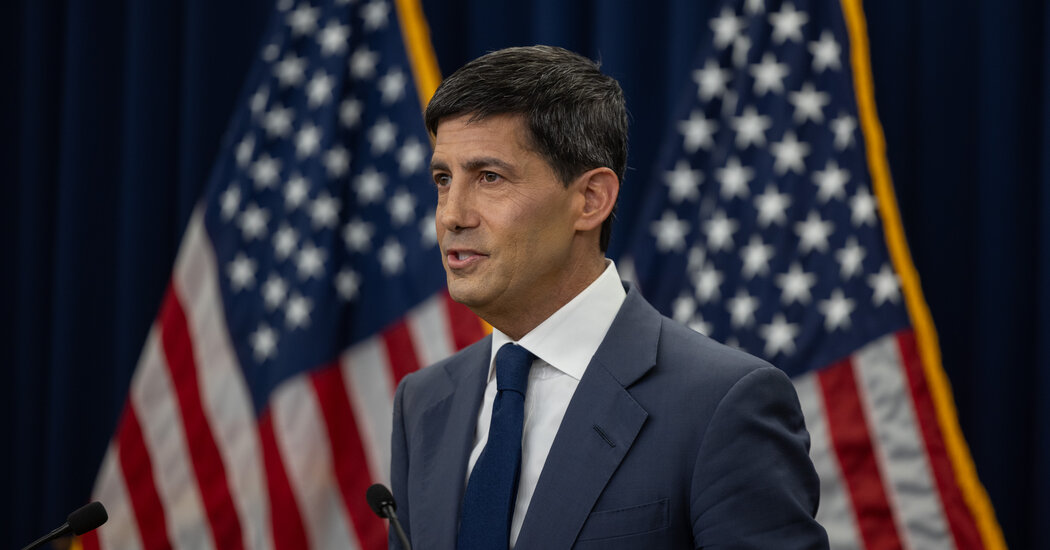
The Fed’s next steps are under heightened scrutiny after the most recent policy gathering at the end of last month. Officials held rates steady as expected, but Kevin M. Warsh, the new chairman, sent mixed signals about how he expected to make good on his pledge to get inflation down.
He did not articulate a clear reason the Fed opted to hold rates steady in July, nor did he say unequivocally that higher rates were the primary tool to get inflation down. His decision to repeatedly highlight how financial conditions had tightened in the absence of rate increases gave the impression that he was comfortable letting markets do part of the central bank’s policy tightening work for it. Moreover, his passing suggestion that the Fed might consider changing the 2 percent inflation target at some point stoked further confusion.
After the communications mishap, which rattled the U.S. government bond market, the onus is now on Mr. Warsh to reset the narrative. His next scheduled opportunity will be at the central bank’s annual conference in Jackson, Wyo., at the end of the month.

