



Canada and the United States are not close to signing a trade deal to reduce current tariffs and avoid new American tariffs coming into place next week, according to a sources with direct knowledge of the trade negotiations.

The distance on a potential deal comes after a week of negotiations in Washington, labelled by multiple sources as constructive, with negotiators on both sides “nerding out” and reviewing individual tariffs on a line-by-line basis.
Even then, Global News has learned, there is still a way to go before any deal could be struck.
Global News has agreed not to identify the sources because they were not authorized to speak publicly about the trade talks.
The gap on potential relief for the softwood lumber industry for now seems unlikely, with two sources with knowledge of the talks saying the Americans are not interested in reducing softwood tariffs and duties, which currently sit at close to 45 per cent.
“We face higher tariffs than Russia,” said B.C. Premier David Eby on Friday, whose province has a large lumber industry. “The U.S. for some inexplicable reason is putting forest families out of work here in order to prioritize lumber imports from Europe and Russia.”
One source told Global News, Canada has had to fight to even put forestry as a topic of negotiation.
Any deal the Trump administration is willing to sign will have some form of tariffs on steel, aluminum, autos and lumber, according to sources, with the U.S. also insisting American alcohol be put back onto all provincial liquor store shelves, which multiple premiers have expressed a willingness to do if enough U.S. concessions are made.

Get daily National news
Get daily Canada news delivered to your inbox so you’ll never miss the day’s top stories.
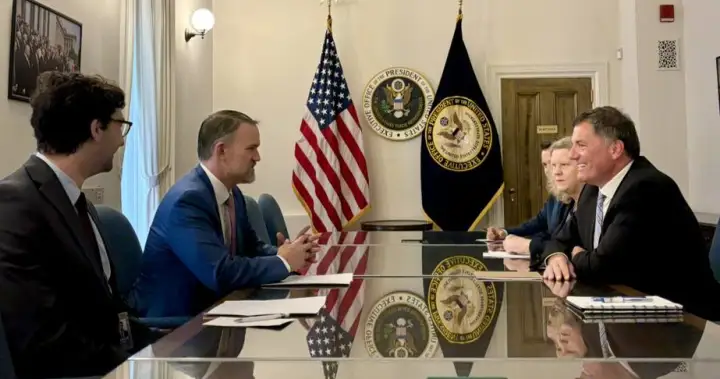
Canada-U.S. Trade Minister Dominic LeBlanc, who is leading the negotiations alongside Canada’s chief trade negotiator Janice Charette, is staying in Washington this weekend as talks continue.
Canada’s goal remains reaching a deal before Wednesday to avoid new 50 per cent tariffs on roughly $28 billion worth of Canadian goods from taking effect.
LeBlanc and Charette briefed Canadian premiers and the federal government’s advisory committee on Canada-U.S. economic relations on the status of the negotiations Friday evening. A statement from LeBlanc’s office did not disclose specifics about what was discussed.
If a deal is reached, tariffs on Canadian autos and parts compliant under the Canada-U.S.-Mexico Agreement (CUSMA) would remain in place, but it is expected that they would be reduced from the current 25 per cent level, according to a source familiar with the talks. One proposal that has been discussed is a tariff rate of between 10-15% on CUSMA compliant autos and parts, according to one source.
Auto industry insiders have told Global News that they would not support any tariff level on CUSMA-complaint parts and autos, saying it would represent a major threat to the Canadian industry.
“We shouldn’t be offering any concessions to the United States right now. The reality is the U.S. has imposed tariffs on Canada,” Lana Payne, Unifor’s national president said Friday at a news conference in Brampton, Ont.

The U.S. is also seeking a change in current quota allotments for U.S. dairy that can be sold into Canada tariff-free.
The Dairy Farmers of Canada said in a statement Thursday that it is “imperative that no more concessions on dairy or supply management are made in talks with the United States.”
U.S. Trade Representative Jamieson Greer repeated Friday that the new 50 per cent tariffs on some Canadian goods are in direct response to the retaliatory measures.
Greer, speaking to reporters at the Iowa State Fair, likened the federal and provincial measures to “the kind of things that China would do.” He said those are things that would have to be resolved.
While LeBlanc and Charette have been leading the talks, one source tells Global News Prime Minister Mark Carney has made multiple calls on to Canadian negotiators, while he is on vacation in Italy.
While the Canadian government is willing to walk away from any deal, it is the preference of the Carney government to find an agreement now to avoid new tariffs coming into place on Aug. 19, according to multiple sources.
That strategy is a part of a three-pronged plan, outlined to sources briefed by the Carney government.
The first step would be to cut a deal on sectorial tariffs and avoid new ones coming into place, followed by a second step where both countries sign partnerships in areas like energy and defence.
Step three would be to renegotiate CUSMA in a more stable environment.
The U.S. opted to not agree to a renewal of the free trade pact at its scheduled review last month, despite Canada and Mexico advocating for a new 16-year term.
—With files from Global’s Bryan Mullan, Sean Boynton and Uday Rana
© 2026 Global News, a division of Corus Entertainment Inc.

