



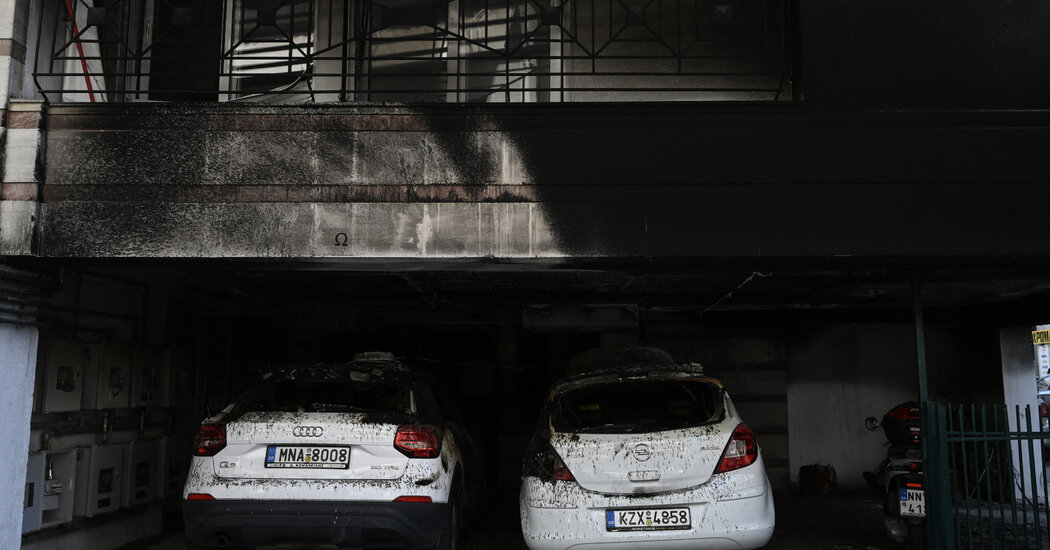
Three makeshift bombs went off within minutes of each other in the northern Greek city of Thessaloniki early on Wednesday morning, in what senior officials described as a campaign targeting members of Greece’s conservative governing party.
A candidate for Parliament for the governing New Democracy party, Afroditi Nestora, suffered minor burns in one of the bombings. Her mother died in the hospital after sustaining burns over much of her body, the hospital reported, and her father was hospitalized with respiratory problems, the police said. The two other bombings caused no injuries.
“The inhumane, indiscriminate terrorist attack on my home has placed my family in an extremely difficult situation,” Nestora said on her Facebook page.
Prime Minister Kyriakos Mitsotakis denounced what he called “the cowardly, terrorist, murderous attack that three of our members suffered in the early hours.”
The police said all three bombs, which went off at about 4:30 a.m., consisted of gas canisters connected to containers of flammable liquid. In Greece, such devices have often been used by anarchist or far-left armed groups, typically in low-intensity attacks meant to send a symbolic message, according to the authorities.
A spokeswoman for the national police, Constantina Dimoglidiou, said the bomb that injured Ms. Nestora and her parents “had been placed under a car, and the explosion caused a fire that spread. They came down to see what happened and got burned.” Two other residents of their apartment complex were treated for breathing difficulties and were later discharged from the hospital, news outlets reported.
The two other bombs were placed at the entrances to apartment complexes, Ms. Dimoglidiou said. Savvas Anastasiadis, a former New Democracy lawmaker, lives in one of them, and Zisis Ioakeimovits, the head of a local party committee, owns apartments in the other.
There was no immediate claim of responsibility for the bombings, but Mr. Mitsotakis and other senior government officials warned about a possible resurgence of domestic terrorism.
“They’ve learned absolutely nothing, not even from those who’ve been in prison for 25 years,” said the minister of public order, Michalis Chrysochoidis. His mention of prison seemed to be a reference to November 17, a leftist militant group that was active in Greece for decades and whose 82-year-old leader, Alexandros Giotopoulos, was sent back to prison last month after being briefly released.
Mr. Mitsotakis said he would go to Thessaloniki to visit the victims and “send a clear and unequivocal message — zero tolerance for any form of new terrorism that may appear in our country.”
The attacks come amid heightened political rhetoric ahead of Greece’s general elections, which must be held by next year, though there has been speculation that Mr. Mitsotakis might call the vote before then.

