



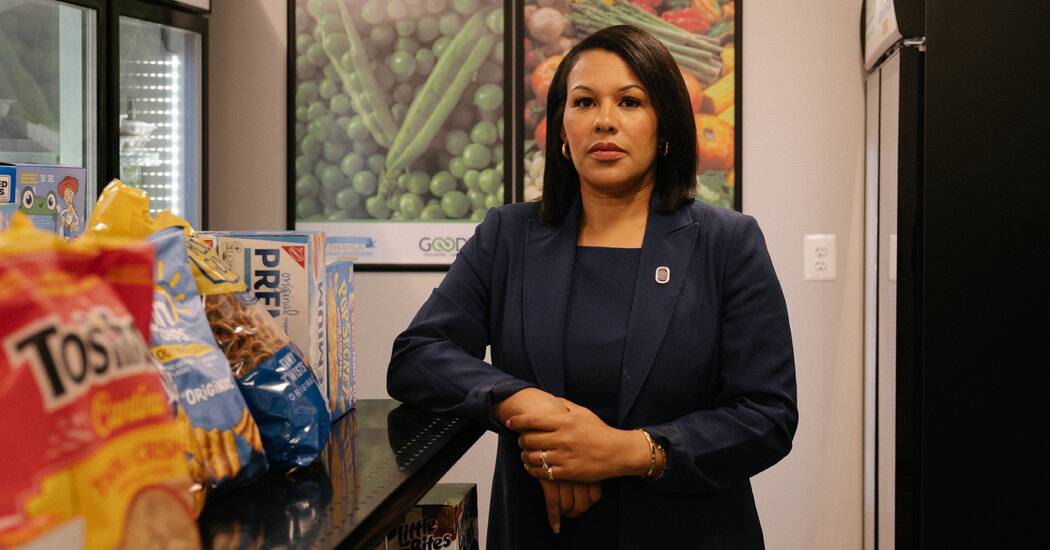
Brittanie Brooks walked into a library in Prince George’s County, Md., breezing past the shelves of books, a printing station and a computer lab. Her destination was a study room, now converted into a no-cost grocery store where seniors on fixed incomes, laid-off federal workers and others in need can shop.
Ms. Brooks surveyed the selection: rows of cereal, crackers and pancake mix stacked on the shelves; pizza and chicken in the freezer; and baskets of apples and oranges, onions and bell peppers. Then she mentally calculated what she would need to feed her five children for the week, settling on pasta, rice and chicken — staples she could stretch. It was all free.
She was among the first customers at the Fairmount Five Market, which opened in May at the back of the Fairmount Heights Branch Library. In June, a second free grocery store, District 7 Fresh Market, opened a few miles away at the Spauldings Branch Library.
“I was getting low on food,” said Ms. Brooks, 34, who lives in Capitol Heights, Md., bordering Washington. She had been looking for a job for two months. She and her children receive government food assistance, but “everything costs so much,” she said. “Any help is a relief.”
The two locations are among a growing number of free grocery stores that have opened across the country in recent years to help address food insecurity and stubbornly high grocery prices.
Generally, the foods offered at free grocery stores are supplied by companies that collect and redistribute surplus foods from retailers and direct donations from traditional supermarkets, food manufacturers and farms. Some stores also rely on funding from a mix of private donations, grants and corporate sponsorships to make large food purchases.
Unlike at some food pantries, customers shopping at free grocery stores are able to choose their own foods, often in private, instead of standing in line for whatever is available on a given day.
Many families are facing difficult trade-offs between food and other necessities or being forced to change their buying habits to stay within budget. Overall, the price of food has increased about 3.1 percent between May 2025 and May 2026.
In Prince George’s, free grocery stores are another way to help those people still reeling from the Trump administration’s mass layoffs of federal employees last year. In Maryland alone, more than 29,000 federal workers lost their jobs between January 2025 and April 2026.
In addition, more than 39,000 people in the state have lost Supplemental Nutrition Assistance Program benefits — the government’s main tool to address hunger — because of stricter eligibility requirements adopted by the Trump administration.
“You have so many people who have worked their entire lives in the federal government, and then all of a sudden, the rug is pulled from under them,” said Shayla Adams-Stafford, a Prince George’s County Council member who helped bring the store to the community. “The impact of what happened on the federal level is very real in this region.”
Shay Leach, a mother of five in Hyattsville, Md., lost her job as a federal contractor last year. She eventually moved in with a relative to cut costs. Ms. Leach, 34, visited the Fairmount store for the first time in June, stocking up on milk, eggs, lunch meat, cereal, granola bars and pasta.
“I finally found a new job — I am not on the streets, but I still have debt over my head,” she said. “I have had a really hard time. This food is a big help.”
The concept of free grocery stores — often operated as partnerships between local governments, nonprofits and hunger relief companies — is not new, but more have opened as the cost of basic living has skyrocketed since the pandemic. They exist in high schools, churches, senior centers and at least one hospital. Earlier this year, Savannah State University in Georgia teamed up with Goodr and Amazon to open a free minimart on campus. And in July, a former traditional food pantry in Newark, N.J., reopened as a free, choice-based market.
In Maryland, the Fairmount and Spauldings locations are among the few that have opened in neighborhood libraries and are part of the Prince George’s County Memorial Library System.
Libraries “are sometimes not understood as a community resource hub,” said Krystal Oriadha, chair of the Prince George’s County Council, who led the effort to open the store in the Spauldings library. “But in some ways, it’s the place that makes the most sense.”
Ms. Oriadha said the county was studying the cost of operating a grocery store that would offer food at more affordable prices, similar to the city-owned stores that Mayor Zohran Mamdani of New York is planning.
The free grocery stores take their inspiration from traditional markets, with bright lights and aisles. Unlike at some food pantries, there are no preselected packages handed out and no long lines. Instead, customers fill their bags with foods that they select during private appointments.
Jasmine Crowe-Houston, the founder and chief executive of Goodr, which worked with Prince George’s County to open the Fairmount market, said the free stores were not just about shopping, but giving the customer a “dignified experience.” The Atlanta-based certified B corporation partners with higher education institutions, sports organizations, hospitality companies, government agencies and others to recover surplus foods which are redistributed to local nonprofits to serve those in need.
“We want people to have their own moment, their own time to make food choices and not feel rushed at a time when they are probably stressed,” Ms. Crowe-Houston said.
The Fairmount store is funded through a $200,000 county grant that allows it to serve about 200 families a month for one year. Another 113 families are on a waiting list. Participants must preregister but do not have to meet income requirements.
“I went knocking on doors when I first got into office, talking to residents, and I realized that we have an issue with food insecurity and that so many people were suffering in silence,” said Ms. Adams-Stafford, a former school board member who won her council seat last year.
The Spauldings store relies on a $250,000 county grant in a partnership with two nonprofits, the StoreHouse and Community on the Frontline. The goal is to feed up to 400 families per month.
“We know we have an aging population on a fixed income,” Ms. Oriadha said. “We are leaving out a crucial population if we don’t also account for the realities of the middle class. Right now, ‘need’ looks different. It’s not just the traditional group living below the poverty line.”

